


Home
Wayward Contracts: The Crisis of Political Obligation England, 1640-1674
Barnes and Noble
Loading Inventory...
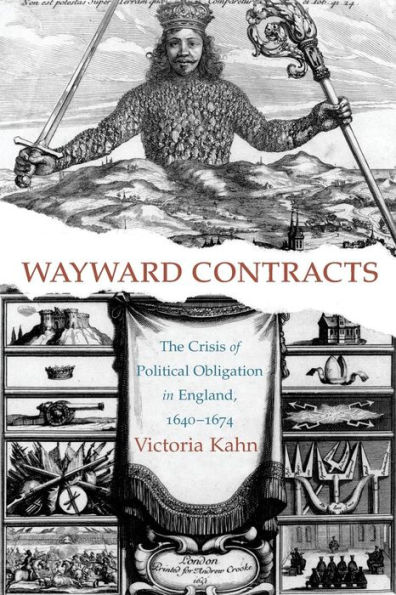
Wayward Contracts: The Crisis of Political Obligation England, 1640-1674 in Bloomington, MN
Current price: $41.00

Wayward Contracts: The Crisis of Political Obligation England, 1640-1674 in Bloomington, MN
Current price: $41.00
Loading Inventory...
Size: Paperback
Why did the language of contract become the dominant metaphor for the relationship between subject and sovereign in mid-seventeenth-century England? In
Wayward Contracts
, Victoria Kahn takes issue with the usual explanation for the emergence of contract theory in terms of the origins of liberalism, with its notions of autonomy, liberty, and equality before the law.
Drawing on literature as well as political theory, state trials as well as religious debates, Kahn argues that the sudden prominence of contract theory was part of the linguistic turn of early modern culture, when government was imagined in terms of the poetic power to bring new artifacts into existence. But this new power also brought in its wake a tremendous anxiety about the contingency of obligation and the instability of the passions that induce individuals to consent to a sovereign power. In this wide-ranging analysis of the cultural significance of contract theory, the lover and the slave, the tyrant and the regicide, the fool and the liar emerge as some of the central, if wayward, protagonists of the new theory of political obligation. The result is must reading for students and scholars of early modern literature and early modern political theory, as well as historians of political thought and of liberalism.
Wayward Contracts
, Victoria Kahn takes issue with the usual explanation for the emergence of contract theory in terms of the origins of liberalism, with its notions of autonomy, liberty, and equality before the law.
Drawing on literature as well as political theory, state trials as well as religious debates, Kahn argues that the sudden prominence of contract theory was part of the linguistic turn of early modern culture, when government was imagined in terms of the poetic power to bring new artifacts into existence. But this new power also brought in its wake a tremendous anxiety about the contingency of obligation and the instability of the passions that induce individuals to consent to a sovereign power. In this wide-ranging analysis of the cultural significance of contract theory, the lover and the slave, the tyrant and the regicide, the fool and the liar emerge as some of the central, if wayward, protagonists of the new theory of political obligation. The result is must reading for students and scholars of early modern literature and early modern political theory, as well as historians of political thought and of liberalism.
Why did the language of contract become the dominant metaphor for the relationship between subject and sovereign in mid-seventeenth-century England? In
Wayward Contracts
, Victoria Kahn takes issue with the usual explanation for the emergence of contract theory in terms of the origins of liberalism, with its notions of autonomy, liberty, and equality before the law.
Drawing on literature as well as political theory, state trials as well as religious debates, Kahn argues that the sudden prominence of contract theory was part of the linguistic turn of early modern culture, when government was imagined in terms of the poetic power to bring new artifacts into existence. But this new power also brought in its wake a tremendous anxiety about the contingency of obligation and the instability of the passions that induce individuals to consent to a sovereign power. In this wide-ranging analysis of the cultural significance of contract theory, the lover and the slave, the tyrant and the regicide, the fool and the liar emerge as some of the central, if wayward, protagonists of the new theory of political obligation. The result is must reading for students and scholars of early modern literature and early modern political theory, as well as historians of political thought and of liberalism.
Wayward Contracts
, Victoria Kahn takes issue with the usual explanation for the emergence of contract theory in terms of the origins of liberalism, with its notions of autonomy, liberty, and equality before the law.
Drawing on literature as well as political theory, state trials as well as religious debates, Kahn argues that the sudden prominence of contract theory was part of the linguistic turn of early modern culture, when government was imagined in terms of the poetic power to bring new artifacts into existence. But this new power also brought in its wake a tremendous anxiety about the contingency of obligation and the instability of the passions that induce individuals to consent to a sovereign power. In this wide-ranging analysis of the cultural significance of contract theory, the lover and the slave, the tyrant and the regicide, the fool and the liar emerge as some of the central, if wayward, protagonists of the new theory of political obligation. The result is must reading for students and scholars of early modern literature and early modern political theory, as well as historians of political thought and of liberalism.
Shop Similar Products










Find at Mall of America® in Bloomington, MN
Visit at Mall of America® in Bloomington, MN