


Home
Time-Constrained Transaction Management: Real-Time Constraints Database Systems
Barnes and Noble
Loading Inventory...
Time-Constrained Transaction Management: Real-Time Constraints Database Systems in Bloomington, MN
By Barnes & Noble
Current price: $109.99

Time-Constrained Transaction Management: Real-Time Constraints Database Systems in Bloomington, MN
Current price: $109.99
Loading Inventory...
Size: Hardcover
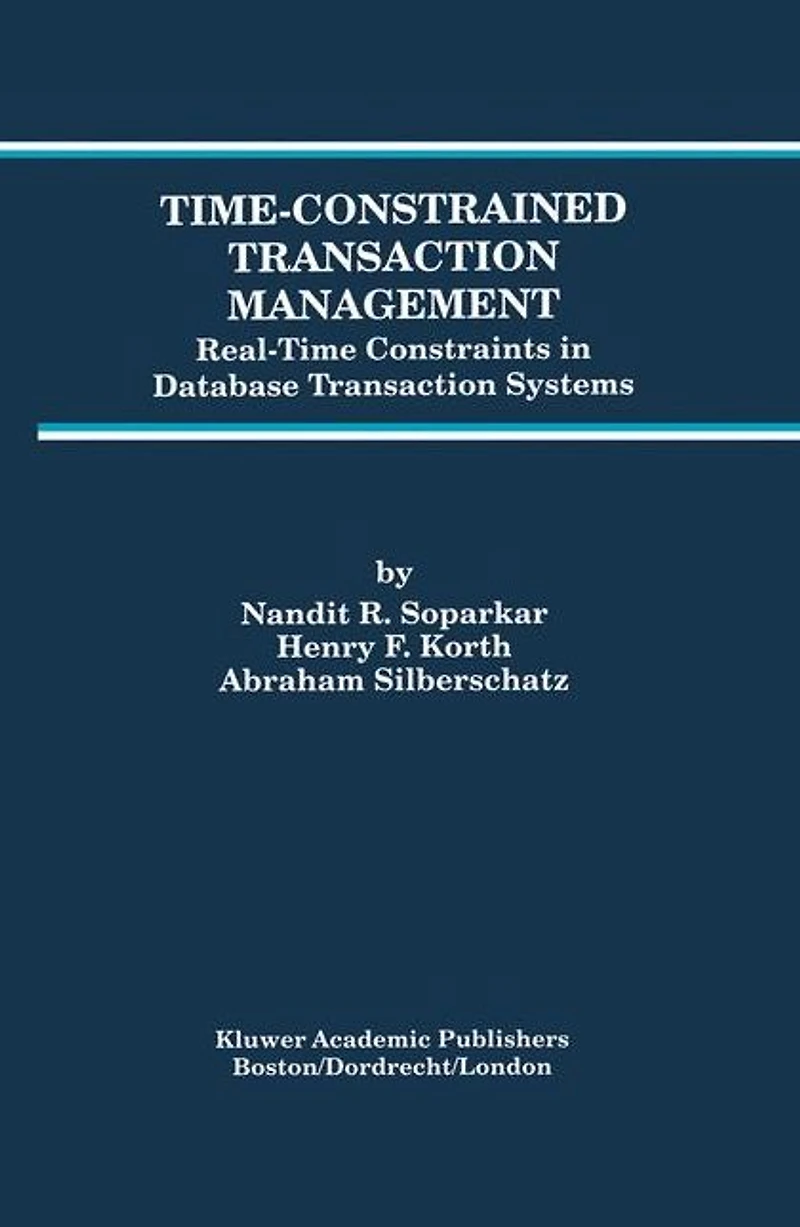
Transaction processing is an established technique for the concurrent and fault tolerant access of persistent data. While this technique has been successful in standard database systems, factors such as time-critical applications, emerg ing technologies, and a re-examination of existing systems suggest that the performance, functionality and applicability of transactions may be substan tially enhanced if temporal considerations are taken into account. That is, transactions should not only execute in a "legal" (i.e., logically correct) man ner, but they should meet certain constraints with regard to their invocation and completion times. Typically, these logical and temporal constraints are application-dependent, and we address some fundamental issues for the management of transactions in the presence of such constraints. Our model for transaction-processing is based on extensions to established mod els, and we briefly outline how logical and temporal constraints may be ex pressed in it. For scheduling the transactions, we describe how legal schedules differ from one another in terms of meeting the temporal constraints. Exist ing scheduling mechanisms do not differentiate among legal schedules, and are thereby inadequate with regard to meeting temporal constraints. This provides the basis for seeking scheduling strategies that attempt to meet the temporal constraints while continuing to produce legal schedules.
Transaction processing is an established technique for the concurrent and fault tolerant access of persistent data. While this technique has been successful in standard database systems, factors such as time-critical applications, emerg ing technologies, and a re-examination of existing systems suggest that the performance, functionality and applicability of transactions may be substan tially enhanced if temporal considerations are taken into account. That is, transactions should not only execute in a "legal" (i.e., logically correct) man ner, but they should meet certain constraints with regard to their invocation and completion times. Typically, these logical and temporal constraints are application-dependent, and we address some fundamental issues for the management of transactions in the presence of such constraints. Our model for transaction-processing is based on extensions to established mod els, and we briefly outline how logical and temporal constraints may be ex pressed in it. For scheduling the transactions, we describe how legal schedules differ from one another in terms of meeting the temporal constraints. Exist ing scheduling mechanisms do not differentiate among legal schedules, and are thereby inadequate with regard to meeting temporal constraints. This provides the basis for seeking scheduling strategies that attempt to meet the temporal constraints while continuing to produce legal schedules.










Find at Mall of America® in Bloomington, MN
Visit at Mall of America® in Bloomington, MN