


Home
Three-Dimensional Beamforming Training Framework for High-Frequency Wireless Networks
Barnes and Noble
Loading Inventory...
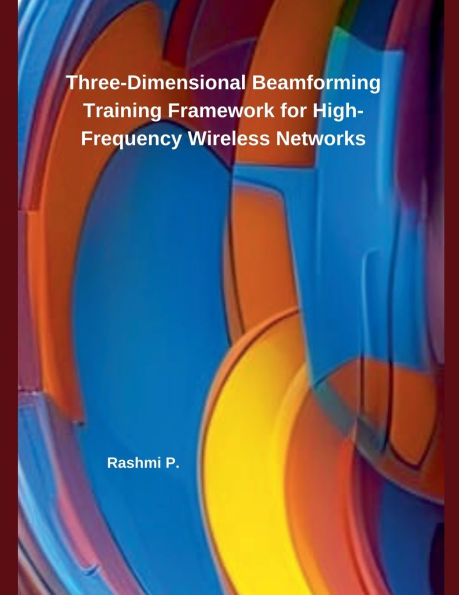
Three-Dimensional Beamforming Training Framework for High-Frequency Wireless Networks in Bloomington, MN
Current price: $31.00

Three-Dimensional Beamforming Training Framework for High-Frequency Wireless Networks in Bloomington, MN
Current price: $31.00
Loading Inventory...
Size: OS
Mobile communication is undoubtedly one of the breakthrough inventions in recent history and has undergone several evolution stages since the introduction of 1G in the 1980s. Rapid advancements in smartphone technology and computation algorithms prepared the ground for the significant changeover in the actual application of mobile communication. The transition from a short-range wireless network with a limited number of users in 1G to an extensive broadband global mobile communication technology with a very high data rate in 4G happened over 30 years. 4G was released in 2008 and can support up to 1Gbps of data speed. Moreover, 4G facilitated high- quality voice and internet calls with good security and uninterrupted connectivity while providing universal roaming facility. Other features supported by 4G are video conferencing, high-definition mobile TV, 3D TV, and gaming services. Subsequently, with the increased availability and popularity of smartphones and other mobile data devices (iPads, laptops, netbooks, ebook readers, digital media etc.), mobile data traffic has seen exceptional growth. According to the Ericsson Mobile data traffic outlook- 2022, the total global mobile network traffic, excluding the traffic generated by fixed wireless access, reached around 67 exabytes per month by the end of 2021 and is projected to grow by a factor of around 4.2 to reach 282 exabytes per month in 2027 (Ericsson, 2022a).
Mobile communication is undoubtedly one of the breakthrough inventions in recent history and has undergone several evolution stages since the introduction of 1G in the 1980s. Rapid advancements in smartphone technology and computation algorithms prepared the ground for the significant changeover in the actual application of mobile communication. The transition from a short-range wireless network with a limited number of users in 1G to an extensive broadband global mobile communication technology with a very high data rate in 4G happened over 30 years. 4G was released in 2008 and can support up to 1Gbps of data speed. Moreover, 4G facilitated high- quality voice and internet calls with good security and uninterrupted connectivity while providing universal roaming facility. Other features supported by 4G are video conferencing, high-definition mobile TV, 3D TV, and gaming services. Subsequently, with the increased availability and popularity of smartphones and other mobile data devices (iPads, laptops, netbooks, ebook readers, digital media etc.), mobile data traffic has seen exceptional growth. According to the Ericsson Mobile data traffic outlook- 2022, the total global mobile network traffic, excluding the traffic generated by fixed wireless access, reached around 67 exabytes per month by the end of 2021 and is projected to grow by a factor of around 4.2 to reach 282 exabytes per month in 2027 (Ericsson, 2022a).
Shop Similar Products














Find at Mall of America® in Bloomington, MN
Visit at Mall of America® in Bloomington, MN