


Home
the Unaccountability Machine: Why Big Systems Make Terrible Decisions-and How World Lost Its Mind
Barnes and Noble
Loading Inventory...



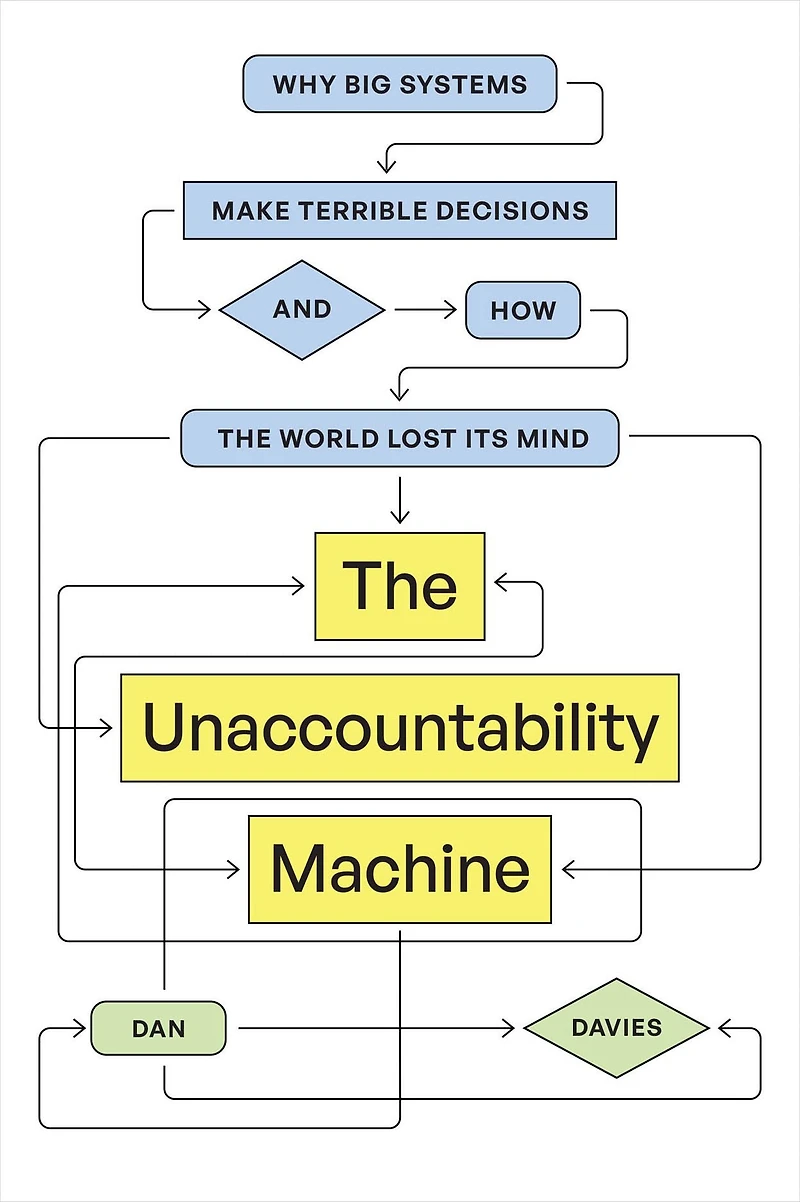
the Unaccountability Machine: Why Big Systems Make Terrible Decisions-and How World Lost Its Mind in Bloomington, MN
By Barnes & Noble
Current price: $14.99

the Unaccountability Machine: Why Big Systems Make Terrible Decisions-and How World Lost Its Mind in Bloomington, MN
Current price: $14.99
Loading Inventory...
Size: Audiobook
Longlisted for the 2024 Financial Times Book of the Year. How life and the economy became a black box-a collection of systems no one understands, producing outcomes no one likes.Passengers get bumped from flights. Phone menus disconnect. Automated financial trades produce market collapse. Of all the challenges in modern life, some of the most vexing come from our relationships with automation: a large system does us wrong, and there's nothing we can do about it.The problem, economist Dan Davies shows, isaccountability sinks: systems in which decisions are delegated to a complex rule book or set of standard procedures, making it impossible to identify the source of mistakes when they happen. In our increasingly unhuman world-lives dominated by algorithms, artificial intelligence, and large organizations-these accountability sinks produce more than just aggravation. They make life and economy unknowable-a black box for no reason.InThe Unaccountability Machine, Davies lays bare how markets, institutions, and even governments systematically generate outcomes that no one-not even those involved in making them-seems to want. Since the earliest days of the computer age, theorists have foreseen the dangers of complex systems without personal accountability. In response, British business scholar Stafford Beer developed an accountability-first approach to management called “cybernetics,” which might have taken off had his biggest client (the Chilean government) not fallen to a bloody coup in 1973.With his signature blend of economic and journalistic rigor, Davies examines what's gone wrong since Beer, including what might have been had the world embraced cybernetics when it had the chance.The Unaccountability Machineis a revelatory and resonant account of how modern life became predisposed to dysfunction.
Longlisted for the 2024 Financial Times Book of the Year. How life and the economy became a black box-a collection of systems no one understands, producing outcomes no one likes.Passengers get bumped from flights. Phone menus disconnect. Automated financial trades produce market collapse. Of all the challenges in modern life, some of the most vexing come from our relationships with automation: a large system does us wrong, and there's nothing we can do about it.The problem, economist Dan Davies shows, isaccountability sinks: systems in which decisions are delegated to a complex rule book or set of standard procedures, making it impossible to identify the source of mistakes when they happen. In our increasingly unhuman world-lives dominated by algorithms, artificial intelligence, and large organizations-these accountability sinks produce more than just aggravation. They make life and economy unknowable-a black box for no reason.InThe Unaccountability Machine, Davies lays bare how markets, institutions, and even governments systematically generate outcomes that no one-not even those involved in making them-seems to want. Since the earliest days of the computer age, theorists have foreseen the dangers of complex systems without personal accountability. In response, British business scholar Stafford Beer developed an accountability-first approach to management called “cybernetics,” which might have taken off had his biggest client (the Chilean government) not fallen to a bloody coup in 1973.With his signature blend of economic and journalistic rigor, Davies examines what's gone wrong since Beer, including what might have been had the world embraced cybernetics when it had the chance.The Unaccountability Machineis a revelatory and resonant account of how modern life became predisposed to dysfunction.
Shop Similar Products














Find at Mall of America® in Bloomington, MN
Visit at Mall of America® in Bloomington, MN