


Home
the Problem of Motion Bodies: A Historical View Development Classical Mechanics
Barnes and Noble
Loading Inventory...
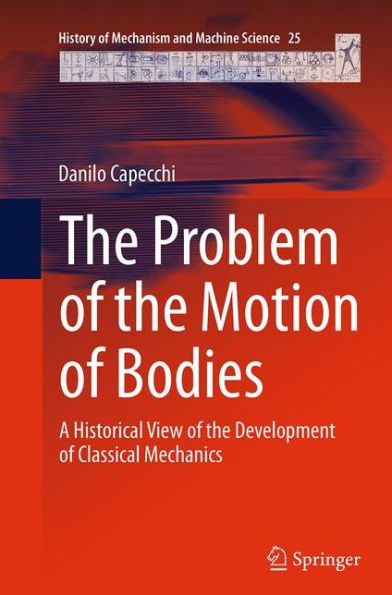
the Problem of Motion Bodies: A Historical View Development Classical Mechanics in Bloomington, MN
Current price: $169.99

the Problem of Motion Bodies: A Historical View Development Classical Mechanics in Bloomington, MN
Current price: $169.99
Loading Inventory...
Size: Hardcover
This book focuses on the way in which the problem of the motion of bodies has been viewed and approached over the course of human history. It is not another traditional history of mechanics but rather aims to enable the reader to fully understand the deeper ideas that inspired men, first in attempting to understand the mechanisms of motion and then in formulating theories with predictive as well as explanatory value. Given this objective, certain parts of the history of mechanics are neglected, such as fluid mechanics, statics and astronomy after Newton. On the other hand, due attention is paid, for example, to the history of thermodynamics, which has its own particular point of view on motion. Inspired in part by historical epistemology, the book examines the various views and theories of a given historical period (synchronic analysis) and then makes comparisons between different periods (diachronic analysis). In each period, one or two of the most meaningful contributions are selected for particular attention, instead of presenting a long inventory of scientific achievements.
This book focuses on the way in which the problem of the motion of bodies has been viewed and approached over the course of human history. It is not another traditional history of mechanics but rather aims to enable the reader to fully understand the deeper ideas that inspired men, first in attempting to understand the mechanisms of motion and then in formulating theories with predictive as well as explanatory value. Given this objective, certain parts of the history of mechanics are neglected, such as fluid mechanics, statics and astronomy after Newton. On the other hand, due attention is paid, for example, to the history of thermodynamics, which has its own particular point of view on motion. Inspired in part by historical epistemology, the book examines the various views and theories of a given historical period (synchronic analysis) and then makes comparisons between different periods (diachronic analysis). In each period, one or two of the most meaningful contributions are selected for particular attention, instead of presenting a long inventory of scientific achievements.
Shop Similar Products















Find at Mall of America® in Bloomington, MN
Visit at Mall of America® in Bloomington, MN