


Home
The Nature and Origins of Mass Opinion Reconsidered: What Determines Public Opinion?
Barnes and Noble
Loading Inventory...
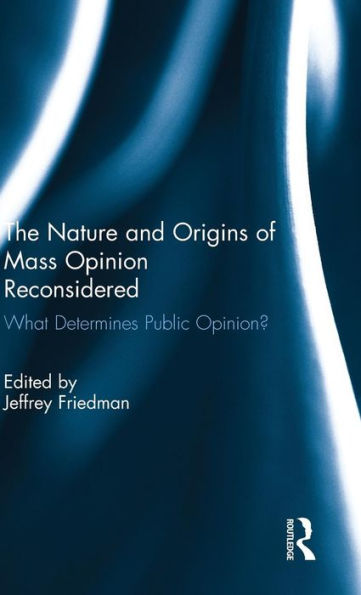
The Nature and Origins of Mass Opinion Reconsidered: What Determines Public Opinion? in Bloomington, MN
Current price: $125.00

The Nature and Origins of Mass Opinion Reconsidered: What Determines Public Opinion? in Bloomington, MN
Current price: $125.00
Loading Inventory...
Size: OS
In the
Nature and Origins of Mass Opinion
(1992), John Zaller set out one of the most influential models of opinion formation: he presented the public as a pliable instrument of political elites, who are able to garner support simply by sending "cues" through the mass media telling Republicans or Democrats, for example, what "the" Republican or Democratic position is on a given issue. Contributors to this volume critically examine Zaller’s model and its implications, empirical and normative. The introduction contrasts two different strands in Zaller’s book, one of which confines the impact of media messages to politicians’ cues, the other of which emphasizes the impact of journalists’ interpretive frames. Other chapters examine whether elite domination of public opinion is desirable and assess how well Zaller’s model has withstood two decades of research. Zaller himself contributes a long retrospective in which he modifies some claims, defends others, and sets out a bold new research agenda.
This book was published as a special issue of
Critical Review: A Journal of Politics and Society.
Nature and Origins of Mass Opinion
(1992), John Zaller set out one of the most influential models of opinion formation: he presented the public as a pliable instrument of political elites, who are able to garner support simply by sending "cues" through the mass media telling Republicans or Democrats, for example, what "the" Republican or Democratic position is on a given issue. Contributors to this volume critically examine Zaller’s model and its implications, empirical and normative. The introduction contrasts two different strands in Zaller’s book, one of which confines the impact of media messages to politicians’ cues, the other of which emphasizes the impact of journalists’ interpretive frames. Other chapters examine whether elite domination of public opinion is desirable and assess how well Zaller’s model has withstood two decades of research. Zaller himself contributes a long retrospective in which he modifies some claims, defends others, and sets out a bold new research agenda.
This book was published as a special issue of
Critical Review: A Journal of Politics and Society.
In the
Nature and Origins of Mass Opinion
(1992), John Zaller set out one of the most influential models of opinion formation: he presented the public as a pliable instrument of political elites, who are able to garner support simply by sending "cues" through the mass media telling Republicans or Democrats, for example, what "the" Republican or Democratic position is on a given issue. Contributors to this volume critically examine Zaller’s model and its implications, empirical and normative. The introduction contrasts two different strands in Zaller’s book, one of which confines the impact of media messages to politicians’ cues, the other of which emphasizes the impact of journalists’ interpretive frames. Other chapters examine whether elite domination of public opinion is desirable and assess how well Zaller’s model has withstood two decades of research. Zaller himself contributes a long retrospective in which he modifies some claims, defends others, and sets out a bold new research agenda.
This book was published as a special issue of
Critical Review: A Journal of Politics and Society.
Nature and Origins of Mass Opinion
(1992), John Zaller set out one of the most influential models of opinion formation: he presented the public as a pliable instrument of political elites, who are able to garner support simply by sending "cues" through the mass media telling Republicans or Democrats, for example, what "the" Republican or Democratic position is on a given issue. Contributors to this volume critically examine Zaller’s model and its implications, empirical and normative. The introduction contrasts two different strands in Zaller’s book, one of which confines the impact of media messages to politicians’ cues, the other of which emphasizes the impact of journalists’ interpretive frames. Other chapters examine whether elite domination of public opinion is desirable and assess how well Zaller’s model has withstood two decades of research. Zaller himself contributes a long retrospective in which he modifies some claims, defends others, and sets out a bold new research agenda.
This book was published as a special issue of
Critical Review: A Journal of Politics and Society.
Shop Similar Products












Find at Mall of America® in Bloomington, MN
Visit at Mall of America® in Bloomington, MN