


Home
The Luftwaffe's Secret Emergency Fighter Competition 1944-45
Barnes and Noble
Loading Inventory...
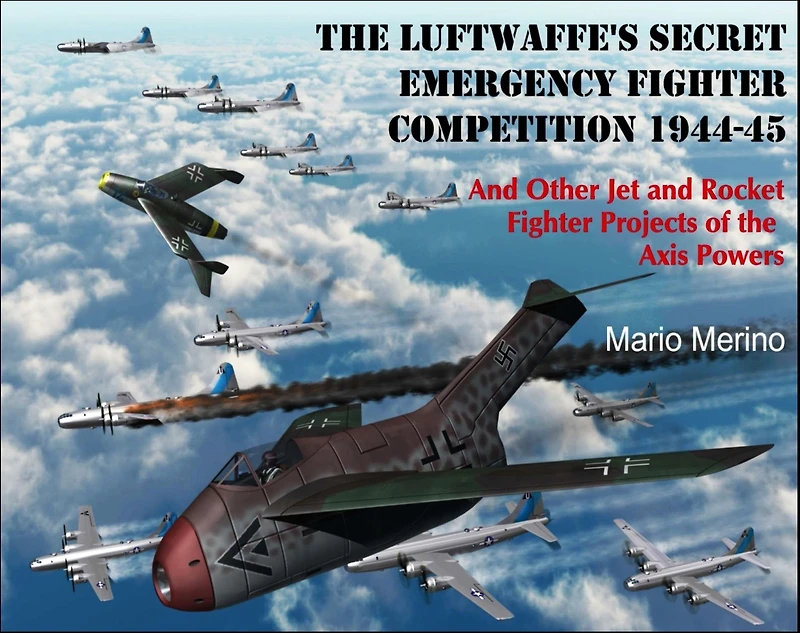
The Luftwaffe's Secret Emergency Fighter Competition 1944-45 in Bloomington, MN
By Barnes & Noble
Current price: $6.99

The Luftwaffe's Secret Emergency Fighter Competition 1944-45 in Bloomington, MN
Current price: $6.99
Loading Inventory...
Size: EBook
This work covers the most advanced fighter and interceptor designs that were drafted on paper and abandonedwhen the war came to an end. A whole array of second generation jet and rocket propelled combat aircraft, mostof which never took to the skies. Anyone who has ever looked at drawings or models of these “paper planes”closely has to agree, most of them just don’t look like 1940’s aircraft, but more like combat aircraft from the late50’s and early 60’s.Only a few of the winning nations took advantage of the advances made by German aircraft designers in thefields of aerodynamics and jet propulsion, but they did. Many of the aircraft seen in the victorious nations’ airforces of the 50’s and 60’s were based on ideas that originated on the drawing boards of the German designers ofthe Third Reich. Even the development of second generation American jets was directly influenced by Germanaerodynamics. For example, the straight-winged North American FJ-1 Fury navy jet fighter, which was a jetpowered development of the P-51 Mustang (opposite page) was updated with the swept wings of theMesserschmitt Me 262. (see page 11) This led to the highly successful F-86 Sabre of Korean War fame. On theother side of the iron curtain, the Focke-Wulf Ta-183’s revolutionary shape served as the basis for the SovietUnion’s MiG-15 fighter, which fought opposite the F-86 Sabre over Korea. Many revisionist historians maychallenge this, but one just needs to look and compare the two aircraft to see the obvious family resemblance.As an artist who loves aircraft, it is my intention to share my renderings of these fascinating German, Japanese,and Italian jet and bi-fuel rocket fighters with other aviation history enthusiasts who share a common interest inthe aborted jet aircraft designs of the Axis Powers. If I can inspire others to learn more about the subject I willhave achieved my objective.
This work covers the most advanced fighter and interceptor designs that were drafted on paper and abandonedwhen the war came to an end. A whole array of second generation jet and rocket propelled combat aircraft, mostof which never took to the skies. Anyone who has ever looked at drawings or models of these “paper planes”closely has to agree, most of them just don’t look like 1940’s aircraft, but more like combat aircraft from the late50’s and early 60’s.Only a few of the winning nations took advantage of the advances made by German aircraft designers in thefields of aerodynamics and jet propulsion, but they did. Many of the aircraft seen in the victorious nations’ airforces of the 50’s and 60’s were based on ideas that originated on the drawing boards of the German designers ofthe Third Reich. Even the development of second generation American jets was directly influenced by Germanaerodynamics. For example, the straight-winged North American FJ-1 Fury navy jet fighter, which was a jetpowered development of the P-51 Mustang (opposite page) was updated with the swept wings of theMesserschmitt Me 262. (see page 11) This led to the highly successful F-86 Sabre of Korean War fame. On theother side of the iron curtain, the Focke-Wulf Ta-183’s revolutionary shape served as the basis for the SovietUnion’s MiG-15 fighter, which fought opposite the F-86 Sabre over Korea. Many revisionist historians maychallenge this, but one just needs to look and compare the two aircraft to see the obvious family resemblance.As an artist who loves aircraft, it is my intention to share my renderings of these fascinating German, Japanese,and Italian jet and bi-fuel rocket fighters with other aviation history enthusiasts who share a common interest inthe aborted jet aircraft designs of the Axis Powers. If I can inspire others to learn more about the subject I willhave achieved my objective.
Shop Similar Products











Find at Mall of America® in Bloomington, MN
Visit at Mall of America® in Bloomington, MN