


Home
The Consistent Force Field: A Documentation
Barnes and Noble
Loading Inventory...
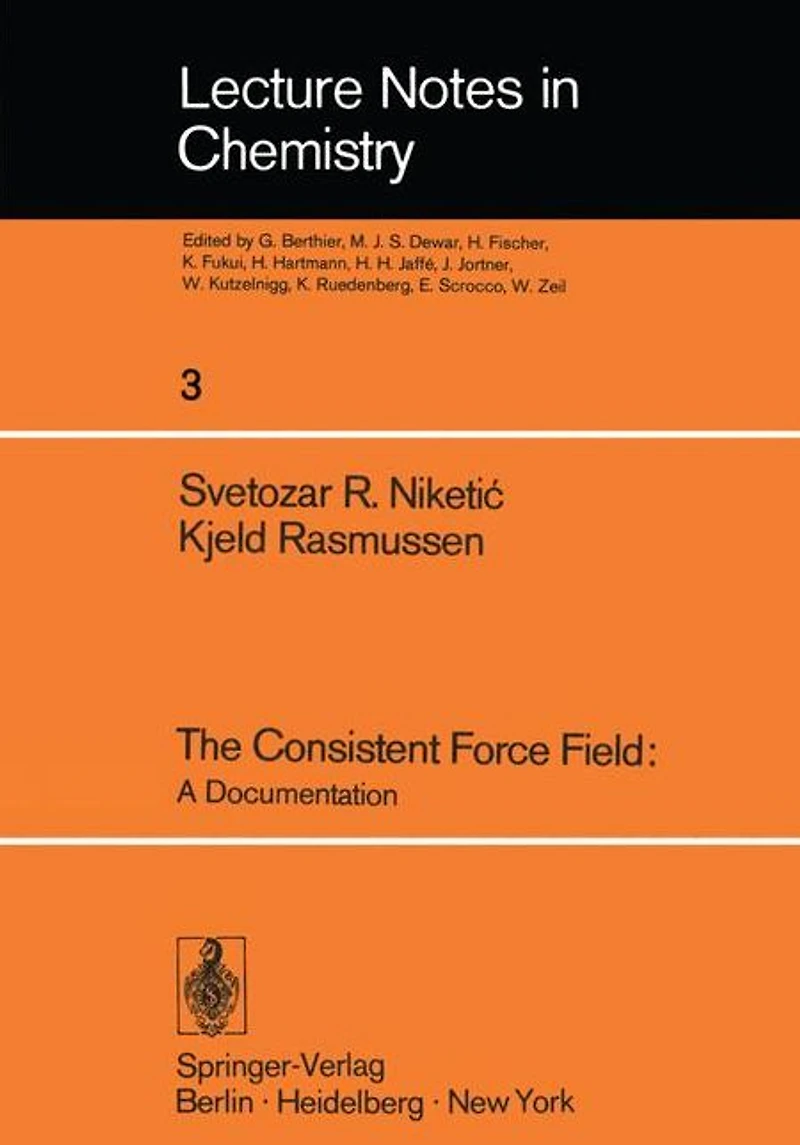
The Consistent Force Field: A Documentation in Bloomington, MN
By Barnes & Noble
Current price: $54.99

The Consistent Force Field: A Documentation in Bloomington, MN
Current price: $54.99
Loading Inventory...
Size: Paperback
In this chapter ve shall discuss the calculation of potential energy associated vith molecular conforaations. Raving obtained cartesian atoaic coordinates defining conforaations. and lists of intraao- cular interactions, as described in Chapter 3, ve are ready to calculate a quantity which in the chemical literature is known as the total aolecular potential energy or the conforaational, steric, strain or intraaolecular energy. he conformational energy of a aolecule can be expressed as a function, of all internal coordinates and interatoaic distances, or as a function of atoaic positions specified by soae general coordi- Dates. he function, is supposed to haye local ainiaa corresponding to the stable equilibrium conforaations of a aolecule in vacuo, Deglecting interaolecular interactions. he exact fora of Y is. of course, unknown. We assume that it can be suitably approximated by a sua of different types of energy contri- hutions:, = Y ., +, +, ., be. nb e he teras represent cODtributions to the total aolecular potential energy, due to bond stretching and coapression teras Vb' valence aDgle bending teras 'e' iDterDal rotational or torsional teras V, . DOD-bonded interactions 'nb and electrostatic or Couloab iDter- actions 'e. If there are other intraaolecular aechanisas affecting 79 V, sucD as hydrogen bonding, corresponding terms say be added.
In this chapter ve shall discuss the calculation of potential energy associated vith molecular conforaations. Raving obtained cartesian atoaic coordinates defining conforaations. and lists of intraao- cular interactions, as described in Chapter 3, ve are ready to calculate a quantity which in the chemical literature is known as the total aolecular potential energy or the conforaational, steric, strain or intraaolecular energy. he conformational energy of a aolecule can be expressed as a function, of all internal coordinates and interatoaic distances, or as a function of atoaic positions specified by soae general coordi- Dates. he function, is supposed to haye local ainiaa corresponding to the stable equilibrium conforaations of a aolecule in vacuo, Deglecting interaolecular interactions. he exact fora of Y is. of course, unknown. We assume that it can be suitably approximated by a sua of different types of energy contri- hutions:, = Y ., +, +, ., be. nb e he teras represent cODtributions to the total aolecular potential energy, due to bond stretching and coapression teras Vb' valence aDgle bending teras 'e' iDterDal rotational or torsional teras V, . DOD-bonded interactions 'nb and electrostatic or Couloab iDter- actions 'e. If there are other intraaolecular aechanisas affecting 79 V, sucD as hydrogen bonding, corresponding terms say be added.
Shop Similar Products


















Find at Mall of America® in Bloomington, MN
Visit at Mall of America® in Bloomington, MN