


Home
The Columbian Tradition on the Discovery of America and of the Part Played Therein, by the Astronomer Toscanelli: A Memoir Addressed to the Professors Hermann Wagner of the University (Classic Reprint)
Barnes and Noble
Loading Inventory...
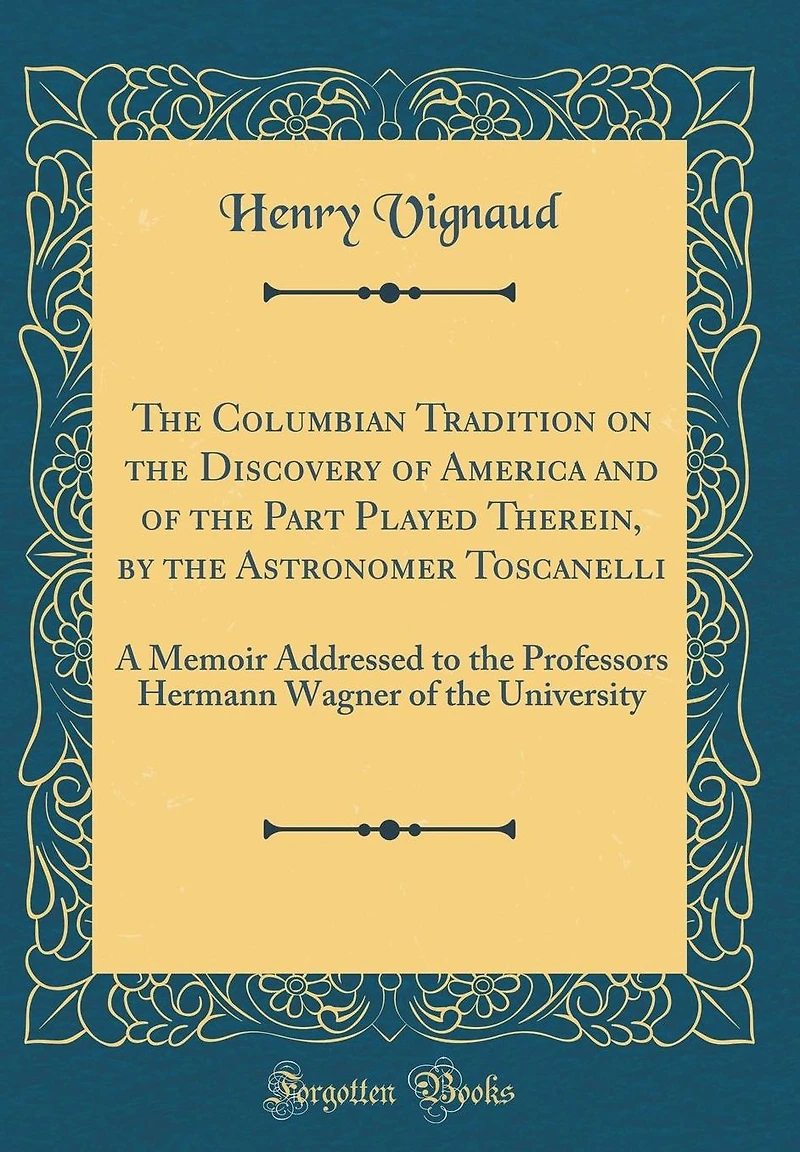
The Columbian Tradition on the Discovery of America and of the Part Played Therein, by the Astronomer Toscanelli: A Memoir Addressed to the Professors Hermann Wagner of the University (Classic Reprint) in Bloomington, MN
By Barnes & Noble
Current price: $25.30

The Columbian Tradition on the Discovery of America and of the Part Played Therein, by the Astronomer Toscanelli: A Memoir Addressed to the Professors Hermann Wagner of the University (Classic Reprint) in Bloomington, MN
Current price: $25.30
Loading Inventory...
Size: Hardcover
Excerpt from The Columbian Tradition on the Discovery of America and of the Part Played Therein, by the Astronomer Toscanelli: A Memoir Addressed to the Professors Hermann Wagner of the UniversityIt is with difficulty that we can realize that this extraordinary project, which Columbus claimed as his own from the first, and which, as he, his son Fernando, and his admirer Las Casas tell us, formed the very object of the ever-memorable voyage of 1492, should never have been once mentioned by him before his return to Palos in 1493, though he had for years been soliciting aid to enable him to embark upon his voyage. It has been suggested that the documents in which Columbus referred to it have disappeared or been lost. But a mere possibility must not be Opposed to a reality. The fact is that Columbus, who wrote a great deal, and who must have been full of his scheme and ready to explain it to Others in applying for help, has left not a single line written prior to his discovery in which he mentions it, whereas, after the discovery, he is constantly referring to it.About the PublisherForgotten Books publishes hundreds of thousands of rare and classic books. Find more at www.forgottenbooks.comThis book is a reproduction of an important historical work. Forgotten Books uses state-of-the-art technology to digitally reconstruct the work, preserving the original format whilst repairing imperfections present in the aged copy. In rare cases, an imperfection in the original, such as a blemish or missing page, may be replicated in our edition. We do, however, repair the vast majority of imperfections successfully; any imperfections that remain are intentionally left to preserve the state of such historical works.
Excerpt from The Columbian Tradition on the Discovery of America and of the Part Played Therein, by the Astronomer Toscanelli: A Memoir Addressed to the Professors Hermann Wagner of the UniversityIt is with difficulty that we can realize that this extraordinary project, which Columbus claimed as his own from the first, and which, as he, his son Fernando, and his admirer Las Casas tell us, formed the very object of the ever-memorable voyage of 1492, should never have been once mentioned by him before his return to Palos in 1493, though he had for years been soliciting aid to enable him to embark upon his voyage. It has been suggested that the documents in which Columbus referred to it have disappeared or been lost. But a mere possibility must not be Opposed to a reality. The fact is that Columbus, who wrote a great deal, and who must have been full of his scheme and ready to explain it to Others in applying for help, has left not a single line written prior to his discovery in which he mentions it, whereas, after the discovery, he is constantly referring to it.About the PublisherForgotten Books publishes hundreds of thousands of rare and classic books. Find more at www.forgottenbooks.comThis book is a reproduction of an important historical work. Forgotten Books uses state-of-the-art technology to digitally reconstruct the work, preserving the original format whilst repairing imperfections present in the aged copy. In rare cases, an imperfection in the original, such as a blemish or missing page, may be replicated in our edition. We do, however, repair the vast majority of imperfections successfully; any imperfections that remain are intentionally left to preserve the state of such historical works.
Shop Similar Products













Find at Mall of America® in Bloomington, MN
Visit at Mall of America® in Bloomington, MN