


Home
The Burnside Problem and Identities in Groups
Barnes and Noble
Loading Inventory...
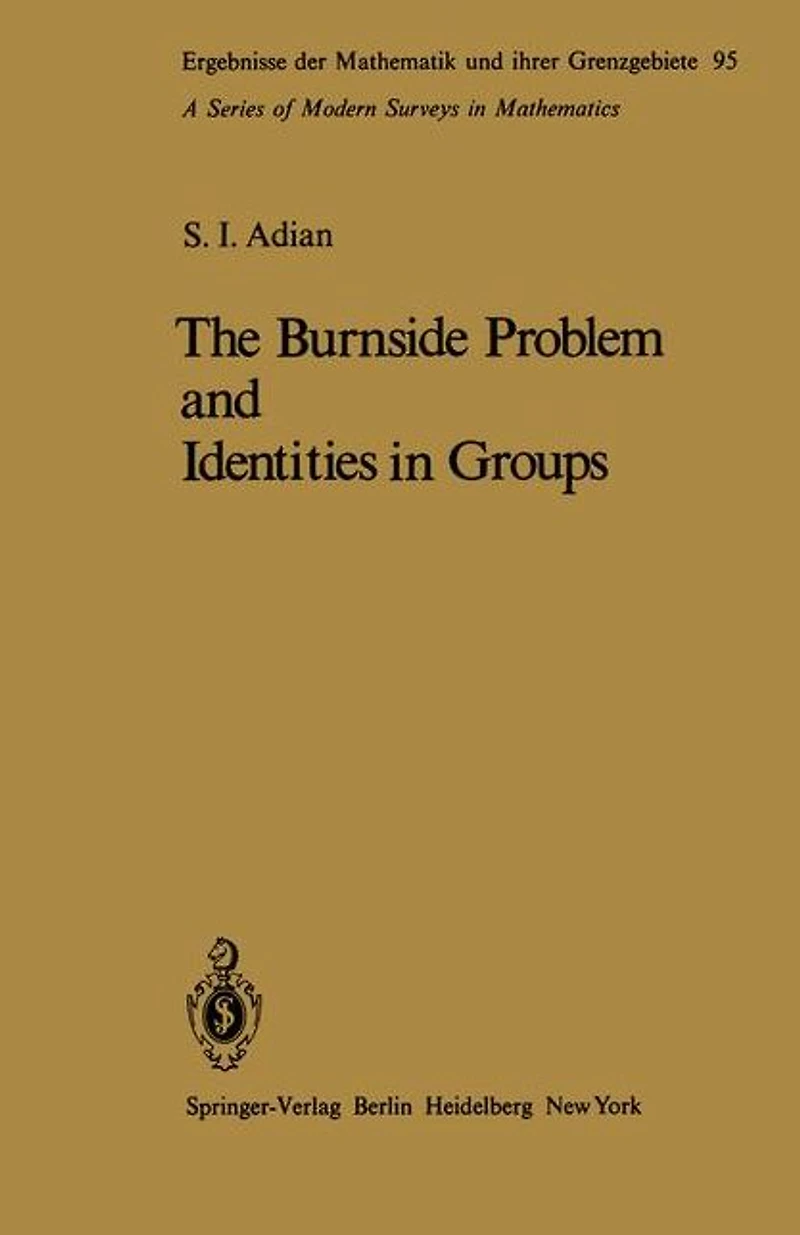
The Burnside Problem and Identities in Groups in Bloomington, MN
By Barnes & Noble
Current price: $54.99

The Burnside Problem and Identities in Groups in Bloomington, MN
Current price: $54.99
Loading Inventory...
Size: Paperback
Three years have passed since the publication of the Russian edition of this book, during which time the method described has found new applications. In [26], the author has introduced the concept of the periodic product of two groups. For any two groups G and G without elements of order 2 and for any 1 2 odd n ~ 665, a group G @ Gmay be constructed which possesses several in 1 2 teresting properties. In G @ G there are subgroups 6 and 6 isomorphic to 1 2 1 2 G and G respectively, such that 6 and 6 generate G @ G and intersect 1 2 1 2 1 2 in the identity. This operation "@" is commutative, associative and satisfies Mal'cev's postulate (see [27], p. 474), i.e., it has a certain hereditary property for subgroups. For any element x which is not conjugate to an element of either 6 1 or 6 , the relation xn = 1 holds in G @ G • From this it follows that when 2 1 2 G and G are periodic groups of exponent n, so is G @ G • In addition, if G 1 2 1 2 1 and G are free periodic groups of exponent n the group G @ G is also free 2 1 2 periodic with rank equal to the sum of the ranks of G and G • I believe that groups 1 2
Three years have passed since the publication of the Russian edition of this book, during which time the method described has found new applications. In [26], the author has introduced the concept of the periodic product of two groups. For any two groups G and G without elements of order 2 and for any 1 2 odd n ~ 665, a group G @ Gmay be constructed which possesses several in 1 2 teresting properties. In G @ G there are subgroups 6 and 6 isomorphic to 1 2 1 2 G and G respectively, such that 6 and 6 generate G @ G and intersect 1 2 1 2 1 2 in the identity. This operation "@" is commutative, associative and satisfies Mal'cev's postulate (see [27], p. 474), i.e., it has a certain hereditary property for subgroups. For any element x which is not conjugate to an element of either 6 1 or 6 , the relation xn = 1 holds in G @ G • From this it follows that when 2 1 2 G and G are periodic groups of exponent n, so is G @ G • In addition, if G 1 2 1 2 1 and G are free periodic groups of exponent n the group G @ G is also free 2 1 2 periodic with rank equal to the sum of the ranks of G and G • I believe that groups 1 2
Shop Similar Products







Find at Mall of America® in Bloomington, MN
Visit at Mall of America® in Bloomington, MN