


Home
Style and the Nineteenth-Century British Critic: Sincere Mannerisms
Barnes and Noble
Loading Inventory...
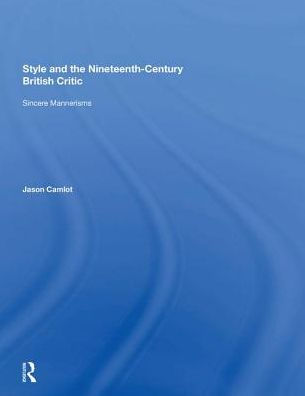
Style and the Nineteenth-Century British Critic: Sincere Mannerisms in Bloomington, MN
Current price: $190.00

Style and the Nineteenth-Century British Critic: Sincere Mannerisms in Bloomington, MN
Current price: $190.00
Loading Inventory...
Size: Hardcover
In analyzing the nonfiction works of writers such as John Wilson, J. S. Mill, De Quincy, Ruskin, Arnold, Pater, and Wilde, Jason Camlot provides an important context for the nineteenth-century critic's changing ideas about style, rhetoric, and technologies of communication. In particular, Camlot contributes to our understanding of how new print media affected the Romantic and Victorian critic's sense of self, as he elaborates the ways nineteenth-century critics used their own essays on rhetoric and stylistics to speculate about the changing conditions for the production and reception of ideas and the formulation of authorial character. Camlot argues that the early 1830s mark the moment when a previously coherent tradition of pragmatic rhetoric was fragmented and redistributed into the diverse, localized sites of an emerging periodicals market. Publishing venues for writers multiplied at midcentury, establishing a new stylistic norm for criticism-one that affirmed style as the manifestation of English discipline and objectivity. The figure of the professional critic soon subsumed the authority of the polyglot intellectual, and the later decades of the nineteenth century brought about a debate on aesthetics and criticism that set ideals of Saxon-rooted 'virile' style against more culturally inclusive theories of expression.
In analyzing the nonfiction works of writers such as John Wilson, J. S. Mill, De Quincy, Ruskin, Arnold, Pater, and Wilde, Jason Camlot provides an important context for the nineteenth-century critic's changing ideas about style, rhetoric, and technologies of communication. In particular, Camlot contributes to our understanding of how new print media affected the Romantic and Victorian critic's sense of self, as he elaborates the ways nineteenth-century critics used their own essays on rhetoric and stylistics to speculate about the changing conditions for the production and reception of ideas and the formulation of authorial character. Camlot argues that the early 1830s mark the moment when a previously coherent tradition of pragmatic rhetoric was fragmented and redistributed into the diverse, localized sites of an emerging periodicals market. Publishing venues for writers multiplied at midcentury, establishing a new stylistic norm for criticism-one that affirmed style as the manifestation of English discipline and objectivity. The figure of the professional critic soon subsumed the authority of the polyglot intellectual, and the later decades of the nineteenth century brought about a debate on aesthetics and criticism that set ideals of Saxon-rooted 'virile' style against more culturally inclusive theories of expression.
Shop Similar Products











Find at Mall of America® in Bloomington, MN
Visit at Mall of America® in Bloomington, MN