


Home
Structural Learning (Volume 1): Theory and Research
Barnes and Noble
Loading Inventory...
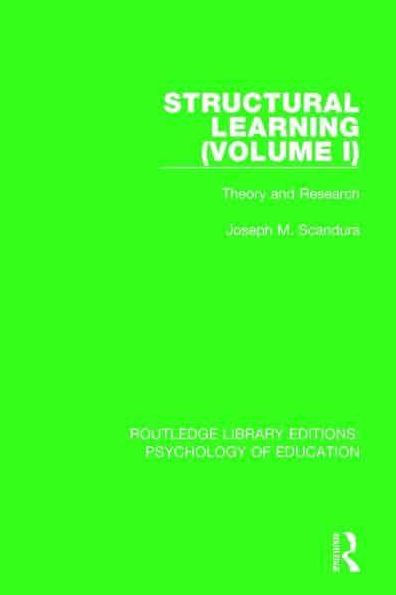
Structural Learning (Volume 1): Theory and Research in Bloomington, MN
Current price: $170.00

Structural Learning (Volume 1): Theory and Research in Bloomington, MN
Current price: $170.00
Loading Inventory...
Size: Hardcover
Originally published in 1973, this book was published in two volumes. In the first volume, the author describes what he sees as the rudiments of three deterministic partial theories of structural learning. The first involves competence, partial theories which deal only with the problem of how to account for the various kinds of behavior of which people are typically capable. Special attention is given to mathematical competence. Nothing is said about learning or performance. The second partial theory is concerned with motivation, learning, and performance under idealized conditions, and is obtained from the first partial theory by imposing further structure on it. This theory says nothing about memory of the limited capacity of human subjects to process information. … The final theory is obtained from the second by making additional assumptions, which bring memory and finite information processing into the picture. The theory is still partial, however, since no attempt is made to deal with certain ultra-short-term behavioral phenomena which appear to depend directly on particular physiological characteristics.
Originally published in 1973, this book was published in two volumes. In the first volume, the author describes what he sees as the rudiments of three deterministic partial theories of structural learning. The first involves competence, partial theories which deal only with the problem of how to account for the various kinds of behavior of which people are typically capable. Special attention is given to mathematical competence. Nothing is said about learning or performance. The second partial theory is concerned with motivation, learning, and performance under idealized conditions, and is obtained from the first partial theory by imposing further structure on it. This theory says nothing about memory of the limited capacity of human subjects to process information. … The final theory is obtained from the second by making additional assumptions, which bring memory and finite information processing into the picture. The theory is still partial, however, since no attempt is made to deal with certain ultra-short-term behavioral phenomena which appear to depend directly on particular physiological characteristics.
Shop Similar Products
















Find at Mall of America® in Bloomington, MN
Visit at Mall of America® in Bloomington, MN