


Home
Reconsidering Identity Economics: Human Well-Being and Governance
Barnes and Noble
Loading Inventory...
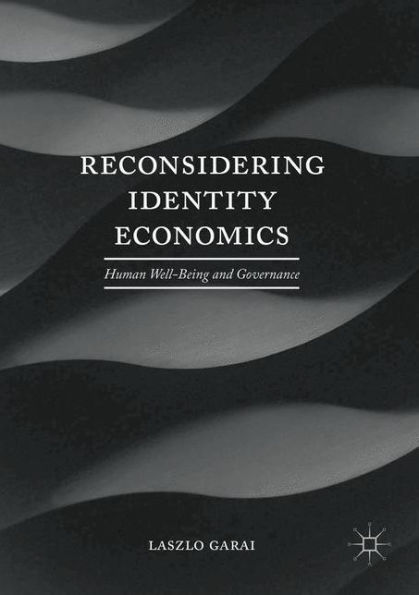
Reconsidering Identity Economics: Human Well-Being and Governance in Bloomington, MN
Current price: $109.99

Reconsidering Identity Economics: Human Well-Being and Governance in Bloomington, MN
Current price: $109.99
Loading Inventory...
Size: Hardcover
This book presents an unorthodox identity economics that approaches social identity through a non-classical psychology. Garai applies the modern physics concept of wave-particle duality to economic psychology, finding a corresponding duality in object-oriented activity and historically generated social identity. These two factors interconnect to create a double-storied structure of social identity and its behavioral manifestations. The book then presents a calculation device for mediating between behavioral and identity economics. Garai then applies all these factors to two socioeconomic systems developed during the second modernization: Bolshevik-type “socialism” and post-Bolshevik “capitalism.” In this context, he examines the Eastern Bloc
nomenklatura
as a duality of bureaucratic and patron-client organization (“state and party”) and the establishment of both today's material capitalism and its other half: human capital economics.
nomenklatura
as a duality of bureaucratic and patron-client organization (“state and party”) and the establishment of both today's material capitalism and its other half: human capital economics.
This book presents an unorthodox identity economics that approaches social identity through a non-classical psychology. Garai applies the modern physics concept of wave-particle duality to economic psychology, finding a corresponding duality in object-oriented activity and historically generated social identity. These two factors interconnect to create a double-storied structure of social identity and its behavioral manifestations. The book then presents a calculation device for mediating between behavioral and identity economics. Garai then applies all these factors to two socioeconomic systems developed during the second modernization: Bolshevik-type “socialism” and post-Bolshevik “capitalism.” In this context, he examines the Eastern Bloc
nomenklatura
as a duality of bureaucratic and patron-client organization (“state and party”) and the establishment of both today's material capitalism and its other half: human capital economics.
nomenklatura
as a duality of bureaucratic and patron-client organization (“state and party”) and the establishment of both today's material capitalism and its other half: human capital economics.
Shop Similar Products
















Find at Mall of America® in Bloomington, MN
Visit at Mall of America® in Bloomington, MN