


Home
Probability With a View Towards Statistics, Volume II
Barnes and Noble
Loading Inventory...
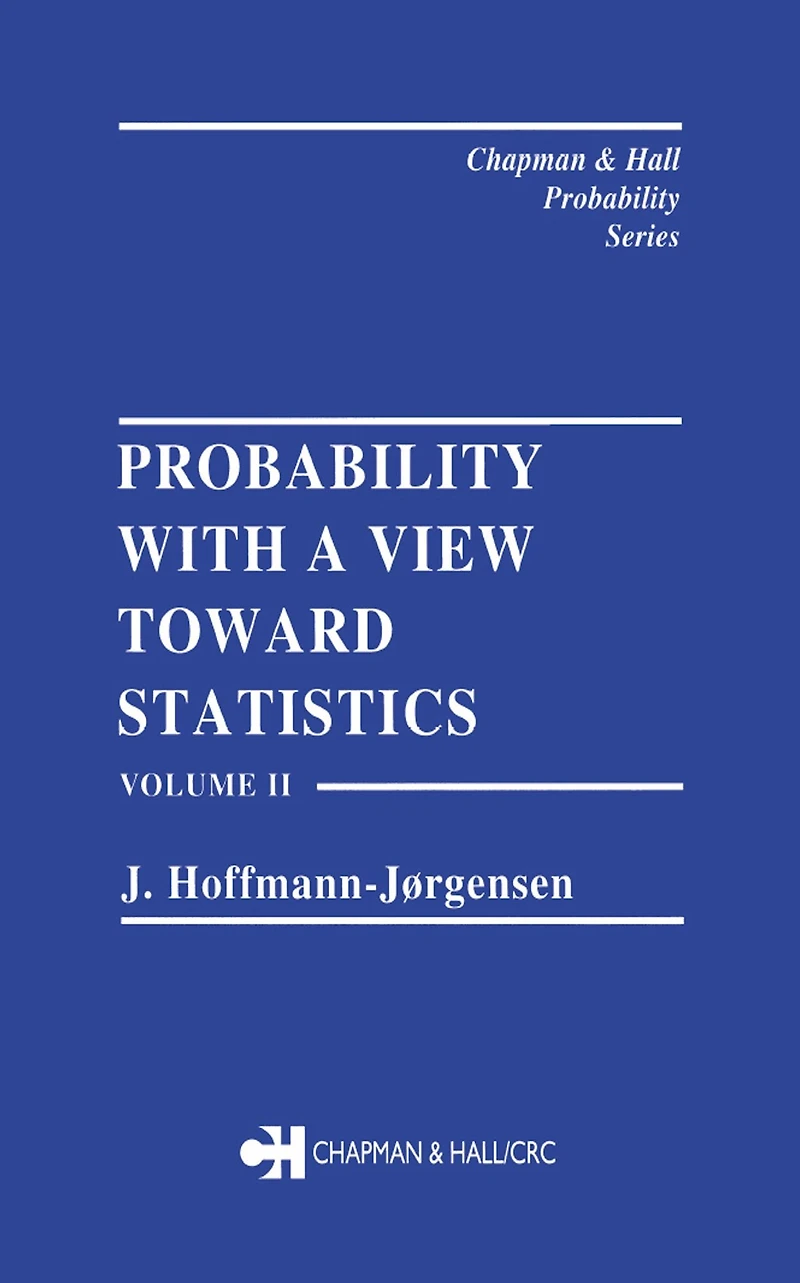
Probability With a View Towards Statistics, Volume II in Bloomington, MN
By Barnes & Noble
Current price: $255.00

Probability With a View Towards Statistics, Volume II in Bloomington, MN
Current price: $255.00
Loading Inventory...
Size: EBook
Volume II of this two-volume text and reference work concentrates on the applications of probability theory to statistics, e.g., the art of calculating densities of complicated transformations of random vectors, exponential models, consistency of maximum estimators, and asymptotic normality of maximum estimators. It also discusses topics of a pure probabilistic nature, such as stochastic processes, regular conditional probabilities, strong Markov chains, random walks, and optimal stopping strategies in random games. Unusual topics include the transformation theory of densities using Hausdorff measures, the consistency theory using the upper definition function, and the asymptotic normality of maximum estimators using twice stochastic differentiability. With an emphasis on applications to statistics, this is a continuation of the first volume, though it may be used independently of that book. Assuming a knowledge of linear algebra and analysis, as well as a course in modern probability, Volume II looks at statistics from a probabilistic point of view, touching only slightly on the practical computation aspects.
Volume II of this two-volume text and reference work concentrates on the applications of probability theory to statistics, e.g., the art of calculating densities of complicated transformations of random vectors, exponential models, consistency of maximum estimators, and asymptotic normality of maximum estimators. It also discusses topics of a pure probabilistic nature, such as stochastic processes, regular conditional probabilities, strong Markov chains, random walks, and optimal stopping strategies in random games. Unusual topics include the transformation theory of densities using Hausdorff measures, the consistency theory using the upper definition function, and the asymptotic normality of maximum estimators using twice stochastic differentiability. With an emphasis on applications to statistics, this is a continuation of the first volume, though it may be used independently of that book. Assuming a knowledge of linear algebra and analysis, as well as a course in modern probability, Volume II looks at statistics from a probabilistic point of view, touching only slightly on the practical computation aspects.
Shop Similar Products









Find at Mall of America® in Bloomington, MN
Visit at Mall of America® in Bloomington, MN