


Home
Optical Properties of Excited States Solids
Barnes and Noble
Loading Inventory...
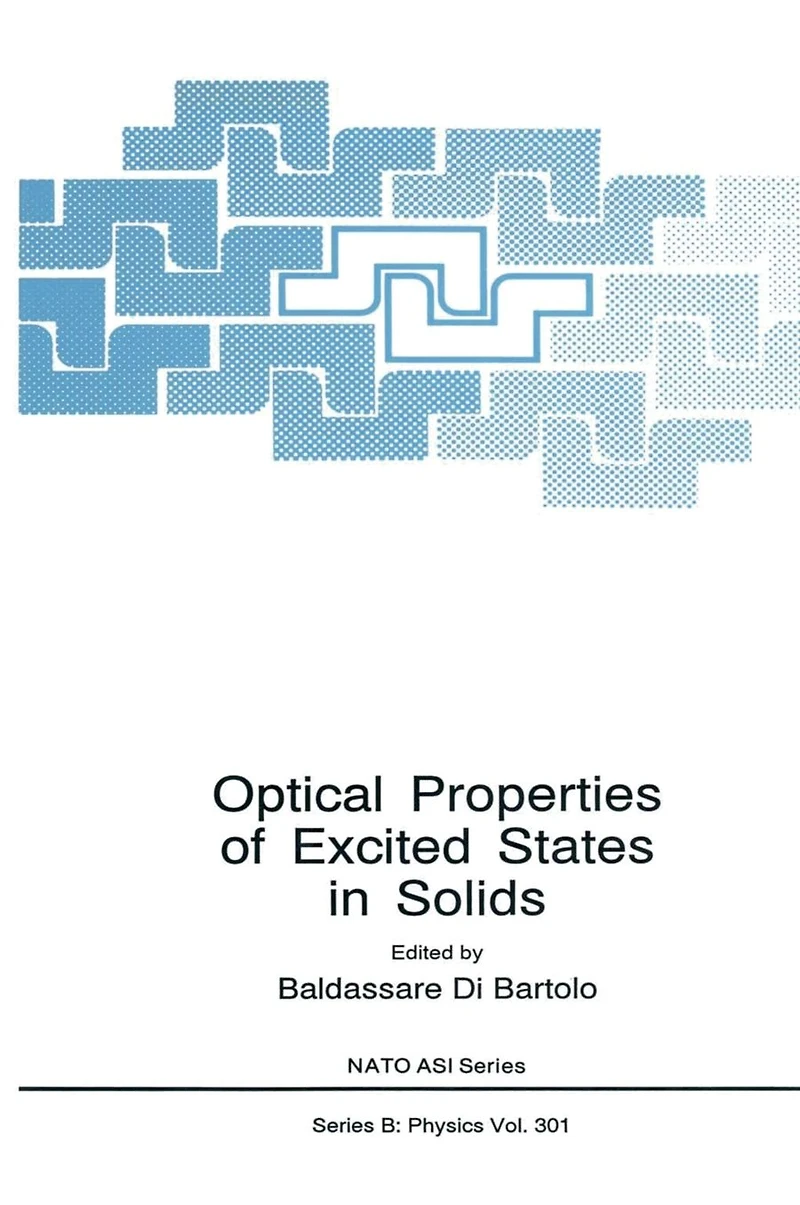
Optical Properties of Excited States Solids in Bloomington, MN
By Barnes & Noble
Current price: $323.00

Optical Properties of Excited States Solids in Bloomington, MN
Current price: $323.00
Loading Inventory...
Size: Hardcover
This book presents an account of the course "Optical Properties of Excited States in Solids" held in Erice, Italy, from June 16 to 3D, 1991. This meeting was organized by the International School of Atomic and Molecular Spectroscopy of the "Ettore Majorana" Centre for Scientific Culture. The purpose of this course was to present physical models, mathematical formalisms and experimental techniques relevant to the optical properties of excited states in solids. Some active physical species, such as ions or radicals, could survive indefinitely if they were completely 'isolated in space. Other active species, such as excited molecular and solid-state systems, are inherently unstable, even in isolation, due to the spontaneous mechanisms that may convert their excitation energies into radiation or heat. Physical parameters that may be used to characterize these excited systems are the localization or delocalization, and the coherence or incoherence, of their state excitations. In solids the excited states, whether they are localized (as for impurities in insulators) or delocalized (as they may occur in semiconductors), are relevant in several regards. Their de-excitation is extremely sensitive to the nature of the excitations of the systems, and a study of the de-excitation processes can yield a variety of information. For example, the excited states may represent the initial condition of the onset of such processes as Stokes-shifted emission, hot luminescence, symmetry-dependent Jahn-Teller and scattering processes, tunneling processes, energy transfer to like and unlike centers, superradiance, coherent radiation, and excited state absorption.
This book presents an account of the course "Optical Properties of Excited States in Solids" held in Erice, Italy, from June 16 to 3D, 1991. This meeting was organized by the International School of Atomic and Molecular Spectroscopy of the "Ettore Majorana" Centre for Scientific Culture. The purpose of this course was to present physical models, mathematical formalisms and experimental techniques relevant to the optical properties of excited states in solids. Some active physical species, such as ions or radicals, could survive indefinitely if they were completely 'isolated in space. Other active species, such as excited molecular and solid-state systems, are inherently unstable, even in isolation, due to the spontaneous mechanisms that may convert their excitation energies into radiation or heat. Physical parameters that may be used to characterize these excited systems are the localization or delocalization, and the coherence or incoherence, of their state excitations. In solids the excited states, whether they are localized (as for impurities in insulators) or delocalized (as they may occur in semiconductors), are relevant in several regards. Their de-excitation is extremely sensitive to the nature of the excitations of the systems, and a study of the de-excitation processes can yield a variety of information. For example, the excited states may represent the initial condition of the onset of such processes as Stokes-shifted emission, hot luminescence, symmetry-dependent Jahn-Teller and scattering processes, tunneling processes, energy transfer to like and unlike centers, superradiance, coherent radiation, and excited state absorption.
Shop Similar Products









Find at Mall of America® in Bloomington, MN
Visit at Mall of America® in Bloomington, MN