


Home
Observations on the Letter of Monsieur Mariette: With Opinions on Architecture, with a Preface to a New Treatise on the Introduction and Progress of the Fine Arts in Europe in Ancient Times
Barnes and Noble
Loading Inventory...
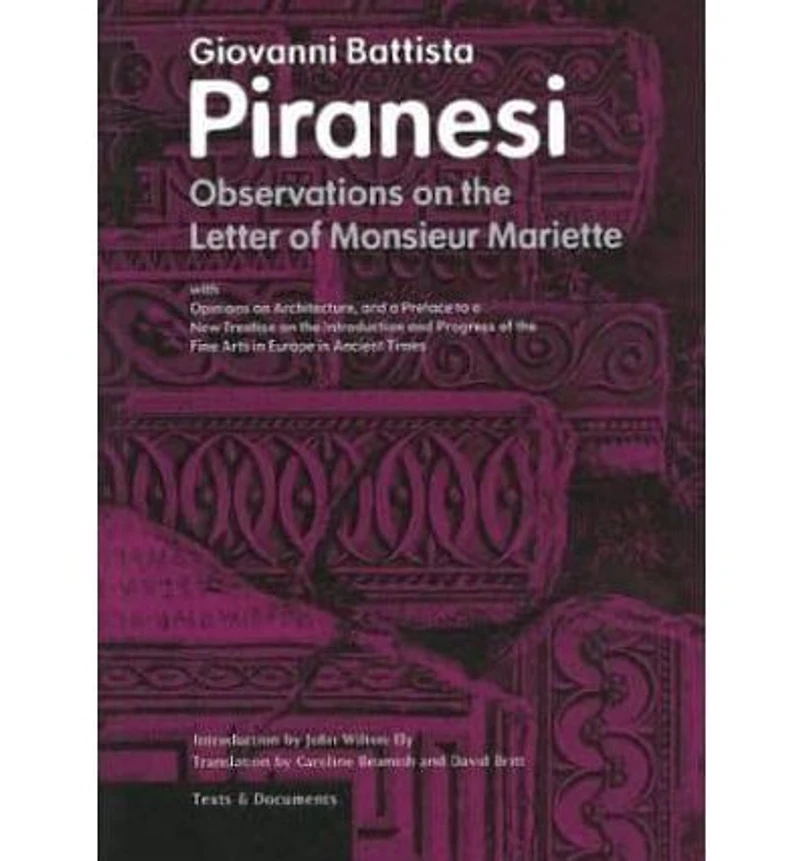
Observations on the Letter of Monsieur Mariette: With Opinions on Architecture, with a Preface to a New Treatise on the Introduction and Progress of the Fine Arts in Europe in Ancient Times in Bloomington, MN
By Barnes & Noble
Current price: $35.00

Observations on the Letter of Monsieur Mariette: With Opinions on Architecture, with a Preface to a New Treatise on the Introduction and Progress of the Fine Arts in Europe in Ancient Times in Bloomington, MN
Current price: $35.00
Loading Inventory...
Size: Paperback
Published in 1765, Giovanni Battista Piranesi's Osservazioni is an impassioned defense of the superiority of Roman architectural "invention" over the "beautiful and noble simplicity" of ancient Greece. In this three-part polemical masterpiece, the famed engraver and designer not only contends that the Etruscans-not the Greeks-were the artistic mentors of the Romans but also argues for a Roman-inspired exuberance in design that draws freely on all forms and traditions of ancient art. Although Piranesi's essentially Baroque vision set him at odds with the austere Neoclassicism of his contemporaries, his ideas were inspirational to such gifted eighteenth-century architects as Robert Adam, John Soňane, Claude-Nicolas Ledoux, and Étienne-Louis Boullée. Today, Piranesi's lively plea for imaginative eclecticism remains topical, as the debate continues over the relative merits of a rational, minimal architecture versus an architecture rich in ornament and historical references.
Published in 1765, Giovanni Battista Piranesi's Osservazioni is an impassioned defense of the superiority of Roman architectural "invention" over the "beautiful and noble simplicity" of ancient Greece. In this three-part polemical masterpiece, the famed engraver and designer not only contends that the Etruscans-not the Greeks-were the artistic mentors of the Romans but also argues for a Roman-inspired exuberance in design that draws freely on all forms and traditions of ancient art. Although Piranesi's essentially Baroque vision set him at odds with the austere Neoclassicism of his contemporaries, his ideas were inspirational to such gifted eighteenth-century architects as Robert Adam, John Soňane, Claude-Nicolas Ledoux, and Étienne-Louis Boullée. Today, Piranesi's lively plea for imaginative eclecticism remains topical, as the debate continues over the relative merits of a rational, minimal architecture versus an architecture rich in ornament and historical references.
Shop Similar Products





![Letters To His Son On The Fine Art Of Becoming A Man Of The World And A Gentleman [ By: Philip Stanhope ]](https://cdn.mall.adeptmind.ai/https%253A%252F%252Fcdn.shopify.com%252Fs%252Ffiles%252F1%252F0674%252F5433%252F7265%252Ffiles%252F2940012636867_p0.jpg_medium.webp)










Find at Mall of America® in Bloomington, MN
Visit at Mall of America® in Bloomington, MN