


Home
MRTD (Multi Resolution Time Domain) Method Electromagnetics
Barnes and Noble
Loading Inventory...
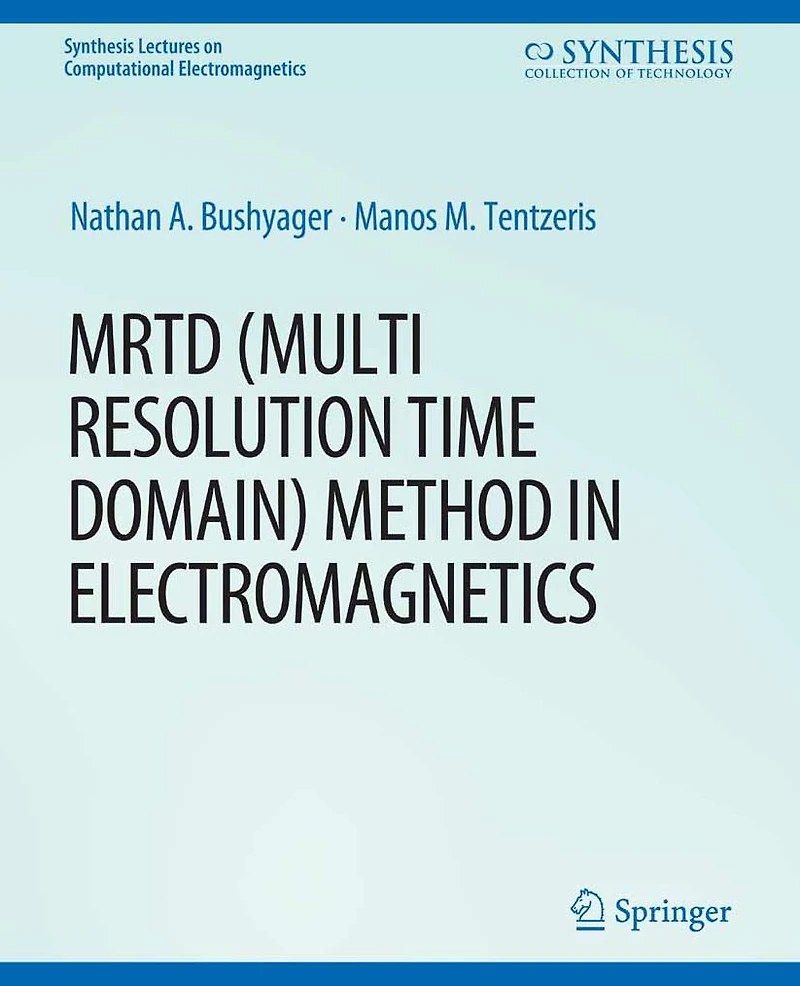

MRTD (Multi Resolution Time Domain) Method Electromagnetics in Bloomington, MN
By Barnes & Noble
Current price: $34.99

MRTD (Multi Resolution Time Domain) Method Electromagnetics in Bloomington, MN
Current price: $34.99
Loading Inventory...
Size: EBook
This book presents a method that allows the use of multiresolution principles in a time domain electromagnetic modeling technique that is applicable to general structures. The multiresolution time-domain (MRTD) technique, as it is often called, is presented for general basis functions. Additional techniques that are presented here allow the modeling of complex structures using a subcell representation that permits the modeling discrete electromagnetic effects at individual equivalent grid points. This is accomplished by transforming the application of the effects at individual points in the grid into the wavelet domain. In this work, the MRTD technique is derived for a general wavelet basis using a relatively compact vector notation that both makes the technique easier to understand and illustrates the differences between MRTD basis functions. In addition, techniques such as the uniaxial perfectly matched layer (UPML) for arbitrary wavelet resolution and non-uniform gridding are presented. Using these techniques, any structure that can be simulated in Yee-FDTD can be modeled with in MRTD.
This book presents a method that allows the use of multiresolution principles in a time domain electromagnetic modeling technique that is applicable to general structures. The multiresolution time-domain (MRTD) technique, as it is often called, is presented for general basis functions. Additional techniques that are presented here allow the modeling of complex structures using a subcell representation that permits the modeling discrete electromagnetic effects at individual equivalent grid points. This is accomplished by transforming the application of the effects at individual points in the grid into the wavelet domain. In this work, the MRTD technique is derived for a general wavelet basis using a relatively compact vector notation that both makes the technique easier to understand and illustrates the differences between MRTD basis functions. In addition, techniques such as the uniaxial perfectly matched layer (UPML) for arbitrary wavelet resolution and non-uniform gridding are presented. Using these techniques, any structure that can be simulated in Yee-FDTD can be modeled with in MRTD.
Shop Similar Products









Find at Mall of America® in Bloomington, MN
Visit at Mall of America® in Bloomington, MN