


Home
Miles Lord: The Maverick Judge Who Brought Corporate America to Justice
Barnes and Noble
Loading Inventory...
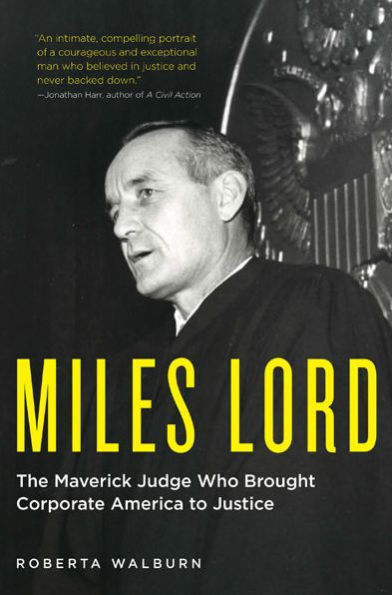
Miles Lord: The Maverick Judge Who Brought Corporate America to Justice in Bloomington, MN
Current price: $29.95

Miles Lord: The Maverick Judge Who Brought Corporate America to Justice in Bloomington, MN
Current price: $29.95
Loading Inventory...
Size: Hardcover
The life of a crusading federal judge who stood up and fought for “the little guy”
This is the story of Miles Lord (1919–2016), who rose from humble beginnings on Minnesota’s Iron Range to become one of the most colorful and powerful judges in the country, described as “an unabashed Prairie populist” and “a livewire slayer of corporate behemoths.” He cut a wide swath through history on his path to the bench: coming of age alongside a cadre of young Midwestern socialgospel progressives, including Hubert H. Humphrey, Eugene McCarthy, and Walter Mondale, in the days before they reached national fame; teaming with Bobby Kennedy as a hotshot prosecutor in pursuit of Jimmy Hoffa; and serving as the secret envoy between his friends Hubert and Eugene in their battle for the soul of the Democratic party in the historic 1968 presidential campaign. Later, after donning his black robe, he reshaped jurisprudence with precedentbreaking rulings—on issues ranging from women’s rights to consumer protection to education reform—and breaking trail when he ordered the shutdown of the Reserve Mining Company in northern Minnesota, which was spewing its waste into Lake Superior, in the most sensational trial of the early environmental era.
One of Judge Lord’s landmark cases—and interlaced as a centerpiece narrative of this book—involved the Dalkon Shield intrauterine device, which caused horrific infections in thousands of women, resulting in infertility and sometimes death. Author Roberta Walburn served as the judge’s law clerk during that litigation in 1983–84, and she provides a pageturning account (both an insider’s view and an indepth chronicle) of what was called “one of the most disastrous episodes of American corporate misconduct.” In the end, more than 200,000 women received nearly $3 billion in compensation, and the Fortune 500 defendant was left in ruins. But Judge Lord was hauled up on judicial misconduct charges for his noholdsbarred actions that were certainly provocative but also stand as a timely reminder, even (or especially) today, of the challenges in balancing the scales of justice for a legal system that too often skews to the rich and powerful.
The author deftly weaves the Dalkon Shield drama into the larger story of the life of a oneofakind man, crafting a sweeping and spirited truelife tale with not only her firsthand experiences as the judge’s law clerk but also with unrestricted access to the judge’s personal files. This is a rare and compelling portrait of a remarkable man and his place in both Minnesota and U.S. history.
This is the story of Miles Lord (1919–2016), who rose from humble beginnings on Minnesota’s Iron Range to become one of the most colorful and powerful judges in the country, described as “an unabashed Prairie populist” and “a livewire slayer of corporate behemoths.” He cut a wide swath through history on his path to the bench: coming of age alongside a cadre of young Midwestern socialgospel progressives, including Hubert H. Humphrey, Eugene McCarthy, and Walter Mondale, in the days before they reached national fame; teaming with Bobby Kennedy as a hotshot prosecutor in pursuit of Jimmy Hoffa; and serving as the secret envoy between his friends Hubert and Eugene in their battle for the soul of the Democratic party in the historic 1968 presidential campaign. Later, after donning his black robe, he reshaped jurisprudence with precedentbreaking rulings—on issues ranging from women’s rights to consumer protection to education reform—and breaking trail when he ordered the shutdown of the Reserve Mining Company in northern Minnesota, which was spewing its waste into Lake Superior, in the most sensational trial of the early environmental era.
One of Judge Lord’s landmark cases—and interlaced as a centerpiece narrative of this book—involved the Dalkon Shield intrauterine device, which caused horrific infections in thousands of women, resulting in infertility and sometimes death. Author Roberta Walburn served as the judge’s law clerk during that litigation in 1983–84, and she provides a pageturning account (both an insider’s view and an indepth chronicle) of what was called “one of the most disastrous episodes of American corporate misconduct.” In the end, more than 200,000 women received nearly $3 billion in compensation, and the Fortune 500 defendant was left in ruins. But Judge Lord was hauled up on judicial misconduct charges for his noholdsbarred actions that were certainly provocative but also stand as a timely reminder, even (or especially) today, of the challenges in balancing the scales of justice for a legal system that too often skews to the rich and powerful.
The author deftly weaves the Dalkon Shield drama into the larger story of the life of a oneofakind man, crafting a sweeping and spirited truelife tale with not only her firsthand experiences as the judge’s law clerk but also with unrestricted access to the judge’s personal files. This is a rare and compelling portrait of a remarkable man and his place in both Minnesota and U.S. history.
The life of a crusading federal judge who stood up and fought for “the little guy”
This is the story of Miles Lord (1919–2016), who rose from humble beginnings on Minnesota’s Iron Range to become one of the most colorful and powerful judges in the country, described as “an unabashed Prairie populist” and “a livewire slayer of corporate behemoths.” He cut a wide swath through history on his path to the bench: coming of age alongside a cadre of young Midwestern socialgospel progressives, including Hubert H. Humphrey, Eugene McCarthy, and Walter Mondale, in the days before they reached national fame; teaming with Bobby Kennedy as a hotshot prosecutor in pursuit of Jimmy Hoffa; and serving as the secret envoy between his friends Hubert and Eugene in their battle for the soul of the Democratic party in the historic 1968 presidential campaign. Later, after donning his black robe, he reshaped jurisprudence with precedentbreaking rulings—on issues ranging from women’s rights to consumer protection to education reform—and breaking trail when he ordered the shutdown of the Reserve Mining Company in northern Minnesota, which was spewing its waste into Lake Superior, in the most sensational trial of the early environmental era.
One of Judge Lord’s landmark cases—and interlaced as a centerpiece narrative of this book—involved the Dalkon Shield intrauterine device, which caused horrific infections in thousands of women, resulting in infertility and sometimes death. Author Roberta Walburn served as the judge’s law clerk during that litigation in 1983–84, and she provides a pageturning account (both an insider’s view and an indepth chronicle) of what was called “one of the most disastrous episodes of American corporate misconduct.” In the end, more than 200,000 women received nearly $3 billion in compensation, and the Fortune 500 defendant was left in ruins. But Judge Lord was hauled up on judicial misconduct charges for his noholdsbarred actions that were certainly provocative but also stand as a timely reminder, even (or especially) today, of the challenges in balancing the scales of justice for a legal system that too often skews to the rich and powerful.
The author deftly weaves the Dalkon Shield drama into the larger story of the life of a oneofakind man, crafting a sweeping and spirited truelife tale with not only her firsthand experiences as the judge’s law clerk but also with unrestricted access to the judge’s personal files. This is a rare and compelling portrait of a remarkable man and his place in both Minnesota and U.S. history.
This is the story of Miles Lord (1919–2016), who rose from humble beginnings on Minnesota’s Iron Range to become one of the most colorful and powerful judges in the country, described as “an unabashed Prairie populist” and “a livewire slayer of corporate behemoths.” He cut a wide swath through history on his path to the bench: coming of age alongside a cadre of young Midwestern socialgospel progressives, including Hubert H. Humphrey, Eugene McCarthy, and Walter Mondale, in the days before they reached national fame; teaming with Bobby Kennedy as a hotshot prosecutor in pursuit of Jimmy Hoffa; and serving as the secret envoy between his friends Hubert and Eugene in their battle for the soul of the Democratic party in the historic 1968 presidential campaign. Later, after donning his black robe, he reshaped jurisprudence with precedentbreaking rulings—on issues ranging from women’s rights to consumer protection to education reform—and breaking trail when he ordered the shutdown of the Reserve Mining Company in northern Minnesota, which was spewing its waste into Lake Superior, in the most sensational trial of the early environmental era.
One of Judge Lord’s landmark cases—and interlaced as a centerpiece narrative of this book—involved the Dalkon Shield intrauterine device, which caused horrific infections in thousands of women, resulting in infertility and sometimes death. Author Roberta Walburn served as the judge’s law clerk during that litigation in 1983–84, and she provides a pageturning account (both an insider’s view and an indepth chronicle) of what was called “one of the most disastrous episodes of American corporate misconduct.” In the end, more than 200,000 women received nearly $3 billion in compensation, and the Fortune 500 defendant was left in ruins. But Judge Lord was hauled up on judicial misconduct charges for his noholdsbarred actions that were certainly provocative but also stand as a timely reminder, even (or especially) today, of the challenges in balancing the scales of justice for a legal system that too often skews to the rich and powerful.
The author deftly weaves the Dalkon Shield drama into the larger story of the life of a oneofakind man, crafting a sweeping and spirited truelife tale with not only her firsthand experiences as the judge’s law clerk but also with unrestricted access to the judge’s personal files. This is a rare and compelling portrait of a remarkable man and his place in both Minnesota and U.S. history.
Shop Similar Products















Find at Mall of America® in Bloomington, MN
Visit at Mall of America® in Bloomington, MN