


Home
Methods for Solving Incorrectly Posed Problems
Barnes and Noble
Loading Inventory...
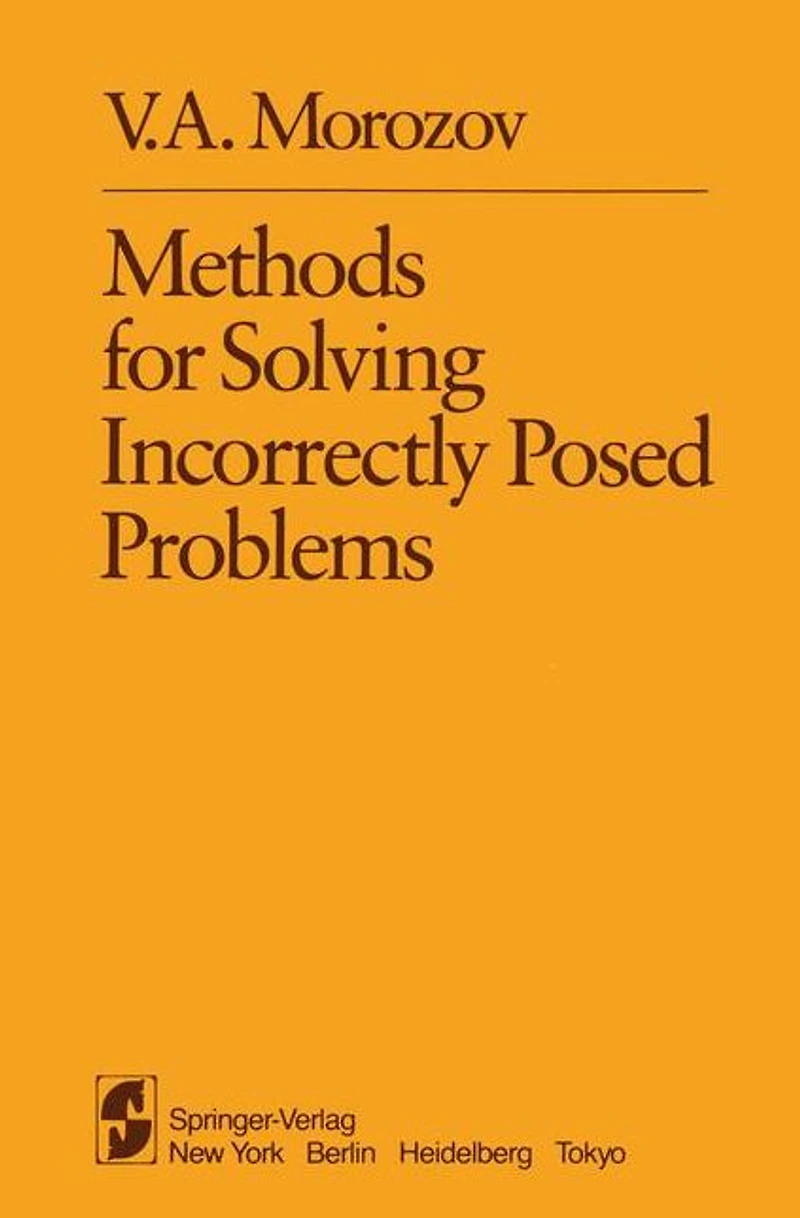
Methods for Solving Incorrectly Posed Problems in Bloomington, MN
By Barnes & Noble
Current price: $54.99

Methods for Solving Incorrectly Posed Problems in Bloomington, MN
Current price: $54.99
Loading Inventory...
Size: Paperback
Some problems of mathematical physics and analysis can be formulated as the problem of solving the equation f € F, (1) Au = f, where A: DA C U + F is an operator with a non-empty domain of definition D , in a metric space U, with range in a metric space F. The metrics A on U and F will be denoted by P and P ' respectively. Relative u F to the twin spaces U and F, J. Hadamard P-06] gave the following defini tion of correctness: the problem (1) is said to be well-posed (correct, properly posed) if the following conditions are satisfied: (1) The range of the value Q of the operator A coincides with A F ("sol vabi li ty" condition); (2) The equality AU = AU for any u ,u € DA implies the I 2 l 2 equality u = u ("uniqueness" condition); l 2 (3) The inverse operator A-I is continuous on F ("stability" condition). Any reasonable mathematical formulation of a physical problem requires that conditions (1)-(3) be satisfied. That is why Hadamard postulated that any "ill-posed" (improperly posed) problem, that is to say, one which does not satisfy conditions (1)-(3), is non-physical. Hadamard also gave the now classical example of an ill-posed problem, namely, the Cauchy problem for the Laplace equation.
Some problems of mathematical physics and analysis can be formulated as the problem of solving the equation f € F, (1) Au = f, where A: DA C U + F is an operator with a non-empty domain of definition D , in a metric space U, with range in a metric space F. The metrics A on U and F will be denoted by P and P ' respectively. Relative u F to the twin spaces U and F, J. Hadamard P-06] gave the following defini tion of correctness: the problem (1) is said to be well-posed (correct, properly posed) if the following conditions are satisfied: (1) The range of the value Q of the operator A coincides with A F ("sol vabi li ty" condition); (2) The equality AU = AU for any u ,u € DA implies the I 2 l 2 equality u = u ("uniqueness" condition); l 2 (3) The inverse operator A-I is continuous on F ("stability" condition). Any reasonable mathematical formulation of a physical problem requires that conditions (1)-(3) be satisfied. That is why Hadamard postulated that any "ill-posed" (improperly posed) problem, that is to say, one which does not satisfy conditions (1)-(3), is non-physical. Hadamard also gave the now classical example of an ill-posed problem, namely, the Cauchy problem for the Laplace equation.
Shop Similar Products

















Find at Mall of America® in Bloomington, MN
Visit at Mall of America® in Bloomington, MN