


Home
Linux Journal November 2012
Barnes and Noble
Loading Inventory...
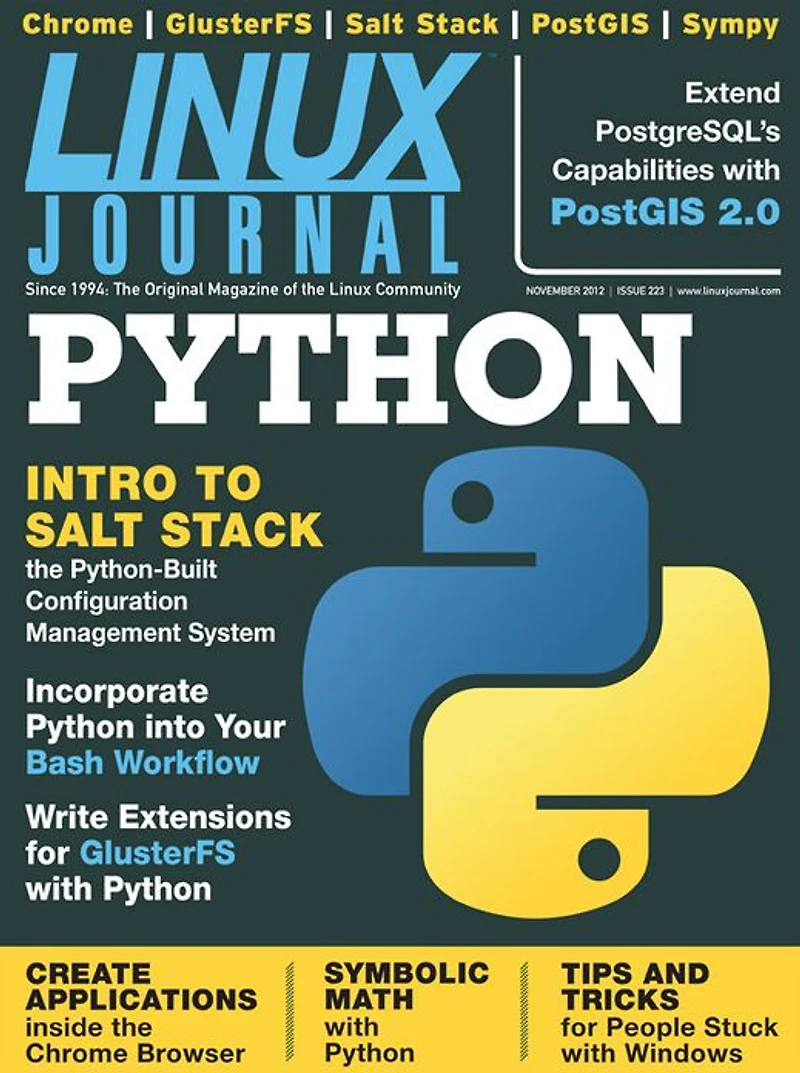
Linux Journal November 2012 in Bloomington, MN
By Barnes & Noble
Current price: $2.99

Linux Journal November 2012 in Bloomington, MN
Current price: $2.99
Loading Inventory...
Size: EBook
A quick overview of what's in this special Python issue: * Intro to Salt Stack--the Python-Built Configuration Management System * Incorporate Python into Your Bash Workflow * Write Extensions for GlusterFS with Python * Extend PostgreSQL's Capabilities with PostGIS 2.0 * Create Applications inside the Chrome BrowserDetailed Overview: Indiana was the Dog's NameMy wife is afraid of snakes. Actually, "afraid" may not be a big enough word.My wife is terrifyingly and abundantly mortified of snakes. Like any goodhusband, I remind her that Indiana Jones also was afraid of snakes, so she's ingood company. This month, our issue is all about vipers--no, wait, Python.Whether you're a new programmer or an old coder, Python is flexible, cross-platform and really quite robust.Joey Bernard gets the Python train rolling in our UpFront section. Sympy is alibrary for Python providing a full-featured computer algebra system.Although Ihave no problem with my kids learning long division, there certainly are somegreat advantages to using computers for complex maths.Reuven M. Lerner takes a trip into HTML5 land. He shows how to create Chromeextensions, which can be entire applications running inside your browser. WithHTML5, CSS, JavaScript and so on, Chrome applications can be robust, complex and afar cry from the Web applications of just a few years ago. In fact, if yourecall from last month, I use a Chrome extension for writing my Linux Journalarticles.Our other resident programmer is Dave Taylor, who teaches how to use SIGALARMin scripts to add valuable complexity to scripts that need it. That mightsound overwhelming, but Dave explains what he's doing along the way, and in theend, what seems like a complex and confusing idea makes sense. Speaking ofconfusing ideas, I had to do a double take when I read Kyle Rankin's article onhis new Android device. Yes, you read that right, Kyle uses Android. Like mostthings Kyle does, however, it's more than just switching from his N900 to a newphone. He's never happy with just a phone; Kyle wants a communication devicethat doubles as an International Space Station. This month, he comes close.I haven't been happy with the lack of hate mail in my inbox recently, so Ithought it would be a good time to write an article about Windows. Okay, to behonest, it's a little more complicated than that, but I fully expect to get hatemail nonetheless! As a Linux user currently stuck in a job with a Windowsinfrastructure (not here at Linux Journal, of course), I'm working hard to feelas at home as possible. I share my struggles with you, and maybe make Windows alittle easier to deal with.After my sacrilegious foray into the Windows world, Richard Delaney brings usback to topic with his article on replacing Bash scripts with Python. SinceBash scripting is the only form of programming I ever do, I'm both hesitant andexcited about this topic. Learning a new language would be very beneficial forme, and if I can use it for the same purposes I use Bash, all the better!GlusterFS is a fascinating distributed filesystem, which can scale to enormoussize. If you're a Python programmer and want to add functionality toGlusterFS, Jeff Darcy's article is perfect. Integrating code across languagescan be a daunting task, but with the flexibility of Python, Jeff shows us it'sworth the effort.Configuration management systems are all the rage. This is obviously because itmakes managing large numbers of servers much easier to do. A part of me thinksit might be due to the funny sounding project names as well. Puppet andChef are both fairly well known, and thanks to their names, they're easy to remember.This month, Ben Hosmer introduces us to a Python-based configuration managementtool named Salt Stack. Apparently having interesting names is a requirementin the configuration management world, and Salt Stack lives up to that. Does itlive up to the functionality of its competition? Ben lets us know.Stefano Iacovella finishes off this issue with PostGIS. PostgreSQL is a greatopen-source database system, but for keeping track of spatial data (thinkmaps), it really needs to run with an extension like PostGIS in order to handlethat type of stuff. Not only does PostGIS allow for complex mapping of spatialdata, but it also can handle four-dimensional information as well. Good luck toIndiana Jones if he tries to follow a four-dimensional treasure map though. It'shard enough to keep track of snakes in three dimensions!--Shawn Powers
A quick overview of what's in this special Python issue: * Intro to Salt Stack--the Python-Built Configuration Management System * Incorporate Python into Your Bash Workflow * Write Extensions for GlusterFS with Python * Extend PostgreSQL's Capabilities with PostGIS 2.0 * Create Applications inside the Chrome BrowserDetailed Overview: Indiana was the Dog's NameMy wife is afraid of snakes. Actually, "afraid" may not be a big enough word.My wife is terrifyingly and abundantly mortified of snakes. Like any goodhusband, I remind her that Indiana Jones also was afraid of snakes, so she's ingood company. This month, our issue is all about vipers--no, wait, Python.Whether you're a new programmer or an old coder, Python is flexible, cross-platform and really quite robust.Joey Bernard gets the Python train rolling in our UpFront section. Sympy is alibrary for Python providing a full-featured computer algebra system.Although Ihave no problem with my kids learning long division, there certainly are somegreat advantages to using computers for complex maths.Reuven M. Lerner takes a trip into HTML5 land. He shows how to create Chromeextensions, which can be entire applications running inside your browser. WithHTML5, CSS, JavaScript and so on, Chrome applications can be robust, complex and afar cry from the Web applications of just a few years ago. In fact, if yourecall from last month, I use a Chrome extension for writing my Linux Journalarticles.Our other resident programmer is Dave Taylor, who teaches how to use SIGALARMin scripts to add valuable complexity to scripts that need it. That mightsound overwhelming, but Dave explains what he's doing along the way, and in theend, what seems like a complex and confusing idea makes sense. Speaking ofconfusing ideas, I had to do a double take when I read Kyle Rankin's article onhis new Android device. Yes, you read that right, Kyle uses Android. Like mostthings Kyle does, however, it's more than just switching from his N900 to a newphone. He's never happy with just a phone; Kyle wants a communication devicethat doubles as an International Space Station. This month, he comes close.I haven't been happy with the lack of hate mail in my inbox recently, so Ithought it would be a good time to write an article about Windows. Okay, to behonest, it's a little more complicated than that, but I fully expect to get hatemail nonetheless! As a Linux user currently stuck in a job with a Windowsinfrastructure (not here at Linux Journal, of course), I'm working hard to feelas at home as possible. I share my struggles with you, and maybe make Windows alittle easier to deal with.After my sacrilegious foray into the Windows world, Richard Delaney brings usback to topic with his article on replacing Bash scripts with Python. SinceBash scripting is the only form of programming I ever do, I'm both hesitant andexcited about this topic. Learning a new language would be very beneficial forme, and if I can use it for the same purposes I use Bash, all the better!GlusterFS is a fascinating distributed filesystem, which can scale to enormoussize. If you're a Python programmer and want to add functionality toGlusterFS, Jeff Darcy's article is perfect. Integrating code across languagescan be a daunting task, but with the flexibility of Python, Jeff shows us it'sworth the effort.Configuration management systems are all the rage. This is obviously because itmakes managing large numbers of servers much easier to do. A part of me thinksit might be due to the funny sounding project names as well. Puppet andChef are both fairly well known, and thanks to their names, they're easy to remember.This month, Ben Hosmer introduces us to a Python-based configuration managementtool named Salt Stack. Apparently having interesting names is a requirementin the configuration management world, and Salt Stack lives up to that. Does itlive up to the functionality of its competition? Ben lets us know.Stefano Iacovella finishes off this issue with PostGIS. PostgreSQL is a greatopen-source database system, but for keeping track of spatial data (thinkmaps), it really needs to run with an extension like PostGIS in order to handlethat type of stuff. Not only does PostGIS allow for complex mapping of spatialdata, but it also can handle four-dimensional information as well. Good luck toIndiana Jones if he tries to follow a four-dimensional treasure map though. It'shard enough to keep track of snakes in three dimensions!--Shawn Powers
Shop Similar Products















Find at Mall of America® in Bloomington, MN
Visit at Mall of America® in Bloomington, MN