


Home
Lessons from German Unification for the Korean Peninsula
Barnes and Noble
Loading Inventory...
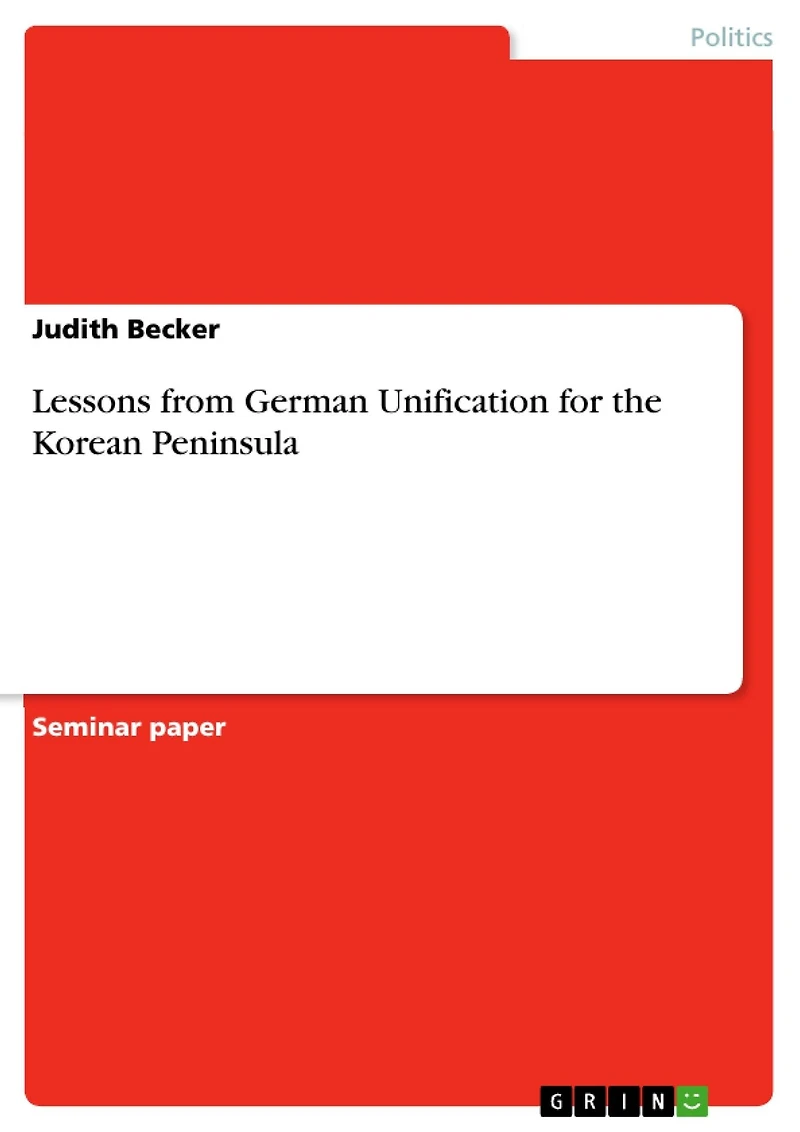
Lessons from German Unification for the Korean Peninsula in Bloomington, MN
By Barnes & Noble
Current price: $20.59

Lessons from German Unification for the Korean Peninsula in Bloomington, MN
Current price: $20.59
Loading Inventory...
Size: EBook
Seminar paper from the year 2008 in the subject Politics - International Politics - Region: Far East, grade: 85% = 2,0/A-/GPA 3.7, Peking Universität (School for International Studies), course: International Securtiy in East Asia, language: English, abstract: Germany achieved what Korea still can achieve, namely peaceful unification. There are several similarities between the divided Koreas and the formerly divided Germanys. In both cases, the division grew out of the Second World War and the following Cold War. The divided nations have totally different systems of government. North Korea, as a communistic one-party state, is similar to the GDR and South Korea, as a democratic republic, is similar to the FDR. Major differences are apparent in the economic development between North and South Korea, which again corresponds to the situation in Germany at the end of the 1980s. In light of these similarities, an important question to answer is the following one: what lessons can the Korean Peninsula learn from German unification? Thus, this essay will proceed as follows. Firstly, the developments in Germany, leading to the opening of the Berlin Wall and the subsequent unification will be described and analyzed. Secondly, the economic and socio-cultural outcomes of the unification will be briefly analyzed. Thirdly, recommendations for the Korean Peninsula will be formulated and finally, the essay will conclude its findings.
Seminar paper from the year 2008 in the subject Politics - International Politics - Region: Far East, grade: 85% = 2,0/A-/GPA 3.7, Peking Universität (School for International Studies), course: International Securtiy in East Asia, language: English, abstract: Germany achieved what Korea still can achieve, namely peaceful unification. There are several similarities between the divided Koreas and the formerly divided Germanys. In both cases, the division grew out of the Second World War and the following Cold War. The divided nations have totally different systems of government. North Korea, as a communistic one-party state, is similar to the GDR and South Korea, as a democratic republic, is similar to the FDR. Major differences are apparent in the economic development between North and South Korea, which again corresponds to the situation in Germany at the end of the 1980s. In light of these similarities, an important question to answer is the following one: what lessons can the Korean Peninsula learn from German unification? Thus, this essay will proceed as follows. Firstly, the developments in Germany, leading to the opening of the Berlin Wall and the subsequent unification will be described and analyzed. Secondly, the economic and socio-cultural outcomes of the unification will be briefly analyzed. Thirdly, recommendations for the Korean Peninsula will be formulated and finally, the essay will conclude its findings.
Shop Similar Products











Find at Mall of America® in Bloomington, MN
Visit at Mall of America® in Bloomington, MN