


Home
Lawful Income Tax Avoidance for the Qualified Wages and Salaries of Natural Persons
Barnes and Noble
Loading Inventory...
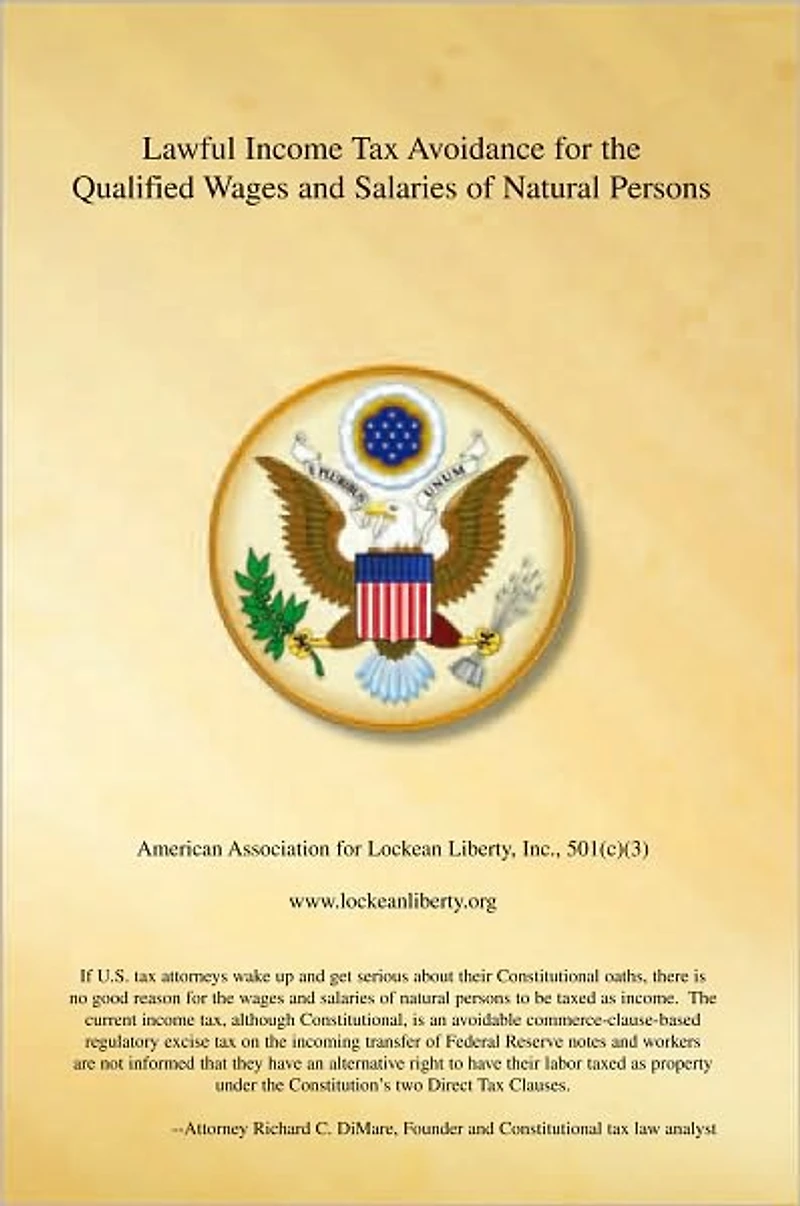
Lawful Income Tax Avoidance for the Qualified Wages and Salaries of Natural Persons in Bloomington, MN
By Barnes & Noble
Current price: $9.99

Lawful Income Tax Avoidance for the Qualified Wages and Salaries of Natural Persons in Bloomington, MN
Current price: $9.99
Loading Inventory...
Size: EBook
This book is a wake-up call to the American legal community, and an insistence that it answer to the silent distress of millions of financially overburdened working people. Because of the unique structure of our legal system, American lawyers have a moral and legal duty to enforce certain tax constraints on government that would favor workers, and lawyers are failing miserably. Support my nonprofit to help lawyers everywhere recognize our Constitution's two classes of taxation, so they and their clients can eventually know the difference between taxes: (1) on property under the Direct Tax Clauses, (2) on income derived from property sources under the Sixteenth Amendment, and (3) on income derived from non-property sources under the Uniformity (or Indirect Tax) Clause. By analyzing the history of Supreme Court tax cases, starting with Hylton (1796) and ending with Lopez (1995), and dividing the cases into three eras, this book will help you understand why the American tax system is the most unique and revolutionary in history.
This book is a wake-up call to the American legal community, and an insistence that it answer to the silent distress of millions of financially overburdened working people. Because of the unique structure of our legal system, American lawyers have a moral and legal duty to enforce certain tax constraints on government that would favor workers, and lawyers are failing miserably. Support my nonprofit to help lawyers everywhere recognize our Constitution's two classes of taxation, so they and their clients can eventually know the difference between taxes: (1) on property under the Direct Tax Clauses, (2) on income derived from property sources under the Sixteenth Amendment, and (3) on income derived from non-property sources under the Uniformity (or Indirect Tax) Clause. By analyzing the history of Supreme Court tax cases, starting with Hylton (1796) and ending with Lopez (1995), and dividing the cases into three eras, this book will help you understand why the American tax system is the most unique and revolutionary in history.
Shop Similar Products








Find at Mall of America® in Bloomington, MN
Visit at Mall of America® in Bloomington, MN