


Home
Introduction to the Laplace Transform
Barnes and Noble
Loading Inventory...
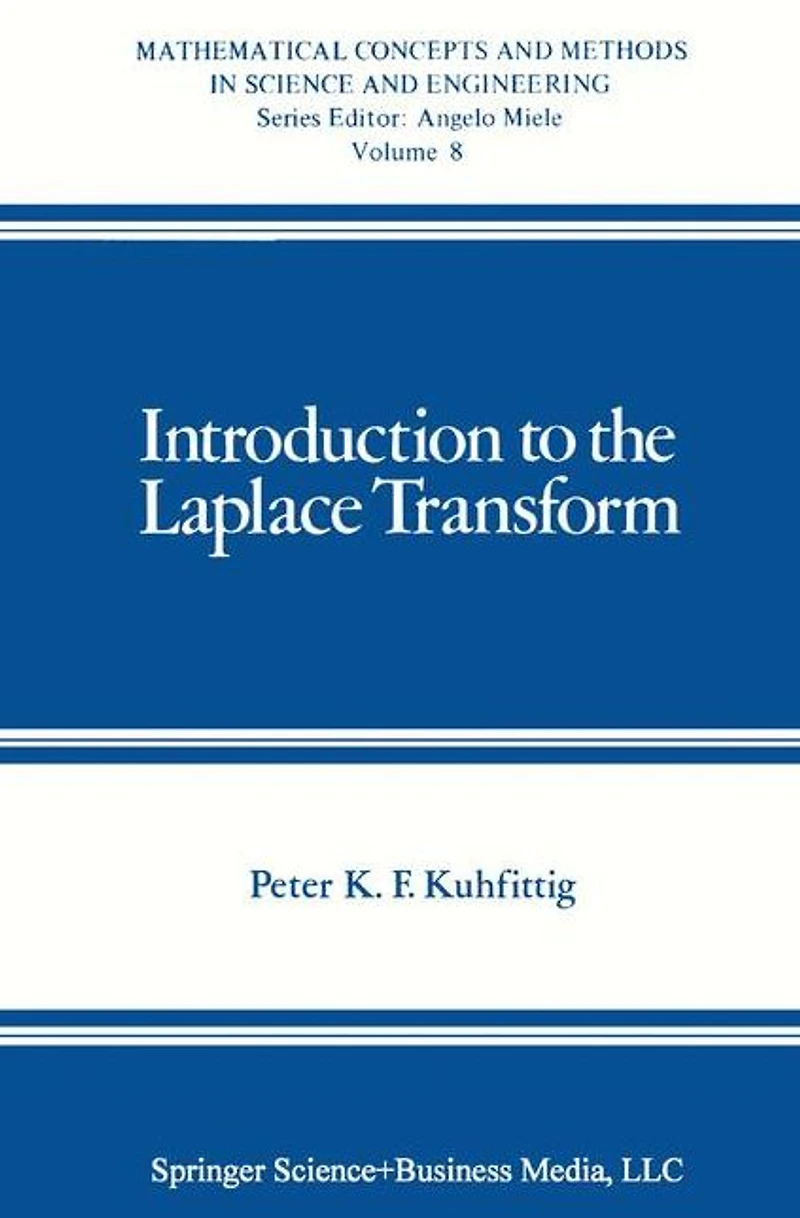
Introduction to the Laplace Transform in Bloomington, MN
By Barnes & Noble
Current price: $54.99

Introduction to the Laplace Transform in Bloomington, MN
Current price: $54.99
Loading Inventory...
Size: Hardcover
The purpose of this book is to give an introduction to the Laplace transform on the undergraduate level. The material is drawn from notes for a course taught by the author at the Milwaukee School of Engineering. Based on classroom experience, an attempt has been made to (1) keep the proofs short, (2) introduce applications as soon as possible, (3) concentrate on problems that are difficult to handle by the older classical methods, and (4) emphasize periodic phenomena. To make it possible to offer the course early in the curriculum (after differential equations), no knowledge of complex variable theory is assumed. However, since a thorough study of Laplace. transforms requires at least the rudiments of this theory, Chapter 3 includes a brief sketch of complex variables, with many of the details presented in Appendix A. This plan permits an introduction of the complex inversion formula, followed by additional applications. The author has found that a course taught three hours a week for a quarter can be based on the material in Chapters 1, 2, and 5 and the first three sections of Chapter 7. If additional time is available (e.g., four quarter-hours or three semester-hours), the whole book can be covered easily. The author is indebted to the students at the Milwaukee School of Engineering for their many helpful comments and criticisms.
The purpose of this book is to give an introduction to the Laplace transform on the undergraduate level. The material is drawn from notes for a course taught by the author at the Milwaukee School of Engineering. Based on classroom experience, an attempt has been made to (1) keep the proofs short, (2) introduce applications as soon as possible, (3) concentrate on problems that are difficult to handle by the older classical methods, and (4) emphasize periodic phenomena. To make it possible to offer the course early in the curriculum (after differential equations), no knowledge of complex variable theory is assumed. However, since a thorough study of Laplace. transforms requires at least the rudiments of this theory, Chapter 3 includes a brief sketch of complex variables, with many of the details presented in Appendix A. This plan permits an introduction of the complex inversion formula, followed by additional applications. The author has found that a course taught three hours a week for a quarter can be based on the material in Chapters 1, 2, and 5 and the first three sections of Chapter 7. If additional time is available (e.g., four quarter-hours or three semester-hours), the whole book can be covered easily. The author is indebted to the students at the Milwaukee School of Engineering for their many helpful comments and criticisms.
Shop Similar Products















Find at Mall of America® in Bloomington, MN
Visit at Mall of America® in Bloomington, MN