


Home
Extra Dimensions in Space and Time
Barnes and Noble
Loading Inventory...
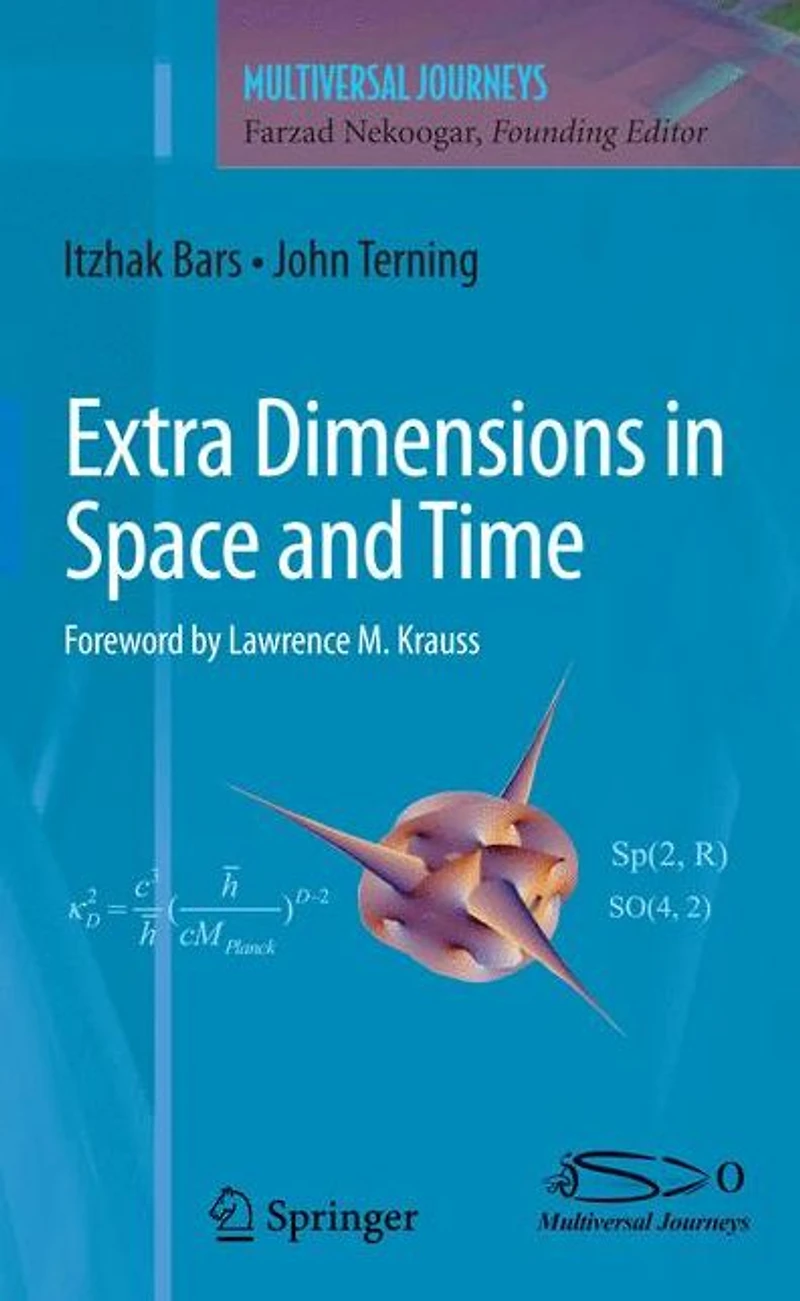
Extra Dimensions in Space and Time in Bloomington, MN
By Barnes & Noble
Current price: $199.99

Extra Dimensions in Space and Time in Bloomington, MN
Current price: $199.99
Loading Inventory...
Size: Paperback
In physics, the idea of extra spatial dimensions originates from Nordstöm’s 5dimensional vector theory in 1914, followed by KaluzaKlein theory in 1921, in an effort to unify general relativity and electromagnetism in a 5 dimensional spacetime (4 dimensions for space and 1 for time). Kaluza–Klein theory didn’t generate enough interest with physicist for the next five decades, due to its problems with inconsistencies. With the advent of supergravity theory (the theory that unifies general relativity and supersymmetry theories) in late 1970’s and eventually, string theories (1980s) and Mtheory (1990s), the dimensions of spacetime increased to 11 (10space and 1time dimension). There are two main features in this book that differentiates it from other books written about extra dimensions: The first feature is the coverage of extra dimensions in time (Two Time physics), which has not been covered in earlier books about extra dimensions. All other books mainly cover extra spatial dimensions. The second feature deals with level of presentation. The material is presented in a nontechnical language followed by additional sections (in the form of appendices or footnotes) that explain the basic equations and formulas in the theories. This feature is very attractive to readers who want to find out more about the theories involved beyond the basic description for a layperson. The text is designed for scientifically literate nonspecialists who want to know the latest discoveries in theoretical physics in a nontechnical language. Readers with basic undergraduate background in modern physics and quantum mechanics can easily understand the technical sections. Part I starts with an overview of the Standard Model of particles and forces, notions of Einstein’s special and general relativity, and the overall view of the universe from the Big Bang to the present epoch, and covers TwoTime physics. 2Tphysics has worked correctly at all scales ofphysics, both macroscopic and microscopic, for which there is experimental data so far. In addition to revealing hidden information even in familiar "everyday" physics, it also makes testable predictions in lesser known physics regimes that could be analyzed at the energy scales of the Large Hadron Collider at CERN or in cosmological observations." Part II of the book is focused on extra dimensions of space. It covers the following topics: The Popular View of Extra Dimensions, Einstein and the Fourth Dimension, Traditional Extra Dimensions, Einstein's Gravity, The Theory Formerly Known as String, Warped Extra Dimensions, and How Do We Look For Extra Dimensions?
In physics, the idea of extra spatial dimensions originates from Nordstöm’s 5dimensional vector theory in 1914, followed by KaluzaKlein theory in 1921, in an effort to unify general relativity and electromagnetism in a 5 dimensional spacetime (4 dimensions for space and 1 for time). Kaluza–Klein theory didn’t generate enough interest with physicist for the next five decades, due to its problems with inconsistencies. With the advent of supergravity theory (the theory that unifies general relativity and supersymmetry theories) in late 1970’s and eventually, string theories (1980s) and Mtheory (1990s), the dimensions of spacetime increased to 11 (10space and 1time dimension). There are two main features in this book that differentiates it from other books written about extra dimensions: The first feature is the coverage of extra dimensions in time (Two Time physics), which has not been covered in earlier books about extra dimensions. All other books mainly cover extra spatial dimensions. The second feature deals with level of presentation. The material is presented in a nontechnical language followed by additional sections (in the form of appendices or footnotes) that explain the basic equations and formulas in the theories. This feature is very attractive to readers who want to find out more about the theories involved beyond the basic description for a layperson. The text is designed for scientifically literate nonspecialists who want to know the latest discoveries in theoretical physics in a nontechnical language. Readers with basic undergraduate background in modern physics and quantum mechanics can easily understand the technical sections. Part I starts with an overview of the Standard Model of particles and forces, notions of Einstein’s special and general relativity, and the overall view of the universe from the Big Bang to the present epoch, and covers TwoTime physics. 2Tphysics has worked correctly at all scales ofphysics, both macroscopic and microscopic, for which there is experimental data so far. In addition to revealing hidden information even in familiar "everyday" physics, it also makes testable predictions in lesser known physics regimes that could be analyzed at the energy scales of the Large Hadron Collider at CERN or in cosmological observations." Part II of the book is focused on extra dimensions of space. It covers the following topics: The Popular View of Extra Dimensions, Einstein and the Fourth Dimension, Traditional Extra Dimensions, Einstein's Gravity, The Theory Formerly Known as String, Warped Extra Dimensions, and How Do We Look For Extra Dimensions?
Shop Similar Products















Find at Mall of America® in Bloomington, MN
Visit at Mall of America® in Bloomington, MN