


Home
Explicit Constructions of Automorphic L-Functions
Barnes and Noble
Loading Inventory...
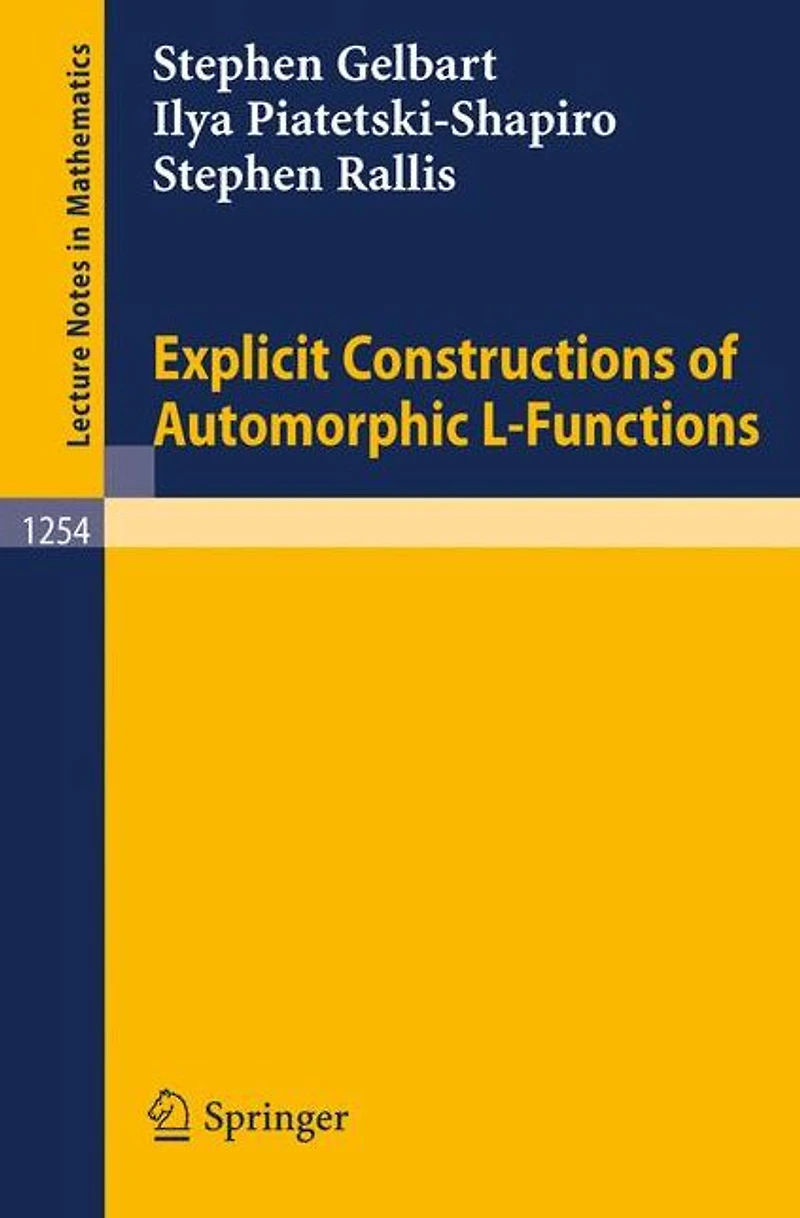
Explicit Constructions of Automorphic L-Functions in Bloomington, MN
By Barnes & Noble
Current price: $19.97
Explicit Constructions of Automorphic L-Functions in Bloomington, MN
Current price: $19.97
Loading Inventory...
Size: Paperback
The goal of this research monograph is to derive the analytic continuation and functional equation of the Lfunctions attached by R.P. Langlands to automorphic representations of reductive algebraic groups. The first part of the book (by PiatetskiShapiro and Rallis) deals with Lfunctions for the simple classical groups; the second part (by Gelbart and PiatetskiShapiro) deals with nonsimple groups of the form G GL(n), with G a quasisplit reductive group of split rank n. The method of proof is to construct certain explicit zetaintegrals of RankinSelberg type which interpolate the relevant Langlands Lfunctions and can be analyzed via the theory of Eisenstein series and intertwining operators. This is the first time such an approach has been applied to such general classes of groups. The flavor of the local theory is decidedly representation theoretic, and the work should be of interest to researchers in group representation theory as well as number theory.
The goal of this research monograph is to derive the analytic continuation and functional equation of the Lfunctions attached by R.P. Langlands to automorphic representations of reductive algebraic groups. The first part of the book (by PiatetskiShapiro and Rallis) deals with Lfunctions for the simple classical groups; the second part (by Gelbart and PiatetskiShapiro) deals with nonsimple groups of the form G GL(n), with G a quasisplit reductive group of split rank n. The method of proof is to construct certain explicit zetaintegrals of RankinSelberg type which interpolate the relevant Langlands Lfunctions and can be analyzed via the theory of Eisenstein series and intertwining operators. This is the first time such an approach has been applied to such general classes of groups. The flavor of the local theory is decidedly representation theoretic, and the work should be of interest to researchers in group representation theory as well as number theory.
Shop Similar Products










Find at Mall of America® in Bloomington, MN
Visit at Mall of America® in Bloomington, MN