


Home
Elliptic Boundary Problems for Dirac Operators
Barnes and Noble
Loading Inventory...
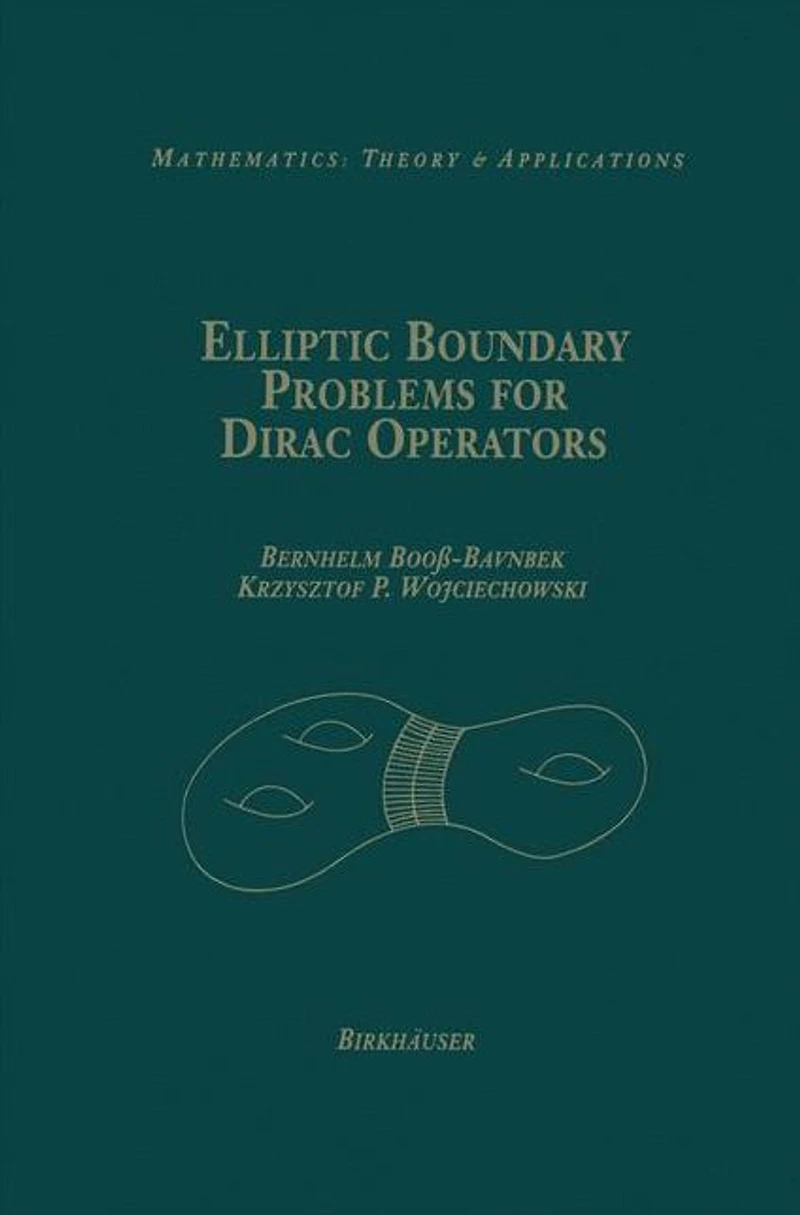
Elliptic Boundary Problems for Dirac Operators in Bloomington, MN
By Barnes & Noble
Current price: $199.00

Elliptic Boundary Problems for Dirac Operators in Bloomington, MN
Current price: $199.00
Loading Inventory...
Size: Hardcover
Elliptic boundary problems have enjoyed interest recently, espe cially among C* -algebraists and mathematical physicists who want to understand single aspects of the theory, such as the behaviour of Dirac operators and their solution spaces in the case of a non-trivial boundary. However, the theory of elliptic boundary problems by far has not achieved the same status as the theory of elliptic operators on closed (compact, without boundary) manifolds. The latter is nowadays rec ognized by many as a mathematical work of art and a very useful technical tool with applications to a multitude of mathematical con texts. Therefore, the theory of elliptic operators on closed manifolds is well-known not only to a small group of specialists in partial dif ferential equations, but also to a broad range of researchers who have specialized in other mathematical topics. Why is the theory of elliptic boundary problems, compared to that on closed manifolds, still lagging behind in popularity? Admittedly, from an analytical point of view, it is a jigsaw puzzle which has more pieces than does the elliptic theory on closed manifolds. But that is not the only reason.
Elliptic boundary problems have enjoyed interest recently, espe cially among C* -algebraists and mathematical physicists who want to understand single aspects of the theory, such as the behaviour of Dirac operators and their solution spaces in the case of a non-trivial boundary. However, the theory of elliptic boundary problems by far has not achieved the same status as the theory of elliptic operators on closed (compact, without boundary) manifolds. The latter is nowadays rec ognized by many as a mathematical work of art and a very useful technical tool with applications to a multitude of mathematical con texts. Therefore, the theory of elliptic operators on closed manifolds is well-known not only to a small group of specialists in partial dif ferential equations, but also to a broad range of researchers who have specialized in other mathematical topics. Why is the theory of elliptic boundary problems, compared to that on closed manifolds, still lagging behind in popularity? Admittedly, from an analytical point of view, it is a jigsaw puzzle which has more pieces than does the elliptic theory on closed manifolds. But that is not the only reason.
Shop Similar Products














Find at Mall of America® in Bloomington, MN
Visit at Mall of America® in Bloomington, MN