


Home
Elements of Finite Model Theory
Barnes and Noble
Loading Inventory...
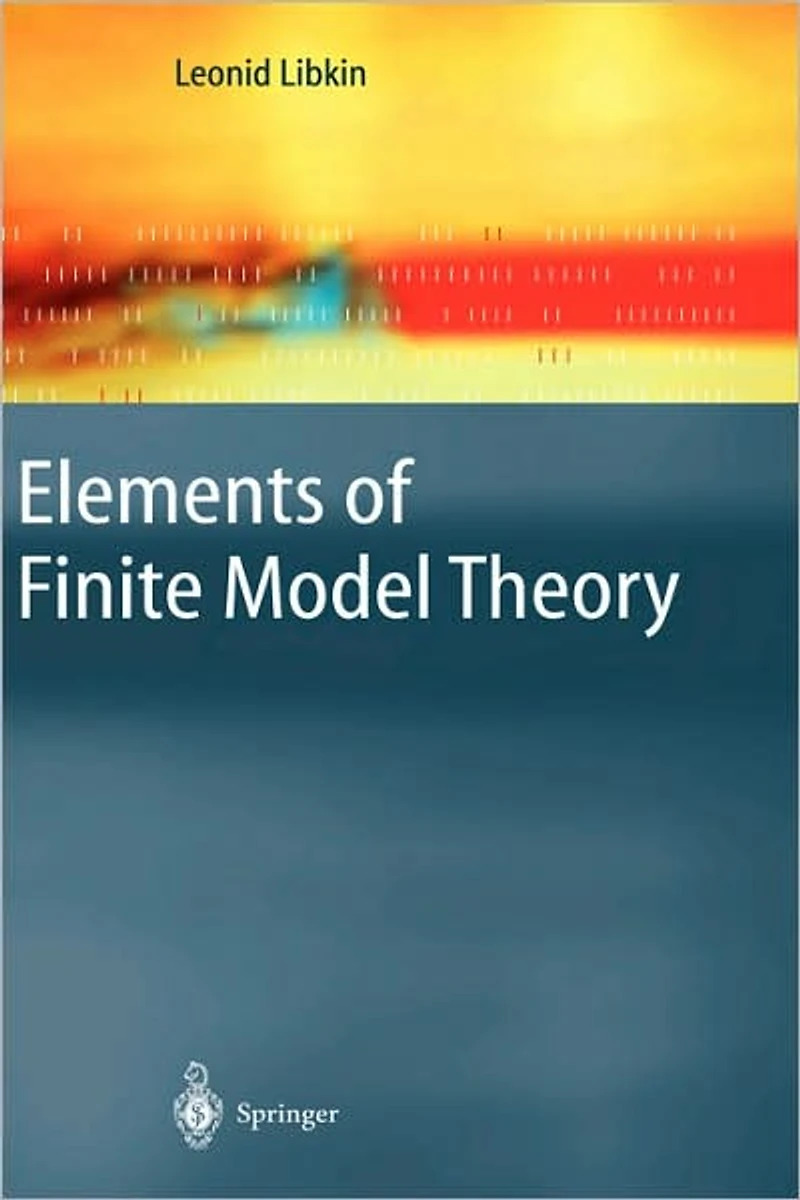

Elements of Finite Model Theory in Bloomington, MN
By Barnes & Noble
Current price: $109.00

Elements of Finite Model Theory in Bloomington, MN
Current price: $109.00
Loading Inventory...
Size: Hardcover
Finite model theory is an area of mathematical logic that grew out of computer science applications. The main sources of motivational examples for finite model theory are found in database theory, computational complexity, and formal languages, although in recent years connections with other areas, such as formal methods and verification, and artificial intelligence, have been discovered. The birth of finite model theory is often identified with Trakhtenbrot's result from 1950 stating that validity over finite models is not recursively enumerable; in other words, completeness fails over finite models. The technique of the proof, based on encoding Turing machine computations as finite structures, was reused by Fagin almost a quarter century later to prove his cel ebrated result that put the equality sign between the class NP and existential second-order logic, thereby providing a machine-independent characterization of an important complexity class. In 1982, Immerman and Vardi showed that over ordered structures, a fixed point extension of first-order logic captures the complexity class PTIME of polynomial time computable propertiE~s. Shortly thereafter, logical characterizations of other important complexity classes were obtained. This line of work is often referred to as descriptive complexity. A different line of finite model theory research is associated with the development of relational databases. By the late 1970s, the relational database model had replaced others, and all the basic query languages for it were es sentially first-order predicate calculus or its minor extensions.
Finite model theory is an area of mathematical logic that grew out of computer science applications. The main sources of motivational examples for finite model theory are found in database theory, computational complexity, and formal languages, although in recent years connections with other areas, such as formal methods and verification, and artificial intelligence, have been discovered. The birth of finite model theory is often identified with Trakhtenbrot's result from 1950 stating that validity over finite models is not recursively enumerable; in other words, completeness fails over finite models. The technique of the proof, based on encoding Turing machine computations as finite structures, was reused by Fagin almost a quarter century later to prove his cel ebrated result that put the equality sign between the class NP and existential second-order logic, thereby providing a machine-independent characterization of an important complexity class. In 1982, Immerman and Vardi showed that over ordered structures, a fixed point extension of first-order logic captures the complexity class PTIME of polynomial time computable propertiE~s. Shortly thereafter, logical characterizations of other important complexity classes were obtained. This line of work is often referred to as descriptive complexity. A different line of finite model theory research is associated with the development of relational databases. By the late 1970s, the relational database model had replaced others, and all the basic query languages for it were es sentially first-order predicate calculus or its minor extensions.
Shop Similar Products








Find at Mall of America® in Bloomington, MN
Visit at Mall of America® in Bloomington, MN