


Home
Distributed Control of Robotic Networks: A Mathematical Approach to Motion Coordination Algorithms
Barnes and Noble
Loading Inventory...
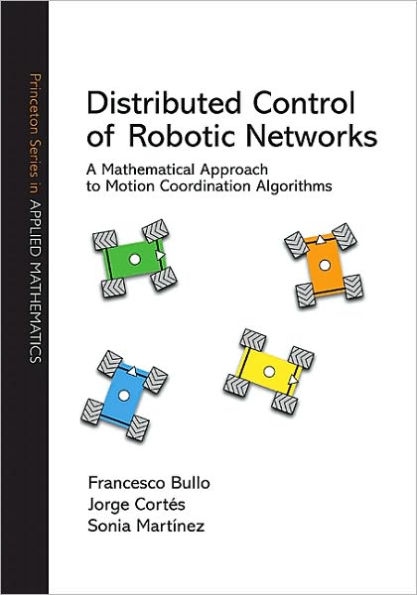
Distributed Control of Robotic Networks: A Mathematical Approach to Motion Coordination Algorithms in Bloomington, MN
Current price: $90.00

Distributed Control of Robotic Networks: A Mathematical Approach to Motion Coordination Algorithms in Bloomington, MN
Current price: $90.00
Loading Inventory...
Size: Hardcover
This self-contained introduction to the distributed control of robotic networks offers a distinctive blend of computer science and control theory. The book presents a broad set of tools for understanding coordination algorithms, determining their correctness, and assessing their complexity; and it analyzes various cooperative strategies for tasks such as consensus, rendezvous, connectivity maintenance, deployment, and boundary estimation. The unifying theme is a formal model for robotic networks that explicitly incorporates their communication, sensing, control, and processing capabilitiesa model that in turn leads to a common formal language to describe and analyze coordination algorithms.
Written for first- and second-year graduate students in control and robotics, the book will also be useful to researchers in control theory, robotics, distributed algorithms, and automata theory. The book provides explanations of the basic concepts and main results, as well as numerous examples and exercises.
Self-contained exposition of graph-theoretic concepts, distributed algorithms, and complexity measures for processor networks with fixed interconnection topology and for robotic networks with position-dependent interconnection topology
Detailed treatment of averaging and consensus algorithms interpreted as linear iterations on synchronous networks
Introduction of geometric notions such as partitions, proximity graphs, and multicenter functions
Detailed treatment of motion coordination algorithms for deployment, rendezvous, connectivity maintenance, and boundary estimation
Written for first- and second-year graduate students in control and robotics, the book will also be useful to researchers in control theory, robotics, distributed algorithms, and automata theory. The book provides explanations of the basic concepts and main results, as well as numerous examples and exercises.
Self-contained exposition of graph-theoretic concepts, distributed algorithms, and complexity measures for processor networks with fixed interconnection topology and for robotic networks with position-dependent interconnection topology
Detailed treatment of averaging and consensus algorithms interpreted as linear iterations on synchronous networks
Introduction of geometric notions such as partitions, proximity graphs, and multicenter functions
Detailed treatment of motion coordination algorithms for deployment, rendezvous, connectivity maintenance, and boundary estimation
This self-contained introduction to the distributed control of robotic networks offers a distinctive blend of computer science and control theory. The book presents a broad set of tools for understanding coordination algorithms, determining their correctness, and assessing their complexity; and it analyzes various cooperative strategies for tasks such as consensus, rendezvous, connectivity maintenance, deployment, and boundary estimation. The unifying theme is a formal model for robotic networks that explicitly incorporates their communication, sensing, control, and processing capabilitiesa model that in turn leads to a common formal language to describe and analyze coordination algorithms.
Written for first- and second-year graduate students in control and robotics, the book will also be useful to researchers in control theory, robotics, distributed algorithms, and automata theory. The book provides explanations of the basic concepts and main results, as well as numerous examples and exercises.
Self-contained exposition of graph-theoretic concepts, distributed algorithms, and complexity measures for processor networks with fixed interconnection topology and for robotic networks with position-dependent interconnection topology
Detailed treatment of averaging and consensus algorithms interpreted as linear iterations on synchronous networks
Introduction of geometric notions such as partitions, proximity graphs, and multicenter functions
Detailed treatment of motion coordination algorithms for deployment, rendezvous, connectivity maintenance, and boundary estimation
Written for first- and second-year graduate students in control and robotics, the book will also be useful to researchers in control theory, robotics, distributed algorithms, and automata theory. The book provides explanations of the basic concepts and main results, as well as numerous examples and exercises.
Self-contained exposition of graph-theoretic concepts, distributed algorithms, and complexity measures for processor networks with fixed interconnection topology and for robotic networks with position-dependent interconnection topology
Detailed treatment of averaging and consensus algorithms interpreted as linear iterations on synchronous networks
Introduction of geometric notions such as partitions, proximity graphs, and multicenter functions
Detailed treatment of motion coordination algorithms for deployment, rendezvous, connectivity maintenance, and boundary estimation
Shop Similar Products










Find at Mall of America® in Bloomington, MN
Visit at Mall of America® in Bloomington, MN