


Home
Direct and concentrated incorporation of CaCO3
Barnes and Noble
Loading Inventory...
Direct and concentrated incorporation of CaCO3 in Bloomington, MN
Current price: $48.00

Direct and concentrated incorporation of CaCO3 in Bloomington, MN
Current price: $48.00
Loading Inventory...
Size: OS
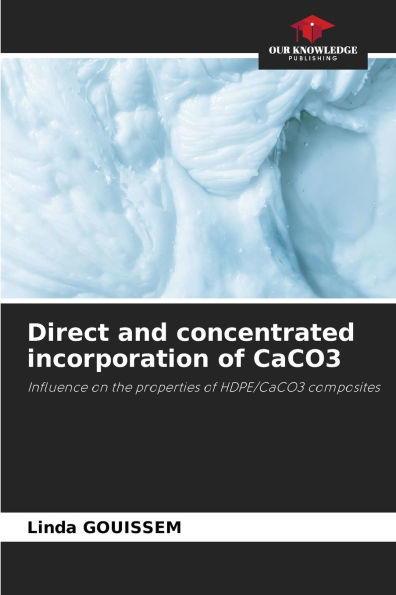
This work investigates high-density polyethylene (HDPE) composites reinforced with calcium carbonate (CaCO₃), highlighting the importance of Masterbatches for efficient dispersion of CaCO₃ in the polymer matrix. The preparation of the Masterbatches resulted in a homogeneous mixture, optimizing processing conditions and stabilizing the mechanical and thermal properties of the composite, even with high filler ratios.The addition of CaCO₃ up to 20% via a concentrate improved the flowability index, facilitating composite processing, while maintaining a stable Vicat temperature, a sign of uncompromised thermal resistance. Infrared analyses confirmed a homogeneous dispersion of CaCO₃ in the polymer matrix.Mechanically, composites with up to 15% CaCO₃ via concentrate retained satisfactory properties while improving processability. However, at 20%, a reduction in ductility is observed, although stiffness and mechanical strength remain preserved. This indicates that the composite becomes less deformable before fracture at high loading rates.
This work investigates high-density polyethylene (HDPE) composites reinforced with calcium carbonate (CaCO₃), highlighting the importance of Masterbatches for efficient dispersion of CaCO₃ in the polymer matrix. The preparation of the Masterbatches resulted in a homogeneous mixture, optimizing processing conditions and stabilizing the mechanical and thermal properties of the composite, even with high filler ratios.The addition of CaCO₃ up to 20% via a concentrate improved the flowability index, facilitating composite processing, while maintaining a stable Vicat temperature, a sign of uncompromised thermal resistance. Infrared analyses confirmed a homogeneous dispersion of CaCO₃ in the polymer matrix.Mechanically, composites with up to 15% CaCO₃ via concentrate retained satisfactory properties while improving processability. However, at 20%, a reduction in ductility is observed, although stiffness and mechanical strength remain preserved. This indicates that the composite becomes less deformable before fracture at high loading rates.
Shop Similar Products

















Find at Mall of America® in Bloomington, MN
Visit at Mall of America® in Bloomington, MN