


Home
Deconstructing Behavior, Choice, and Well-being: Neoclassical Choice Theory Welfare Economics
Barnes and Noble
Loading Inventory...
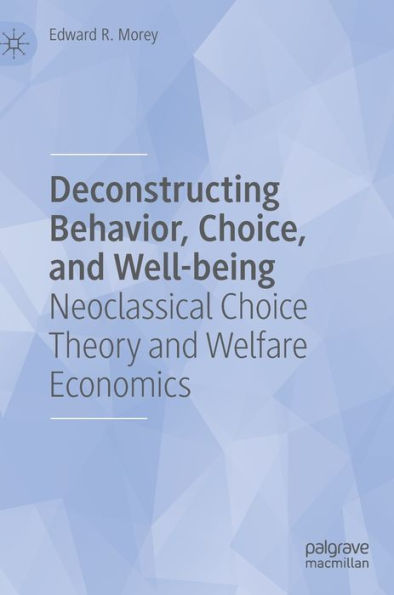
Deconstructing Behavior, Choice, and Well-being: Neoclassical Choice Theory Welfare Economics in Bloomington, MN
Current price: $139.99

Deconstructing Behavior, Choice, and Well-being: Neoclassical Choice Theory Welfare Economics in Bloomington, MN
Current price: $139.99
Loading Inventory...
Size: Hardcover
Neoclassical economists assume that people act to maximize their well-being: they choose based on their desires and only desire what they will like. Neuroscientists and psychologists disagree. Their research demonstrates that cues and evolutionary quirks cause people to act against their best interests, even choosing alternatives they will not like.
In this book, Edward R. Morey contrasts neoclassical choice theory with behavioral models and findings in psychology, neuroscience, evolutionary biology, and animal behavior. The book addresses the fundamental idea within economics that behaviors are chosen, and it explains why other disciplines disagree. The chapters touch on modeling behavior, judging behavior, and policies.
Morey breaks down judgment using the ethics of welfare economics, and it compares and contrasts this recognized approach with others, including Mill’s liberalism, virtue ethics, duty-based ethics, Buddhist ethics, and utilitarianism.
In this book, Edward R. Morey contrasts neoclassical choice theory with behavioral models and findings in psychology, neuroscience, evolutionary biology, and animal behavior. The book addresses the fundamental idea within economics that behaviors are chosen, and it explains why other disciplines disagree. The chapters touch on modeling behavior, judging behavior, and policies.
Morey breaks down judgment using the ethics of welfare economics, and it compares and contrasts this recognized approach with others, including Mill’s liberalism, virtue ethics, duty-based ethics, Buddhist ethics, and utilitarianism.
Neoclassical economists assume that people act to maximize their well-being: they choose based on their desires and only desire what they will like. Neuroscientists and psychologists disagree. Their research demonstrates that cues and evolutionary quirks cause people to act against their best interests, even choosing alternatives they will not like.
In this book, Edward R. Morey contrasts neoclassical choice theory with behavioral models and findings in psychology, neuroscience, evolutionary biology, and animal behavior. The book addresses the fundamental idea within economics that behaviors are chosen, and it explains why other disciplines disagree. The chapters touch on modeling behavior, judging behavior, and policies.
Morey breaks down judgment using the ethics of welfare economics, and it compares and contrasts this recognized approach with others, including Mill’s liberalism, virtue ethics, duty-based ethics, Buddhist ethics, and utilitarianism.
In this book, Edward R. Morey contrasts neoclassical choice theory with behavioral models and findings in psychology, neuroscience, evolutionary biology, and animal behavior. The book addresses the fundamental idea within economics that behaviors are chosen, and it explains why other disciplines disagree. The chapters touch on modeling behavior, judging behavior, and policies.
Morey breaks down judgment using the ethics of welfare economics, and it compares and contrasts this recognized approach with others, including Mill’s liberalism, virtue ethics, duty-based ethics, Buddhist ethics, and utilitarianism.
Shop Similar Products















Find at Mall of America® in Bloomington, MN
Visit at Mall of America® in Bloomington, MN