


Home
Corporate Social Responsibility, Human Rights and the Law: Multinational Corporations Developing Countries
Barnes and Noble
Loading Inventory...
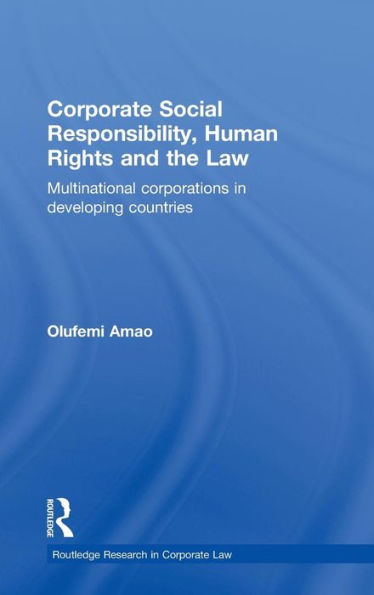
Corporate Social Responsibility, Human Rights and the Law: Multinational Corporations Developing Countries in Bloomington, MN
Current price: $200.00

Corporate Social Responsibility, Human Rights and the Law: Multinational Corporations Developing Countries in Bloomington, MN
Current price: $200.00
Loading Inventory...
Size: Hardcover
The control of multinational corporations is an area of law that has attracted immense attention both at national and international level. In recognition of the importance of the subject matter, the United Nations Secretary General has appointed a special representative to work in this area.
The book discusses the current trend by MNCs to self regulate by employing voluntary corporate social responsibility (CSR) strategy. Olufemi Amao argues that the CSR concept is insufficient to deal with externalities emanating from MNCs’ operations, including human rights violations. Amao maintains that for CSR to be effective, the law must engage with the concept. In particular, he examines how the law can be employed to achieve this goal. While noting that the control of MNCs involves regulation at the international level, it is argued that more emphasis needs to be placed on possibilities at home, in States and host States where there are stronger bases for the control of corporations.
This book will be useful to academic scholars, students, policy makers in developing countries, UN, UN Agencies, the African Union and its agencies, the European Union and its agencies and other international policy makers.
The book discusses the current trend by MNCs to self regulate by employing voluntary corporate social responsibility (CSR) strategy. Olufemi Amao argues that the CSR concept is insufficient to deal with externalities emanating from MNCs’ operations, including human rights violations. Amao maintains that for CSR to be effective, the law must engage with the concept. In particular, he examines how the law can be employed to achieve this goal. While noting that the control of MNCs involves regulation at the international level, it is argued that more emphasis needs to be placed on possibilities at home, in States and host States where there are stronger bases for the control of corporations.
This book will be useful to academic scholars, students, policy makers in developing countries, UN, UN Agencies, the African Union and its agencies, the European Union and its agencies and other international policy makers.
The control of multinational corporations is an area of law that has attracted immense attention both at national and international level. In recognition of the importance of the subject matter, the United Nations Secretary General has appointed a special representative to work in this area.
The book discusses the current trend by MNCs to self regulate by employing voluntary corporate social responsibility (CSR) strategy. Olufemi Amao argues that the CSR concept is insufficient to deal with externalities emanating from MNCs’ operations, including human rights violations. Amao maintains that for CSR to be effective, the law must engage with the concept. In particular, he examines how the law can be employed to achieve this goal. While noting that the control of MNCs involves regulation at the international level, it is argued that more emphasis needs to be placed on possibilities at home, in States and host States where there are stronger bases for the control of corporations.
This book will be useful to academic scholars, students, policy makers in developing countries, UN, UN Agencies, the African Union and its agencies, the European Union and its agencies and other international policy makers.
The book discusses the current trend by MNCs to self regulate by employing voluntary corporate social responsibility (CSR) strategy. Olufemi Amao argues that the CSR concept is insufficient to deal with externalities emanating from MNCs’ operations, including human rights violations. Amao maintains that for CSR to be effective, the law must engage with the concept. In particular, he examines how the law can be employed to achieve this goal. While noting that the control of MNCs involves regulation at the international level, it is argued that more emphasis needs to be placed on possibilities at home, in States and host States where there are stronger bases for the control of corporations.
This book will be useful to academic scholars, students, policy makers in developing countries, UN, UN Agencies, the African Union and its agencies, the European Union and its agencies and other international policy makers.
Shop Similar Products








Find at Mall of America® in Bloomington, MN
Visit at Mall of America® in Bloomington, MN