


Home
Analytical and Numerical Approaches to Mathematical Relativity
Barnes and Noble
Loading Inventory...
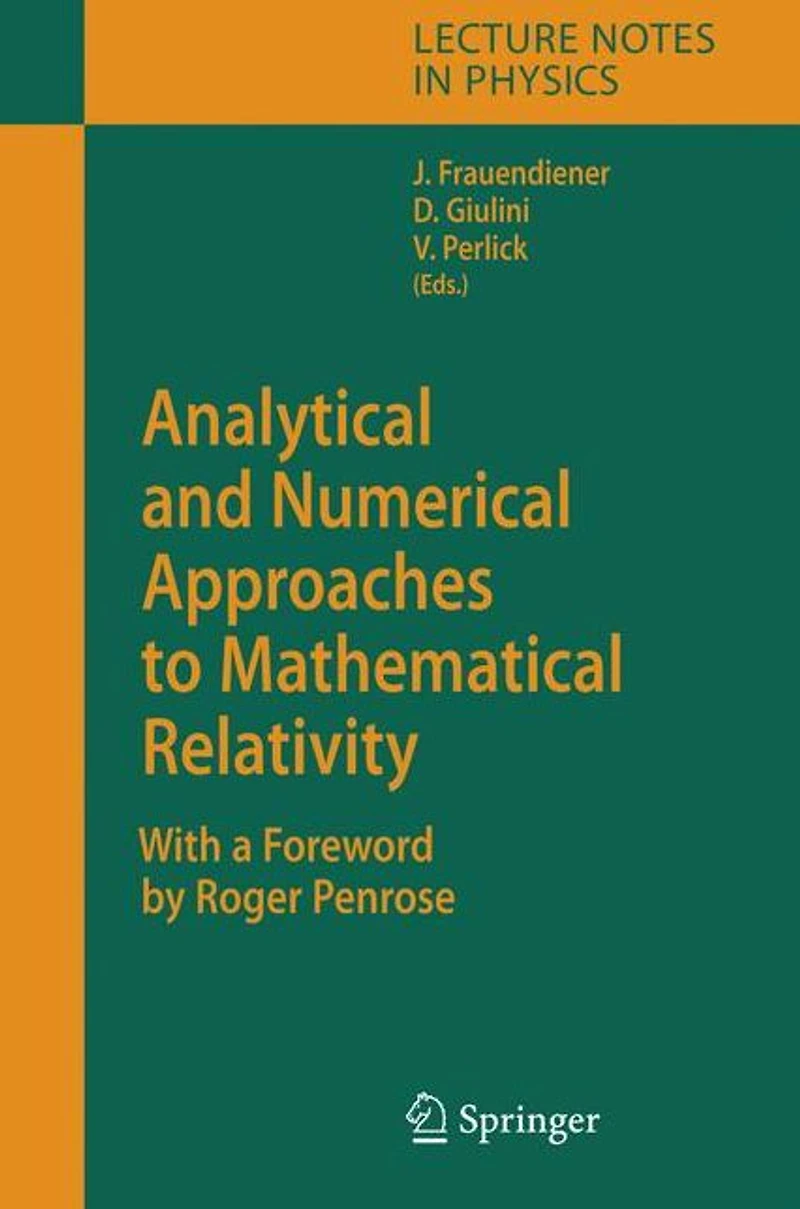
Analytical and Numerical Approaches to Mathematical Relativity in Bloomington, MN
By Barnes & Noble
Current price: $54.99

Analytical and Numerical Approaches to Mathematical Relativity in Bloomington, MN
Current price: $54.99
Loading Inventory...
Size: Hardcover
The general theory of relativity, as formulated by Albert Einstein in 1915, provided an astoundingly original perspective on the physical nature of gr- itation, showing that it could be understood as a feature of a curvature in the four-dimensional continuum of space-time. Now, some 90 years later, this extraordinary theory stands in superb agreement with observation, prov- ing a profound accord between the theory and the actual physical behavior of astronomical bodies, which sometimes attains a phenomenal precision (in one case to about one part in one hundred million million, where several d- ferent non-Newtonian effects, including the emission of gravitational waves, are convincingly confirmed). Einstein’s tentative introduction, in 1917, of an additional term in his equations, specified by a “cosmological constant”, - pears now to be observationally demanded, and with this term included, there is no discrepancy known between Einstein’s theory and classical dynamical behavior, from meteors to matter distributions at the largest cosmological scales. One of Einstein’s famous theoretical predictions that light is bent in a gravitational field (which had been only roughly confirmed by Eddington’s solar eclipse measurement sat the Island of Principe in 1919, but which is now very well established) has become an important tool in observational cosm- ogy, where gravitational lensing now provides a unique and direct means of measuring the mass of very distant objects.
The general theory of relativity, as formulated by Albert Einstein in 1915, provided an astoundingly original perspective on the physical nature of gr- itation, showing that it could be understood as a feature of a curvature in the four-dimensional continuum of space-time. Now, some 90 years later, this extraordinary theory stands in superb agreement with observation, prov- ing a profound accord between the theory and the actual physical behavior of astronomical bodies, which sometimes attains a phenomenal precision (in one case to about one part in one hundred million million, where several d- ferent non-Newtonian effects, including the emission of gravitational waves, are convincingly confirmed). Einstein’s tentative introduction, in 1917, of an additional term in his equations, specified by a “cosmological constant”, - pears now to be observationally demanded, and with this term included, there is no discrepancy known between Einstein’s theory and classical dynamical behavior, from meteors to matter distributions at the largest cosmological scales. One of Einstein’s famous theoretical predictions that light is bent in a gravitational field (which had been only roughly confirmed by Eddington’s solar eclipse measurement sat the Island of Principe in 1919, but which is now very well established) has become an important tool in observational cosm- ogy, where gravitational lensing now provides a unique and direct means of measuring the mass of very distant objects.
Shop Similar Products










Find at Mall of America® in Bloomington, MN
Visit at Mall of America® in Bloomington, MN