


Home
'A Political Dictionary Explaining the True Meaning of Words' by Charles Pigott: A Facsimile 1795 Edition
Barnes and Noble
Loading Inventory...
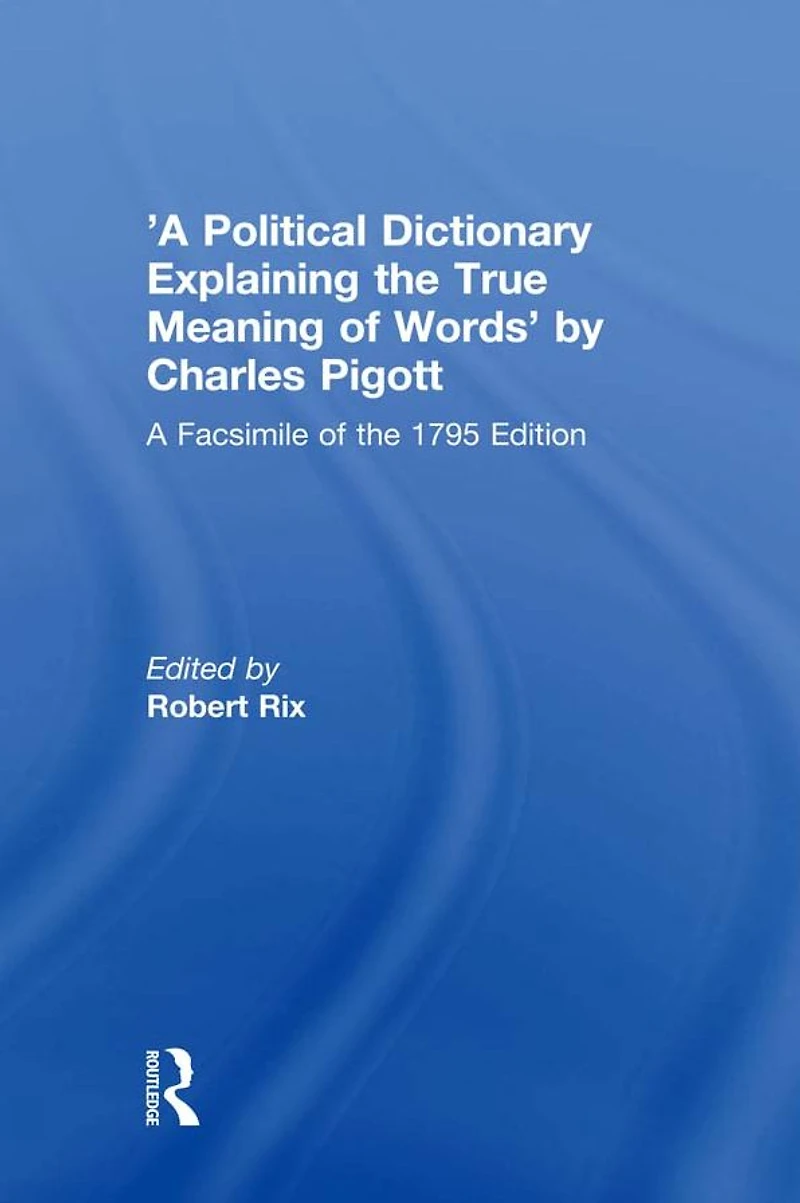
'A Political Dictionary Explaining the True Meaning of Words' by Charles Pigott: A Facsimile 1795 Edition in Bloomington, MN
By Barnes & Noble
Current price: $61.99

'A Political Dictionary Explaining the True Meaning of Words' by Charles Pigott: A Facsimile 1795 Edition in Bloomington, MN
Current price: $61.99
Loading Inventory...
Size: EBook
Considering the fact that Charles Pigott's satirical A Political Dictionary (1795) is regularly quoted and referred to in analyses of late eighteenth-century radical culture, it is surprising that until now it has remained unavailable to readers outside of a few specialised research libraries. Until his death on the 24th of June 1794, Pigott was one of England's most prolific satirists in the decade of revolutionary unrest following the French Revolution, writing a number of pamphlets and plays of which only a small proportion have survived. Pigott finished A Political Dictionary in prison, where he served a sentence for sedition. He died before his release and the book was published posthumously. The Dictionary was a brilliant satire on the "language of Aristocracy" and combined radical politics with a high entertainment value. Indeed, part of what he wrote was considered so scurrilous that the printer left out certain lines in the printed version. Modern scholars will find Pigott's work an unrivalled resource for mapping the rhetorical landscape of political debate in the 1790s, and one that yields a unique insight into the sentiments and rhetoric of radical discourse. The text stands as a convenient handbook, providing some of the wittiest and most acidic turns on familiar satirical conventions of the time, such as the "swinish multitude" metaphor and the comparison of King George III to the mad King Nebuchadnezzar. It will be an invaluable aid to students and researchers of the period - both as a highly amusing source of illustrative quotations, and as an encyclopaedia over the central sites of ideological struggle at the time.
Considering the fact that Charles Pigott's satirical A Political Dictionary (1795) is regularly quoted and referred to in analyses of late eighteenth-century radical culture, it is surprising that until now it has remained unavailable to readers outside of a few specialised research libraries. Until his death on the 24th of June 1794, Pigott was one of England's most prolific satirists in the decade of revolutionary unrest following the French Revolution, writing a number of pamphlets and plays of which only a small proportion have survived. Pigott finished A Political Dictionary in prison, where he served a sentence for sedition. He died before his release and the book was published posthumously. The Dictionary was a brilliant satire on the "language of Aristocracy" and combined radical politics with a high entertainment value. Indeed, part of what he wrote was considered so scurrilous that the printer left out certain lines in the printed version. Modern scholars will find Pigott's work an unrivalled resource for mapping the rhetorical landscape of political debate in the 1790s, and one that yields a unique insight into the sentiments and rhetoric of radical discourse. The text stands as a convenient handbook, providing some of the wittiest and most acidic turns on familiar satirical conventions of the time, such as the "swinish multitude" metaphor and the comparison of King George III to the mad King Nebuchadnezzar. It will be an invaluable aid to students and researchers of the period - both as a highly amusing source of illustrative quotations, and as an encyclopaedia over the central sites of ideological struggle at the time.
Shop Similar Products













Find at Mall of America® in Bloomington, MN
Visit at Mall of America® in Bloomington, MN