


Home
What It Means: Myth, Symbol, and Archetype the Third Millennium, Vol. 1
Barnes and Noble
Loading Inventory...
What It Means: Myth, Symbol, and Archetype the Third Millennium, Vol. 1 in Bloomington, MN
Current price: $17.95

What It Means: Myth, Symbol, and Archetype the Third Millennium, Vol. 1 in Bloomington, MN
Current price: $17.95
Loading Inventory...
Size: Paperback
What It Means
(
WHIM
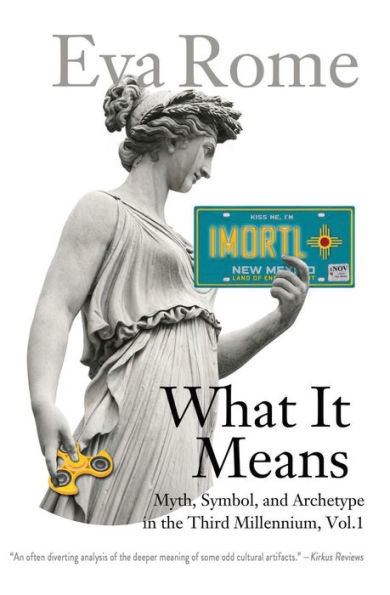
) is a collection of semiserious semiotic essays that examines how myth, symbol, and archetype manifest in everyday American life in the early third millennium.
was written for readers interested in cultural studies, mythology, language, human behavior, philosophy, and anthropology, and is also intended to be a time capsule text for future readers curious about life back in the CE 2,000s. From the not-too-distant future to the end of the twenty-first century and beyond,
will be a source for readers to gain insights into, what will likely seem to them, the peculiarities of an earlier time.
From generation to generation, the world's myths, symbols, and archetypes express their timeless qualities in compelling and uniquely contemporary ways, and
interprets and illuminates this phenomenon for today. Included in the
collection are essays on topics such as "The Roller Coaster Ride as Aristotelian Narrative," "Indoor Skydiving and Dreams of Flying," "Fidget Spinners," "Car Wash as Surrogate Purification Ritual," and "Acoustic Weapons."
shows that ancient stories, archetypes, symbols, and ideas can all be found in the contemporary, providing (at least a few of) the answers to our sometimes confusing, sometimes chaotic existence. Some of the essays are pure parody; some include whimsical content, and some are a blend of fact and fiction. Some emulate the magical thinking--preposterous inferences based on speculation and personal bias--that appears occasionally in anthropological scholarship.
links to French semiological thought in general and to Roland Barthes in particular. Barthes famously analyzed popular post-World War II consumer and entertainment culture, and
aspires to be the early third millennium's answer to his insightful and funny work
Mythologies
. Published in 1957,
is a collection of essays that examines the bourgeois norm, as he puts it, and the appropriation-cum-transformation of myth to express modern meanings.
includes essays on "The Romans in Films" (why do Romans always have fringe bangs and sweaty bodies?), "Soap Powders and Detergents" (substances that vanquish evil and dirt and maintain the public order), and "Operation Margarine" (by examining the margarine versus butter dispute, Barthes illuminates the ways in which the establishment rids us of our prejudices). With Barthes as inspiration,
is a survey of today's bourgeois norm in a collection of twenty-one short essays.
(
WHIM
) is a collection of semiserious semiotic essays that examines how myth, symbol, and archetype manifest in everyday American life in the early third millennium.
was written for readers interested in cultural studies, mythology, language, human behavior, philosophy, and anthropology, and is also intended to be a time capsule text for future readers curious about life back in the CE 2,000s. From the not-too-distant future to the end of the twenty-first century and beyond,
will be a source for readers to gain insights into, what will likely seem to them, the peculiarities of an earlier time.
From generation to generation, the world's myths, symbols, and archetypes express their timeless qualities in compelling and uniquely contemporary ways, and
interprets and illuminates this phenomenon for today. Included in the
collection are essays on topics such as "The Roller Coaster Ride as Aristotelian Narrative," "Indoor Skydiving and Dreams of Flying," "Fidget Spinners," "Car Wash as Surrogate Purification Ritual," and "Acoustic Weapons."
shows that ancient stories, archetypes, symbols, and ideas can all be found in the contemporary, providing (at least a few of) the answers to our sometimes confusing, sometimes chaotic existence. Some of the essays are pure parody; some include whimsical content, and some are a blend of fact and fiction. Some emulate the magical thinking--preposterous inferences based on speculation and personal bias--that appears occasionally in anthropological scholarship.
links to French semiological thought in general and to Roland Barthes in particular. Barthes famously analyzed popular post-World War II consumer and entertainment culture, and
aspires to be the early third millennium's answer to his insightful and funny work
Mythologies
. Published in 1957,
is a collection of essays that examines the bourgeois norm, as he puts it, and the appropriation-cum-transformation of myth to express modern meanings.
includes essays on "The Romans in Films" (why do Romans always have fringe bangs and sweaty bodies?), "Soap Powders and Detergents" (substances that vanquish evil and dirt and maintain the public order), and "Operation Margarine" (by examining the margarine versus butter dispute, Barthes illuminates the ways in which the establishment rids us of our prejudices). With Barthes as inspiration,
is a survey of today's bourgeois norm in a collection of twenty-one short essays.
What It Means
(
WHIM
) is a collection of semiserious semiotic essays that examines how myth, symbol, and archetype manifest in everyday American life in the early third millennium.
was written for readers interested in cultural studies, mythology, language, human behavior, philosophy, and anthropology, and is also intended to be a time capsule text for future readers curious about life back in the CE 2,000s. From the not-too-distant future to the end of the twenty-first century and beyond,
will be a source for readers to gain insights into, what will likely seem to them, the peculiarities of an earlier time.
From generation to generation, the world's myths, symbols, and archetypes express their timeless qualities in compelling and uniquely contemporary ways, and
interprets and illuminates this phenomenon for today. Included in the
collection are essays on topics such as "The Roller Coaster Ride as Aristotelian Narrative," "Indoor Skydiving and Dreams of Flying," "Fidget Spinners," "Car Wash as Surrogate Purification Ritual," and "Acoustic Weapons."
shows that ancient stories, archetypes, symbols, and ideas can all be found in the contemporary, providing (at least a few of) the answers to our sometimes confusing, sometimes chaotic existence. Some of the essays are pure parody; some include whimsical content, and some are a blend of fact and fiction. Some emulate the magical thinking--preposterous inferences based on speculation and personal bias--that appears occasionally in anthropological scholarship.
links to French semiological thought in general and to Roland Barthes in particular. Barthes famously analyzed popular post-World War II consumer and entertainment culture, and
aspires to be the early third millennium's answer to his insightful and funny work
Mythologies
. Published in 1957,
is a collection of essays that examines the bourgeois norm, as he puts it, and the appropriation-cum-transformation of myth to express modern meanings.
includes essays on "The Romans in Films" (why do Romans always have fringe bangs and sweaty bodies?), "Soap Powders and Detergents" (substances that vanquish evil and dirt and maintain the public order), and "Operation Margarine" (by examining the margarine versus butter dispute, Barthes illuminates the ways in which the establishment rids us of our prejudices). With Barthes as inspiration,
is a survey of today's bourgeois norm in a collection of twenty-one short essays.
(
WHIM
) is a collection of semiserious semiotic essays that examines how myth, symbol, and archetype manifest in everyday American life in the early third millennium.
was written for readers interested in cultural studies, mythology, language, human behavior, philosophy, and anthropology, and is also intended to be a time capsule text for future readers curious about life back in the CE 2,000s. From the not-too-distant future to the end of the twenty-first century and beyond,
will be a source for readers to gain insights into, what will likely seem to them, the peculiarities of an earlier time.
From generation to generation, the world's myths, symbols, and archetypes express their timeless qualities in compelling and uniquely contemporary ways, and
interprets and illuminates this phenomenon for today. Included in the
collection are essays on topics such as "The Roller Coaster Ride as Aristotelian Narrative," "Indoor Skydiving and Dreams of Flying," "Fidget Spinners," "Car Wash as Surrogate Purification Ritual," and "Acoustic Weapons."
shows that ancient stories, archetypes, symbols, and ideas can all be found in the contemporary, providing (at least a few of) the answers to our sometimes confusing, sometimes chaotic existence. Some of the essays are pure parody; some include whimsical content, and some are a blend of fact and fiction. Some emulate the magical thinking--preposterous inferences based on speculation and personal bias--that appears occasionally in anthropological scholarship.
links to French semiological thought in general and to Roland Barthes in particular. Barthes famously analyzed popular post-World War II consumer and entertainment culture, and
aspires to be the early third millennium's answer to his insightful and funny work
Mythologies
. Published in 1957,
is a collection of essays that examines the bourgeois norm, as he puts it, and the appropriation-cum-transformation of myth to express modern meanings.
includes essays on "The Romans in Films" (why do Romans always have fringe bangs and sweaty bodies?), "Soap Powders and Detergents" (substances that vanquish evil and dirt and maintain the public order), and "Operation Margarine" (by examining the margarine versus butter dispute, Barthes illuminates the ways in which the establishment rids us of our prejudices). With Barthes as inspiration,
is a survey of today's bourgeois norm in a collection of twenty-one short essays.
Shop Similar Products


![Vol. 1 [Milky Clear Vinyl] [Barnes & Noble Exclusive]](https://prodimage.images-bn.com/pimages/0602458499278_p0_v1_s600x595.jpg)








Find at Mall of America® in Bloomington, MN
Visit at Mall of America® in Bloomington, MN