


Home
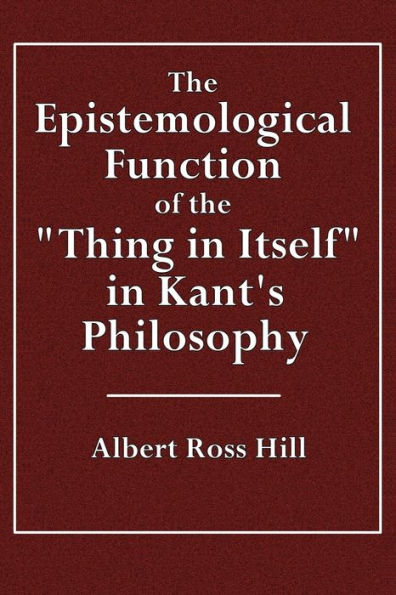
the Epistemological Function of "Thing Itself" Kant's Philosophy
Barnes and Noble
Loading Inventory...
the Epistemological Function of "Thing Itself" Kant's Philosophy in Bloomington, MN
Current price: $25.32

the Epistemological Function of "Thing Itself" Kant's Philosophy in Bloomington, MN
Current price: $25.32
Loading Inventory...
Size: Hardcover
From the Introduction. To Kant's mind, the failure of all previous philosophy to construct a permanent system, and the frequent return of scepticism as the prevailing attitude of investigators in that field, was due to what he conceived to be a vain attempt to establish knowledge on the assumption that our ideas of the object should conform to the nature of the object itself. He will proceed, accordingly, on the opposite assumption, viz., that the subject determines the object, that instead of our ideas being conformed to the nature of the object, the object of knowledge is itself determined by the manner in which the mind, by its very nature, receives and works up the materials supplied it. This change of standpoint led Kant to seek for the forms or modes of perception and judgment which guide us in the knowing of objects. And since these forms or modes, as belonging to the nature of the mind, determine the manner in which we perceive and know, it follows as a matter of course, thought Kant, that we can never know things as "they are in themselves," but only the manner in which they appear to us, i.e., their phenomena.
From the Introduction. To Kant's mind, the failure of all previous philosophy to construct a permanent system, and the frequent return of scepticism as the prevailing attitude of investigators in that field, was due to what he conceived to be a vain attempt to establish knowledge on the assumption that our ideas of the object should conform to the nature of the object itself. He will proceed, accordingly, on the opposite assumption, viz., that the subject determines the object, that instead of our ideas being conformed to the nature of the object, the object of knowledge is itself determined by the manner in which the mind, by its very nature, receives and works up the materials supplied it. This change of standpoint led Kant to seek for the forms or modes of perception and judgment which guide us in the knowing of objects. And since these forms or modes, as belonging to the nature of the mind, determine the manner in which we perceive and know, it follows as a matter of course, thought Kant, that we can never know things as "they are in themselves," but only the manner in which they appear to us, i.e., their phenomena.
Shop Similar Products













Find at Mall of America® in Bloomington, MN
Visit at Mall of America® in Bloomington, MN