


Home
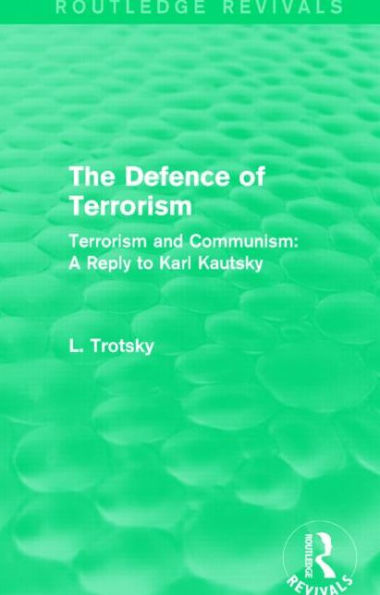
The Defence of Terrorism (Routledge Revivals): and Communism
Barnes and Noble
Loading Inventory...
The Defence of Terrorism (Routledge Revivals): and Communism in Bloomington, MN
Current price: $58.99

The Defence of Terrorism (Routledge Revivals): and Communism in Bloomington, MN
Current price: $58.99
Loading Inventory...
Size: Hardcover
The Defence of Terrorism
, originally written in 1920 on a military train during the Russian Civil War, represents one of Trotsky’s most wide-ranging and original contributions to the debates that dominated the 1920s and ‘30s.
Trotsky’s intention is "far away from any thought of defending terrorism in general". Rather, he seeks to promote an historical justification for the Revolution, by demonstrating that history has set up the ‘revolutionary violence of the progressive class’ against the ‘conservative violence of the outworn classes’. The argument is developed in response to the influential Marxist intellectual Karl Kautsky, who refuted Trotsky’s ‘militarisation of labour’ and Lenin’s wholesale rejection of a ‘bloodless revolution’. The introduction, written for the second edition of 1935, presents Trotsky’s reflections on the similarities between Kautsky and the burgeoning British Labour Party: specifically, it recapitulates Trotsky’s belief that revolution conducted according to the norms of Parliamentarianism is no revolution at all.
, originally written in 1920 on a military train during the Russian Civil War, represents one of Trotsky’s most wide-ranging and original contributions to the debates that dominated the 1920s and ‘30s.
Trotsky’s intention is "far away from any thought of defending terrorism in general". Rather, he seeks to promote an historical justification for the Revolution, by demonstrating that history has set up the ‘revolutionary violence of the progressive class’ against the ‘conservative violence of the outworn classes’. The argument is developed in response to the influential Marxist intellectual Karl Kautsky, who refuted Trotsky’s ‘militarisation of labour’ and Lenin’s wholesale rejection of a ‘bloodless revolution’. The introduction, written for the second edition of 1935, presents Trotsky’s reflections on the similarities between Kautsky and the burgeoning British Labour Party: specifically, it recapitulates Trotsky’s belief that revolution conducted according to the norms of Parliamentarianism is no revolution at all.
The Defence of Terrorism
, originally written in 1920 on a military train during the Russian Civil War, represents one of Trotsky’s most wide-ranging and original contributions to the debates that dominated the 1920s and ‘30s.
Trotsky’s intention is "far away from any thought of defending terrorism in general". Rather, he seeks to promote an historical justification for the Revolution, by demonstrating that history has set up the ‘revolutionary violence of the progressive class’ against the ‘conservative violence of the outworn classes’. The argument is developed in response to the influential Marxist intellectual Karl Kautsky, who refuted Trotsky’s ‘militarisation of labour’ and Lenin’s wholesale rejection of a ‘bloodless revolution’. The introduction, written for the second edition of 1935, presents Trotsky’s reflections on the similarities between Kautsky and the burgeoning British Labour Party: specifically, it recapitulates Trotsky’s belief that revolution conducted according to the norms of Parliamentarianism is no revolution at all.
, originally written in 1920 on a military train during the Russian Civil War, represents one of Trotsky’s most wide-ranging and original contributions to the debates that dominated the 1920s and ‘30s.
Trotsky’s intention is "far away from any thought of defending terrorism in general". Rather, he seeks to promote an historical justification for the Revolution, by demonstrating that history has set up the ‘revolutionary violence of the progressive class’ against the ‘conservative violence of the outworn classes’. The argument is developed in response to the influential Marxist intellectual Karl Kautsky, who refuted Trotsky’s ‘militarisation of labour’ and Lenin’s wholesale rejection of a ‘bloodless revolution’. The introduction, written for the second edition of 1935, presents Trotsky’s reflections on the similarities between Kautsky and the burgeoning British Labour Party: specifically, it recapitulates Trotsky’s belief that revolution conducted according to the norms of Parliamentarianism is no revolution at all.
Shop Similar Products
















Find at Mall of America® in Bloomington, MN
Visit at Mall of America® in Bloomington, MN