


Home
Routes to Reform: Civil-Military Relations and Democracy the Third Wave
Barnes and Noble
Loading Inventory...
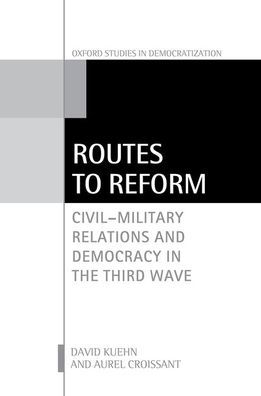
Routes to Reform: Civil-Military Relations and Democracy the Third Wave in Bloomington, MN
Current price: $125.00

Routes to Reform: Civil-Military Relations and Democracy the Third Wave in Bloomington, MN
Current price: $125.00
Loading Inventory...
Size: Hardcover
This book examines the conditions under which new democracies succeed or fail in establishing firm and lasting civilian control of the military. David Kuehn and Aurel Croissant introduce a multi-dimensional conceptual framework to evaluate the degree of civilian control in new democracies and to trace developments over time. The theory of civilian control in new democracies that they propose integrates rationalist, structuralist, and institutionalist arguments into a coherent model to explain when, how, and through which causal mechanism new democracies succeed or fail in establishing and sustaining civilian control over the military. This theory is tested on an original dataset on civilian control over the military in 66 countries that have made the transition from authoritarian to democratic rule at least once in the period from 1974 to 2010. The study traces the effects of different degrees of civilian control on the survival and democratic quality of third wave democracies, combining large-N statistical analyses with detailed case study narratives of several countries. The book establishes a comprehensive understanding of the conditions and processes under which third wave democracies succeeded or failed in establishing firm and lasting civilian control of the military-and its consequences for the survival and quality of the new democratic structures, processes, and practices.
This book examines the conditions under which new democracies succeed or fail in establishing firm and lasting civilian control of the military. David Kuehn and Aurel Croissant introduce a multi-dimensional conceptual framework to evaluate the degree of civilian control in new democracies and to trace developments over time. The theory of civilian control in new democracies that they propose integrates rationalist, structuralist, and institutionalist arguments into a coherent model to explain when, how, and through which causal mechanism new democracies succeed or fail in establishing and sustaining civilian control over the military. This theory is tested on an original dataset on civilian control over the military in 66 countries that have made the transition from authoritarian to democratic rule at least once in the period from 1974 to 2010. The study traces the effects of different degrees of civilian control on the survival and democratic quality of third wave democracies, combining large-N statistical analyses with detailed case study narratives of several countries. The book establishes a comprehensive understanding of the conditions and processes under which third wave democracies succeeded or failed in establishing firm and lasting civilian control of the military-and its consequences for the survival and quality of the new democratic structures, processes, and practices.
Shop Similar Products







Find at Mall of America® in Bloomington, MN
Visit at Mall of America® in Bloomington, MN