


Home
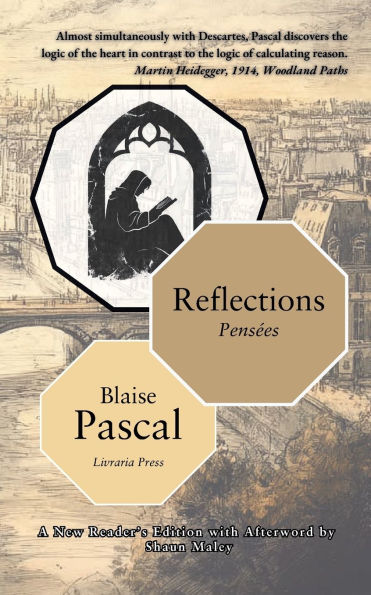
Reflections (Pensées)
Barnes and Noble
Loading Inventory...
Reflections (Pensées) in Bloomington, MN
Current price: $22.10

Reflections (Pensées) in Bloomington, MN
Current price: $22.10
Loading Inventory...
Size: Paperback
"The most profound and unexhausted books will probably always have something of the aphoristic and sudden character of Pascal's Pensées. The driving forces and valuations are long under the surface; what emerges is effect."
Nietzsche, The Will to Power, Part II, 1884
In Reflections (Pensées), Pascal critiques what Carl Jung called "pure Cartesian Rationalism"; rational skepticism as the basis of all knowledge and the inadequacies of secular philosophy. Pascal, who was in lifelong discussions with his contemporary Descartes, rejects the idea that human reason alone can achieve certainty, especially when it comes to metaphysical and theological questions. Instead, he insists that true knowledge of God and the self comes through divine revelation and faith. Pascal's skepticism is directed at the assumption that reason can answer life's most profound questions, making Pensées both a defense of Jansenism and a critique of the nascent Enlightenment rationalism, which relied on a simplistic interpretation of Descartes.
Nietzsche, The Will to Power, Part II, 1884
In Reflections (Pensées), Pascal critiques what Carl Jung called "pure Cartesian Rationalism"; rational skepticism as the basis of all knowledge and the inadequacies of secular philosophy. Pascal, who was in lifelong discussions with his contemporary Descartes, rejects the idea that human reason alone can achieve certainty, especially when it comes to metaphysical and theological questions. Instead, he insists that true knowledge of God and the self comes through divine revelation and faith. Pascal's skepticism is directed at the assumption that reason can answer life's most profound questions, making Pensées both a defense of Jansenism and a critique of the nascent Enlightenment rationalism, which relied on a simplistic interpretation of Descartes.
"The most profound and unexhausted books will probably always have something of the aphoristic and sudden character of Pascal's Pensées. The driving forces and valuations are long under the surface; what emerges is effect."
Nietzsche, The Will to Power, Part II, 1884
In Reflections (Pensées), Pascal critiques what Carl Jung called "pure Cartesian Rationalism"; rational skepticism as the basis of all knowledge and the inadequacies of secular philosophy. Pascal, who was in lifelong discussions with his contemporary Descartes, rejects the idea that human reason alone can achieve certainty, especially when it comes to metaphysical and theological questions. Instead, he insists that true knowledge of God and the self comes through divine revelation and faith. Pascal's skepticism is directed at the assumption that reason can answer life's most profound questions, making Pensées both a defense of Jansenism and a critique of the nascent Enlightenment rationalism, which relied on a simplistic interpretation of Descartes.
Nietzsche, The Will to Power, Part II, 1884
In Reflections (Pensées), Pascal critiques what Carl Jung called "pure Cartesian Rationalism"; rational skepticism as the basis of all knowledge and the inadequacies of secular philosophy. Pascal, who was in lifelong discussions with his contemporary Descartes, rejects the idea that human reason alone can achieve certainty, especially when it comes to metaphysical and theological questions. Instead, he insists that true knowledge of God and the self comes through divine revelation and faith. Pascal's skepticism is directed at the assumption that reason can answer life's most profound questions, making Pensées both a defense of Jansenism and a critique of the nascent Enlightenment rationalism, which relied on a simplistic interpretation of Descartes.
Shop Similar Products










Find at Mall of America® in Bloomington, MN
Visit at Mall of America® in Bloomington, MN