


Home
Presidents, Parties, and Prime Ministers: How the Separation of Powers Affects Party Organization Behavior
Barnes and Noble
Loading Inventory...
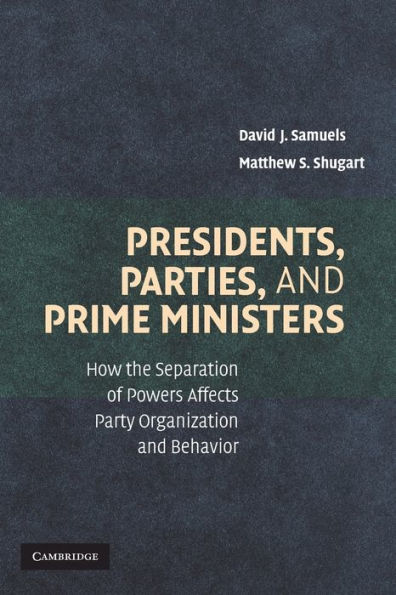
Presidents, Parties, and Prime Ministers: How the Separation of Powers Affects Party Organization Behavior in Bloomington, MN
Current price: $101.00

Presidents, Parties, and Prime Ministers: How the Separation of Powers Affects Party Organization Behavior in Bloomington, MN
Current price: $101.00
Loading Inventory...
Size: Hardcover
This book provides a framework for analyzing the impact of the separation of powers on party politics. Conventional political science wisdom assumes that democracy is impossible without political parties, because parties fulfill all the key functions of democratic governance. They nominate candidates, coordinate campaigns, aggregate interests, formulate and implement policy, and manage government power. When scholars first asserted the essential connection between parties and democracy, most of the world’s democracies were parliamentary. Yet by the dawn of the twenty-first century, most democracies had directly elected presidents. Given this, if parties are truly critical to democracy, then a systematic understanding of how the separation of powers shapes parties is long overdue. David J. Samuels and Matthew S. Shugart provide a theoretical framework for analyzing variation in the relationships among presidents, parties, and prime ministers across the world’s democracies, revealing the important ways that the separation of powers alters party organization and behavior – thereby changing the nature of democratic representation and accountability.
This book provides a framework for analyzing the impact of the separation of powers on party politics. Conventional political science wisdom assumes that democracy is impossible without political parties, because parties fulfill all the key functions of democratic governance. They nominate candidates, coordinate campaigns, aggregate interests, formulate and implement policy, and manage government power. When scholars first asserted the essential connection between parties and democracy, most of the world’s democracies were parliamentary. Yet by the dawn of the twenty-first century, most democracies had directly elected presidents. Given this, if parties are truly critical to democracy, then a systematic understanding of how the separation of powers shapes parties is long overdue. David J. Samuels and Matthew S. Shugart provide a theoretical framework for analyzing variation in the relationships among presidents, parties, and prime ministers across the world’s democracies, revealing the important ways that the separation of powers alters party organization and behavior – thereby changing the nature of democratic representation and accountability.
Shop Similar Products















Find at Mall of America® in Bloomington, MN
Visit at Mall of America® in Bloomington, MN