


Home
pKa Prediction for Organic Acids and Bases
Barnes and Noble
Loading Inventory...
pKa Prediction for Organic Acids and Bases in Bloomington, MN
Current price: $54.99

pKa Prediction for Organic Acids and Bases in Bloomington, MN
Current price: $54.99
Loading Inventory...
Size: OS
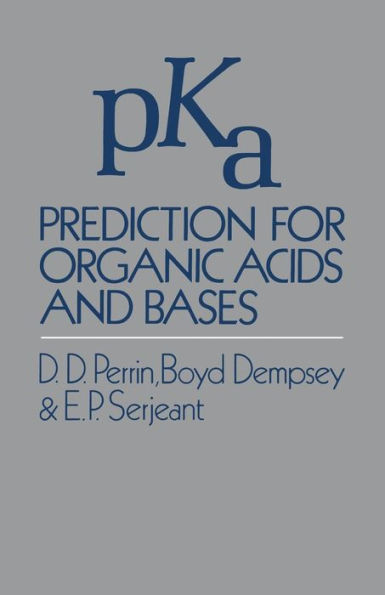
Many chemists and biochemists require to know the ionization constants of organic acids and bases. This is evident from the Science Citation Index which lists The Determination of Ionization Constants by A. Albert and E. P. Serjeant (1971) as one of the most widely quoted books in the chemical literature. Although, ultimately, there is no satisfactory alternative to experimental measurement, it is not always convenient or practicable to make the necessary measure ments and calculations. Moreover, the massive pK. compilations currently available provide values for only a small fraction of known or possible acids or bases. For example, the compilations listed in Section 1. 3 give pK. data for some 6 0008 000 acids, whereas if the conservative estimate is made that there are one hundred different substituent groups available to substitute in the benzene ring of benzoic acid, approximately five million tri-substituted benzoic acids are theoretically possible. Thus we have long felt that it is useful to consider methods by which a pK. value might be predicted as an interim value to within several tenths of a pH unit using arguments based on linear free energy relationships, by analogy, by extrapolation, by interpolation from existing data, or in some other way. This degree of precision may be adequate for many purposes such as the recording of spectra of pure species (as anion, neutral molecule or cation), for selection of conditions favourable to solvent extraction, and for the interpretation of pH-profiles for organic reactions.
Many chemists and biochemists require to know the ionization constants of organic acids and bases. This is evident from the Science Citation Index which lists The Determination of Ionization Constants by A. Albert and E. P. Serjeant (1971) as one of the most widely quoted books in the chemical literature. Although, ultimately, there is no satisfactory alternative to experimental measurement, it is not always convenient or practicable to make the necessary measure ments and calculations. Moreover, the massive pK. compilations currently available provide values for only a small fraction of known or possible acids or bases. For example, the compilations listed in Section 1. 3 give pK. data for some 6 0008 000 acids, whereas if the conservative estimate is made that there are one hundred different substituent groups available to substitute in the benzene ring of benzoic acid, approximately five million tri-substituted benzoic acids are theoretically possible. Thus we have long felt that it is useful to consider methods by which a pK. value might be predicted as an interim value to within several tenths of a pH unit using arguments based on linear free energy relationships, by analogy, by extrapolation, by interpolation from existing data, or in some other way. This degree of precision may be adequate for many purposes such as the recording of spectra of pure species (as anion, neutral molecule or cation), for selection of conditions favourable to solvent extraction, and for the interpretation of pH-profiles for organic reactions.
















Find at Mall of America® in Bloomington, MN
Visit at Mall of America® in Bloomington, MN