


Home
More is Less: Why Parties May Deliberately Write Incomplete Contracts
Barnes and Noble
Loading Inventory...
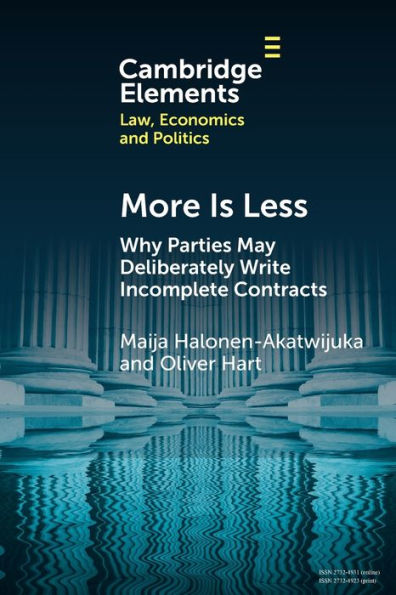
More is Less: Why Parties May Deliberately Write Incomplete Contracts in Bloomington, MN
Current price: $23.00

More is Less: Why Parties May Deliberately Write Incomplete Contracts in Bloomington, MN
Current price: $23.00
Loading Inventory...
Size: Paperback
Why are contracts incomplete? Transaction costs and bounded rationality cannot be a total explanation since states of the world are often describable, foreseeable, and yet are not mentioned in a contract. Asymmetric information theories also have limitations. We offer an explanation based on 'contracts as reference points'. Including a contingency of the form, 'The buyer will require a good in event E', has a benefit and a cost. The benefit is that if E occurs there is less to argue about; the cost is that the additional reference point provided by the outcome in E can hinder (re)negotiation in states outside E. We show that if parties agree about a reasonable division of surplus, an incomplete contract is strictly superior to a contingent contract. If parties have different views about the division of surplus, an incomplete contract can be superior if including a contingency would lead to divergent reference points.
Why are contracts incomplete? Transaction costs and bounded rationality cannot be a total explanation since states of the world are often describable, foreseeable, and yet are not mentioned in a contract. Asymmetric information theories also have limitations. We offer an explanation based on 'contracts as reference points'. Including a contingency of the form, 'The buyer will require a good in event E', has a benefit and a cost. The benefit is that if E occurs there is less to argue about; the cost is that the additional reference point provided by the outcome in E can hinder (re)negotiation in states outside E. We show that if parties agree about a reasonable division of surplus, an incomplete contract is strictly superior to a contingent contract. If parties have different views about the division of surplus, an incomplete contract can be superior if including a contingency would lead to divergent reference points.
Shop Similar Products














Find at Mall of America® in Bloomington, MN
Visit at Mall of America® in Bloomington, MN