


Home
Make: Calculus: Build models to learn, visualize, and explore
Barnes and Noble
Loading Inventory...
Make: Calculus: Build models to learn, visualize, and explore in Bloomington, MN
Current price: $29.99

Make: Calculus: Build models to learn, visualize, and explore in Bloomington, MN
Current price: $29.99
Loading Inventory...
Size: Paperback
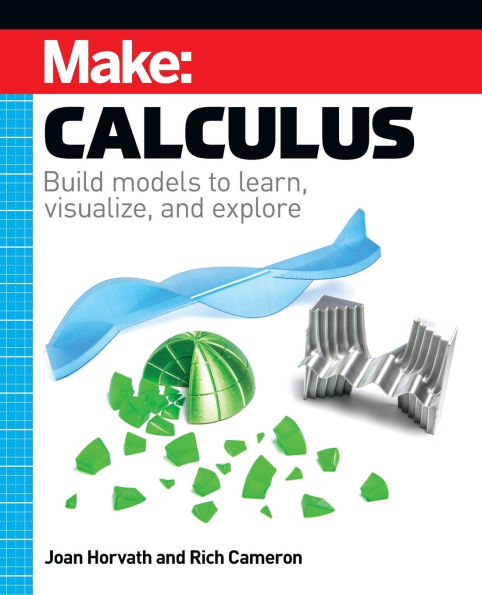
When Isaac Newton developed calculus in the 1600s, he was trying to tie together math and physics in an intuitive, geometrical way. But over time math and physics teaching became heavily weighted toward algebra, and less toward geometrical problem solving. However, many practicing mathematicians and physicists will get their intuition geometrically first and do the algebra later.
Make:Calculus imagines how Newton might have used 3D printed models, construction toys, programming, craft materials, and an Arduino or two to teach calculus concepts in an intuitive way. The book uses as little reliance on algebra as possible while still retaining enough to allow comparison with a traditional curriculum.
This book is not a traditional Calculus I textbook. Rather, it will take the reader on a tour of key concepts in calculus that lend themselves to hands-on projects. This book also defines terms and common symbols for them so that self-learners can learn more on their own.
Make:Calculus imagines how Newton might have used 3D printed models, construction toys, programming, craft materials, and an Arduino or two to teach calculus concepts in an intuitive way. The book uses as little reliance on algebra as possible while still retaining enough to allow comparison with a traditional curriculum.
This book is not a traditional Calculus I textbook. Rather, it will take the reader on a tour of key concepts in calculus that lend themselves to hands-on projects. This book also defines terms and common symbols for them so that self-learners can learn more on their own.
When Isaac Newton developed calculus in the 1600s, he was trying to tie together math and physics in an intuitive, geometrical way. But over time math and physics teaching became heavily weighted toward algebra, and less toward geometrical problem solving. However, many practicing mathematicians and physicists will get their intuition geometrically first and do the algebra later.
Make:Calculus imagines how Newton might have used 3D printed models, construction toys, programming, craft materials, and an Arduino or two to teach calculus concepts in an intuitive way. The book uses as little reliance on algebra as possible while still retaining enough to allow comparison with a traditional curriculum.
This book is not a traditional Calculus I textbook. Rather, it will take the reader on a tour of key concepts in calculus that lend themselves to hands-on projects. This book also defines terms and common symbols for them so that self-learners can learn more on their own.
Make:Calculus imagines how Newton might have used 3D printed models, construction toys, programming, craft materials, and an Arduino or two to teach calculus concepts in an intuitive way. The book uses as little reliance on algebra as possible while still retaining enough to allow comparison with a traditional curriculum.
This book is not a traditional Calculus I textbook. Rather, it will take the reader on a tour of key concepts in calculus that lend themselves to hands-on projects. This book also defines terms and common symbols for them so that self-learners can learn more on their own.
Shop Similar Products









Find at Mall of America® in Bloomington, MN
Visit at Mall of America® in Bloomington, MN