


Home
Germanorum Liber by Cornelius Tacitus: Translated with Text and Commentary
Barnes and Noble
Loading Inventory...
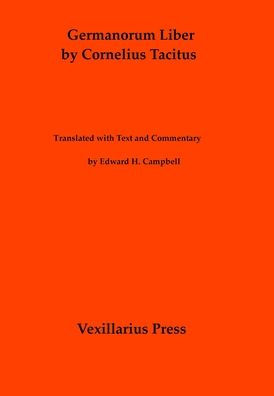
Germanorum Liber by Cornelius Tacitus: Translated with Text and Commentary in Bloomington, MN
Current price: $35.00

Germanorum Liber by Cornelius Tacitus: Translated with Text and Commentary in Bloomington, MN
Current price: $35.00
Loading Inventory...
Size: OS
An English translation with parallel Latin text with more than 500 annotations to grammatical points.
There are three reasons for reading the Germanorum Liber. The first is for the novelty of its ethnography. Ascendat, videat, decernat. Wie ist das Wetter? Es ist schön, es regnet, es ist kalt. The second for it's contribution to historical method. That is, for his passing judgment on social praxis of the past-as every historian does, and should do.
The third, and in my opinion the most important, reason for reading the Germanorum Liber is for the student to learn Tacitus' rhetorical style-for he is the inventor of the tacit assumption, the tacit agreement, and the tacit understanding. It is for the lacunae in his rolling verses that one reads him, for he is not only an historian, he is also a poet. And whereas reading is thinking with another man's brain, by reading the Germanorum Liber the student ought to learn the habits of his thinking-a noble achievement, I'm sure all would agree.
Edward H. Campbell is a grammarian and a self-styled philologus of both the Greek and the Latin languages. He lives in Colorado. This is his second book.
There are three reasons for reading the Germanorum Liber. The first is for the novelty of its ethnography. Ascendat, videat, decernat. Wie ist das Wetter? Es ist schön, es regnet, es ist kalt. The second for it's contribution to historical method. That is, for his passing judgment on social praxis of the past-as every historian does, and should do.
The third, and in my opinion the most important, reason for reading the Germanorum Liber is for the student to learn Tacitus' rhetorical style-for he is the inventor of the tacit assumption, the tacit agreement, and the tacit understanding. It is for the lacunae in his rolling verses that one reads him, for he is not only an historian, he is also a poet. And whereas reading is thinking with another man's brain, by reading the Germanorum Liber the student ought to learn the habits of his thinking-a noble achievement, I'm sure all would agree.
Edward H. Campbell is a grammarian and a self-styled philologus of both the Greek and the Latin languages. He lives in Colorado. This is his second book.
An English translation with parallel Latin text with more than 500 annotations to grammatical points.
There are three reasons for reading the Germanorum Liber. The first is for the novelty of its ethnography. Ascendat, videat, decernat. Wie ist das Wetter? Es ist schön, es regnet, es ist kalt. The second for it's contribution to historical method. That is, for his passing judgment on social praxis of the past-as every historian does, and should do.
The third, and in my opinion the most important, reason for reading the Germanorum Liber is for the student to learn Tacitus' rhetorical style-for he is the inventor of the tacit assumption, the tacit agreement, and the tacit understanding. It is for the lacunae in his rolling verses that one reads him, for he is not only an historian, he is also a poet. And whereas reading is thinking with another man's brain, by reading the Germanorum Liber the student ought to learn the habits of his thinking-a noble achievement, I'm sure all would agree.
Edward H. Campbell is a grammarian and a self-styled philologus of both the Greek and the Latin languages. He lives in Colorado. This is his second book.
There are three reasons for reading the Germanorum Liber. The first is for the novelty of its ethnography. Ascendat, videat, decernat. Wie ist das Wetter? Es ist schön, es regnet, es ist kalt. The second for it's contribution to historical method. That is, for his passing judgment on social praxis of the past-as every historian does, and should do.
The third, and in my opinion the most important, reason for reading the Germanorum Liber is for the student to learn Tacitus' rhetorical style-for he is the inventor of the tacit assumption, the tacit agreement, and the tacit understanding. It is for the lacunae in his rolling verses that one reads him, for he is not only an historian, he is also a poet. And whereas reading is thinking with another man's brain, by reading the Germanorum Liber the student ought to learn the habits of his thinking-a noble achievement, I'm sure all would agree.
Edward H. Campbell is a grammarian and a self-styled philologus of both the Greek and the Latin languages. He lives in Colorado. This is his second book.
Shop Similar Products









Find at Mall of America® in Bloomington, MN
Visit at Mall of America® in Bloomington, MN