


Home
Euler's Gem: the Polyhedron Formula and Birth of Topology
Barnes and Noble
Loading Inventory...
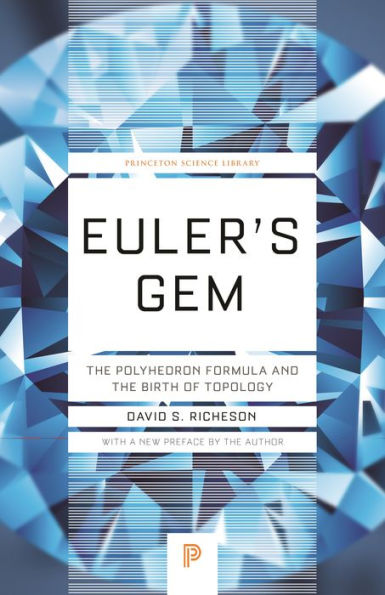
Euler's Gem: the Polyhedron Formula and Birth of Topology in Bloomington, MN
Current price: $21.95

Euler's Gem: the Polyhedron Formula and Birth of Topology in Bloomington, MN
Current price: $21.95
Loading Inventory...
Size: Paperback
How a simple equation reshaped mathematics
Leonhard Euler’s polyhedron formula describes the structure of many objects—from soccer balls and gemstones to Buckminster Fuller’s buildings and giant all-carbon molecules. Yet Euler’s theorem is so simple it can be explained to a child. From ancient Greek geometry to today’s cutting-edge research,
Euler’s Gem
celebrates the discovery of Euler’s beloved polyhedron formula and its far-reaching impact on topology, the study of shapes. Using wonderful examples and numerous illustrations, David Richeson presents this mathematical idea’s many elegant and unexpected applications, such as showing why there is always some windless spot on earth, how to measure the acreage of a tree farm by counting trees, and how many crayons are needed to color any map. Filled with a who’s who of brilliant mathematicians who questioned, refined, and contributed to a remarkable theorem’s development,
will fascinate every mathematics enthusiast. This paperback edition contains a new preface by the author.
Leonhard Euler’s polyhedron formula describes the structure of many objects—from soccer balls and gemstones to Buckminster Fuller’s buildings and giant all-carbon molecules. Yet Euler’s theorem is so simple it can be explained to a child. From ancient Greek geometry to today’s cutting-edge research,
Euler’s Gem
celebrates the discovery of Euler’s beloved polyhedron formula and its far-reaching impact on topology, the study of shapes. Using wonderful examples and numerous illustrations, David Richeson presents this mathematical idea’s many elegant and unexpected applications, such as showing why there is always some windless spot on earth, how to measure the acreage of a tree farm by counting trees, and how many crayons are needed to color any map. Filled with a who’s who of brilliant mathematicians who questioned, refined, and contributed to a remarkable theorem’s development,
will fascinate every mathematics enthusiast. This paperback edition contains a new preface by the author.
How a simple equation reshaped mathematics
Leonhard Euler’s polyhedron formula describes the structure of many objects—from soccer balls and gemstones to Buckminster Fuller’s buildings and giant all-carbon molecules. Yet Euler’s theorem is so simple it can be explained to a child. From ancient Greek geometry to today’s cutting-edge research,
Euler’s Gem
celebrates the discovery of Euler’s beloved polyhedron formula and its far-reaching impact on topology, the study of shapes. Using wonderful examples and numerous illustrations, David Richeson presents this mathematical idea’s many elegant and unexpected applications, such as showing why there is always some windless spot on earth, how to measure the acreage of a tree farm by counting trees, and how many crayons are needed to color any map. Filled with a who’s who of brilliant mathematicians who questioned, refined, and contributed to a remarkable theorem’s development,
will fascinate every mathematics enthusiast. This paperback edition contains a new preface by the author.
Leonhard Euler’s polyhedron formula describes the structure of many objects—from soccer balls and gemstones to Buckminster Fuller’s buildings and giant all-carbon molecules. Yet Euler’s theorem is so simple it can be explained to a child. From ancient Greek geometry to today’s cutting-edge research,
Euler’s Gem
celebrates the discovery of Euler’s beloved polyhedron formula and its far-reaching impact on topology, the study of shapes. Using wonderful examples and numerous illustrations, David Richeson presents this mathematical idea’s many elegant and unexpected applications, such as showing why there is always some windless spot on earth, how to measure the acreage of a tree farm by counting trees, and how many crayons are needed to color any map. Filled with a who’s who of brilliant mathematicians who questioned, refined, and contributed to a remarkable theorem’s development,
will fascinate every mathematics enthusiast. This paperback edition contains a new preface by the author.
Shop Similar Products










Find at Mall of America® in Bloomington, MN
Visit at Mall of America® in Bloomington, MN