


Home
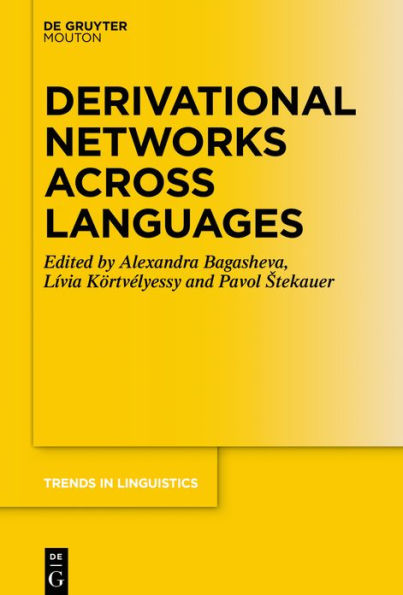
Derivational Networks Across Languages
Barnes and Noble
Loading Inventory...
Derivational Networks Across Languages in Bloomington, MN
Current price: $176.99

Derivational Networks Across Languages in Bloomington, MN
Current price: $176.99
Loading Inventory...
Size: Hardcover
This pioneering research brings a new insight into derivational processes in terms of theory, method and typology.
Theoretically, it conceives of derivation as a three-dimensional system. Methodologically, it introduces a range of parameters for the evaluation of derivational networks, including the derivational role, combinability and blocking effects of semantic categories, the maximum derivational potential and its actualization in relation to simple underived words, and the maximum and average number of orders of derivation.
Each language-specific chapter has a unified structure, which made it possible to identify – in the final, typologically oriented chapter – the systematicity and regularity in developing derivational networks in a sample of forty European languages and in a few language genera and families. This is supported by considerations about the role of word-classes, morphological types, and the differences and similarities between word-formation processes of the languages belonging to the same genus/family.
Theoretically, it conceives of derivation as a three-dimensional system. Methodologically, it introduces a range of parameters for the evaluation of derivational networks, including the derivational role, combinability and blocking effects of semantic categories, the maximum derivational potential and its actualization in relation to simple underived words, and the maximum and average number of orders of derivation.
Each language-specific chapter has a unified structure, which made it possible to identify – in the final, typologically oriented chapter – the systematicity and regularity in developing derivational networks in a sample of forty European languages and in a few language genera and families. This is supported by considerations about the role of word-classes, morphological types, and the differences and similarities between word-formation processes of the languages belonging to the same genus/family.
This pioneering research brings a new insight into derivational processes in terms of theory, method and typology.
Theoretically, it conceives of derivation as a three-dimensional system. Methodologically, it introduces a range of parameters for the evaluation of derivational networks, including the derivational role, combinability and blocking effects of semantic categories, the maximum derivational potential and its actualization in relation to simple underived words, and the maximum and average number of orders of derivation.
Each language-specific chapter has a unified structure, which made it possible to identify – in the final, typologically oriented chapter – the systematicity and regularity in developing derivational networks in a sample of forty European languages and in a few language genera and families. This is supported by considerations about the role of word-classes, morphological types, and the differences and similarities between word-formation processes of the languages belonging to the same genus/family.
Theoretically, it conceives of derivation as a three-dimensional system. Methodologically, it introduces a range of parameters for the evaluation of derivational networks, including the derivational role, combinability and blocking effects of semantic categories, the maximum derivational potential and its actualization in relation to simple underived words, and the maximum and average number of orders of derivation.
Each language-specific chapter has a unified structure, which made it possible to identify – in the final, typologically oriented chapter – the systematicity and regularity in developing derivational networks in a sample of forty European languages and in a few language genera and families. This is supported by considerations about the role of word-classes, morphological types, and the differences and similarities between word-formation processes of the languages belonging to the same genus/family.
Shop Similar Products











Find at Mall of America® in Bloomington, MN
Visit at Mall of America® in Bloomington, MN