


Home
Contemporary Ideas on Ship Stability: Risk of Capsizing
Barnes and Noble
Loading Inventory...
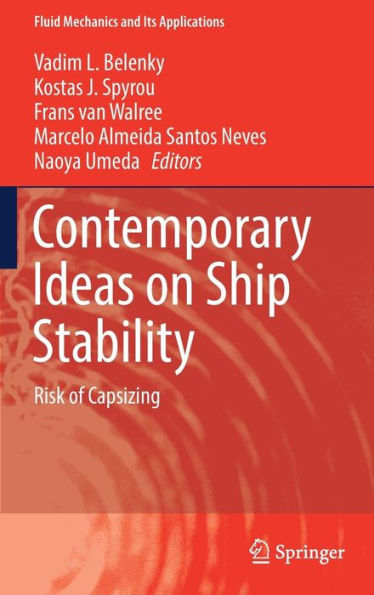
Contemporary Ideas on Ship Stability: Risk of Capsizing in Bloomington, MN
Current price: $279.99

Contemporary Ideas on Ship Stability: Risk of Capsizing in Bloomington, MN
Current price: $279.99
Loading Inventory...
Size: Hardcover
This book contains a selection of research papers presented at the 11
th
and 12
International Ship Stability Workshops (Wageningen, 2010 and Washington DC, 2011) and the 11
International Conference on Stability of Ships and Ocean Vehicles (Athens, 2012). The book is directed toward the ship stability community and presents innovative ideas concerning the understanding of the physical nature of stability failures and methodologies for assessing ship stability. Particular interest of the readership is expected in relation with appearance of new and unconventional types of ships; assessment of stability of these ships cannot rely on the existing experience and has to be based on the first principles. As the complexity of the physical processes responsible for stability failure have increasingly made time-domain numerical simulation the main tool for stability assessment, particular emphasis is made on the development an application of such tools.
The included papers have been selected by the editorial committee and have gone through an additional review process, with at least two reviewers allocated for each. Many of the papers have been significantly updated or expanded from their original version, in order to best reflect the state of knowledge concerning stability at the time of the book’s publication.
The book consist of four parts:
Mathematical Model of Ship Motions in Waves, Dynamics of Large Motions
,
Experimental Research
and
Requirements, Regulations and Operations
.
th
and 12
International Ship Stability Workshops (Wageningen, 2010 and Washington DC, 2011) and the 11
International Conference on Stability of Ships and Ocean Vehicles (Athens, 2012). The book is directed toward the ship stability community and presents innovative ideas concerning the understanding of the physical nature of stability failures and methodologies for assessing ship stability. Particular interest of the readership is expected in relation with appearance of new and unconventional types of ships; assessment of stability of these ships cannot rely on the existing experience and has to be based on the first principles. As the complexity of the physical processes responsible for stability failure have increasingly made time-domain numerical simulation the main tool for stability assessment, particular emphasis is made on the development an application of such tools.
The included papers have been selected by the editorial committee and have gone through an additional review process, with at least two reviewers allocated for each. Many of the papers have been significantly updated or expanded from their original version, in order to best reflect the state of knowledge concerning stability at the time of the book’s publication.
The book consist of four parts:
Mathematical Model of Ship Motions in Waves, Dynamics of Large Motions
,
Experimental Research
and
Requirements, Regulations and Operations
.
This book contains a selection of research papers presented at the 11
th
and 12
International Ship Stability Workshops (Wageningen, 2010 and Washington DC, 2011) and the 11
International Conference on Stability of Ships and Ocean Vehicles (Athens, 2012). The book is directed toward the ship stability community and presents innovative ideas concerning the understanding of the physical nature of stability failures and methodologies for assessing ship stability. Particular interest of the readership is expected in relation with appearance of new and unconventional types of ships; assessment of stability of these ships cannot rely on the existing experience and has to be based on the first principles. As the complexity of the physical processes responsible for stability failure have increasingly made time-domain numerical simulation the main tool for stability assessment, particular emphasis is made on the development an application of such tools.
The included papers have been selected by the editorial committee and have gone through an additional review process, with at least two reviewers allocated for each. Many of the papers have been significantly updated or expanded from their original version, in order to best reflect the state of knowledge concerning stability at the time of the book’s publication.
The book consist of four parts:
Mathematical Model of Ship Motions in Waves, Dynamics of Large Motions
,
Experimental Research
and
Requirements, Regulations and Operations
.
th
and 12
International Ship Stability Workshops (Wageningen, 2010 and Washington DC, 2011) and the 11
International Conference on Stability of Ships and Ocean Vehicles (Athens, 2012). The book is directed toward the ship stability community and presents innovative ideas concerning the understanding of the physical nature of stability failures and methodologies for assessing ship stability. Particular interest of the readership is expected in relation with appearance of new and unconventional types of ships; assessment of stability of these ships cannot rely on the existing experience and has to be based on the first principles. As the complexity of the physical processes responsible for stability failure have increasingly made time-domain numerical simulation the main tool for stability assessment, particular emphasis is made on the development an application of such tools.
The included papers have been selected by the editorial committee and have gone through an additional review process, with at least two reviewers allocated for each. Many of the papers have been significantly updated or expanded from their original version, in order to best reflect the state of knowledge concerning stability at the time of the book’s publication.
The book consist of four parts:
Mathematical Model of Ship Motions in Waves, Dynamics of Large Motions
,
Experimental Research
and
Requirements, Regulations and Operations
.
Shop Similar Products

















Find at Mall of America® in Bloomington, MN
Visit at Mall of America® in Bloomington, MN