


Home
Children at the Birth of Empire: British Law, Liberty, and Global Migration Destitute Children, c. 1607-1760
Barnes and Noble
Loading Inventory...
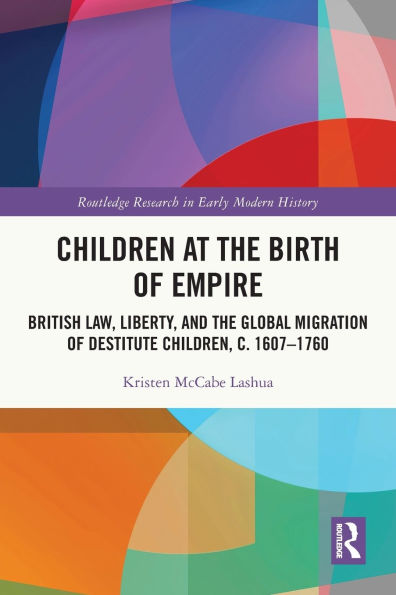
Children at the Birth of Empire: British Law, Liberty, and Global Migration Destitute Children, c. 1607-1760 in Bloomington, MN
Current price: $180.00

Children at the Birth of Empire: British Law, Liberty, and Global Migration Destitute Children, c. 1607-1760 in Bloomington, MN
Current price: $180.00
Loading Inventory...
Size: Hardcover
This is the first study to focus specifically on destitute children who became part of the early British Empire, uniting separate historiographies on poverty, childhood, global expansion, forced migration, bound labor, and law.
Britons used their nascent empire to employ thousands of destitute children, launching an experiment in using plantations and ships as a solution for strains on London’s inadequate poor relief schemes. Starting with the settlement of Jamestown (1607) and ending with Britain’s participation in the Seven Years’ War (1756–1763), British children were sent all around the world. Authorities, parents, and the public fought against the men and women they called "spirits" and "kidnappers," who were reviled because they employed children in the same empire but without respecting the complexities surrounding children’s legal status when it came to questions of authority, consent, and self-determination. Children mattered to Britons: protecting their liberty became emblematic of protecting the liberty of Britons as a whole. Therefore, contests over the legal means of sending children abroad helped define what it meant to be British.
This work is written for a wide audience, including scholars of early modern history, childhood, law, poverty, and empire.
Britons used their nascent empire to employ thousands of destitute children, launching an experiment in using plantations and ships as a solution for strains on London’s inadequate poor relief schemes. Starting with the settlement of Jamestown (1607) and ending with Britain’s participation in the Seven Years’ War (1756–1763), British children were sent all around the world. Authorities, parents, and the public fought against the men and women they called "spirits" and "kidnappers," who were reviled because they employed children in the same empire but without respecting the complexities surrounding children’s legal status when it came to questions of authority, consent, and self-determination. Children mattered to Britons: protecting their liberty became emblematic of protecting the liberty of Britons as a whole. Therefore, contests over the legal means of sending children abroad helped define what it meant to be British.
This work is written for a wide audience, including scholars of early modern history, childhood, law, poverty, and empire.
This is the first study to focus specifically on destitute children who became part of the early British Empire, uniting separate historiographies on poverty, childhood, global expansion, forced migration, bound labor, and law.
Britons used their nascent empire to employ thousands of destitute children, launching an experiment in using plantations and ships as a solution for strains on London’s inadequate poor relief schemes. Starting with the settlement of Jamestown (1607) and ending with Britain’s participation in the Seven Years’ War (1756–1763), British children were sent all around the world. Authorities, parents, and the public fought against the men and women they called "spirits" and "kidnappers," who were reviled because they employed children in the same empire but without respecting the complexities surrounding children’s legal status when it came to questions of authority, consent, and self-determination. Children mattered to Britons: protecting their liberty became emblematic of protecting the liberty of Britons as a whole. Therefore, contests over the legal means of sending children abroad helped define what it meant to be British.
This work is written for a wide audience, including scholars of early modern history, childhood, law, poverty, and empire.
Britons used their nascent empire to employ thousands of destitute children, launching an experiment in using plantations and ships as a solution for strains on London’s inadequate poor relief schemes. Starting with the settlement of Jamestown (1607) and ending with Britain’s participation in the Seven Years’ War (1756–1763), British children were sent all around the world. Authorities, parents, and the public fought against the men and women they called "spirits" and "kidnappers," who were reviled because they employed children in the same empire but without respecting the complexities surrounding children’s legal status when it came to questions of authority, consent, and self-determination. Children mattered to Britons: protecting their liberty became emblematic of protecting the liberty of Britons as a whole. Therefore, contests over the legal means of sending children abroad helped define what it meant to be British.
This work is written for a wide audience, including scholars of early modern history, childhood, law, poverty, and empire.
Shop Similar Products












Find at Mall of America® in Bloomington, MN
Visit at Mall of America® in Bloomington, MN