


Home
Too-Big-to-Fail Banking: Impact of G-SIB Designation and Regulation on Relative Equity Valuations
Barnes and Noble
Loading Inventory...
Too-Big-to-Fail Banking: Impact of G-SIB Designation and Regulation on Relative Equity Valuations in Bloomington, MN
Current price: $119.99

Too-Big-to-Fail Banking: Impact of G-SIB Designation and Regulation on Relative Equity Valuations in Bloomington, MN
Current price: $119.99
Loading Inventory...
Size: Paperback
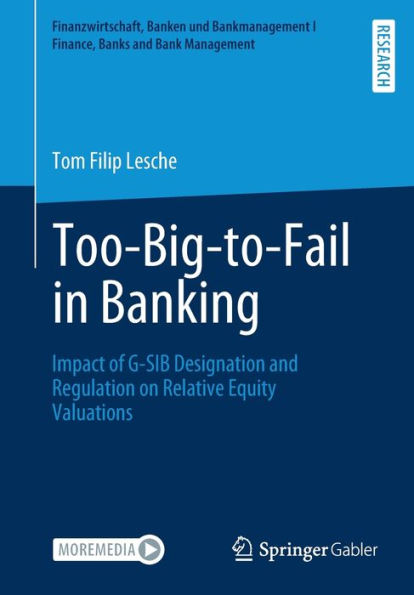
This book provides a comprehensive summary of the latest academic research on the important topic of too-big-to-fail (TBTF) in banking. It explains TBTF from various perspectives including the range of regulatory measures proposed to counter TBTF, most notably the globally accepted regulation of global-systemically important banks (G-SIBs) and its main tool of capital surcharges. The empirical analysis quantifies the shareholder value of the G-SIB attribution by using quarterly observations from more than 750 global banks between Q2 2008 and Q3 2015. The main finding is that G-SIBs are confronted with a substantial relative valuation discount compared to non-G-SIBs. From the end of 2011 until the end of 2015, a stable discount of 0.6x–0.8x price-to-tangible common equity (P/TCE) is statistically highly significant. The results suggest that the G-SIB designation effect, which positively impacts G-SIBs’ share prices because of funding benefits from IGGs, is dominated by the regulatory G-SIB burden effect, which negatively impacts G-SIBs’ share prices because of lower profitability due to capital surcharges and other regulatory requirements placed on G-SIBs. The findings re-open the debate about whether breaking up G-SIBs would unlock shareholder value and whether G-SIBs are regulated efficiently.
This book provides a comprehensive summary of the latest academic research on the important topic of too-big-to-fail (TBTF) in banking. It explains TBTF from various perspectives including the range of regulatory measures proposed to counter TBTF, most notably the globally accepted regulation of global-systemically important banks (G-SIBs) and its main tool of capital surcharges. The empirical analysis quantifies the shareholder value of the G-SIB attribution by using quarterly observations from more than 750 global banks between Q2 2008 and Q3 2015. The main finding is that G-SIBs are confronted with a substantial relative valuation discount compared to non-G-SIBs. From the end of 2011 until the end of 2015, a stable discount of 0.6x–0.8x price-to-tangible common equity (P/TCE) is statistically highly significant. The results suggest that the G-SIB designation effect, which positively impacts G-SIBs’ share prices because of funding benefits from IGGs, is dominated by the regulatory G-SIB burden effect, which negatively impacts G-SIBs’ share prices because of lower profitability due to capital surcharges and other regulatory requirements placed on G-SIBs. The findings re-open the debate about whether breaking up G-SIBs would unlock shareholder value and whether G-SIBs are regulated efficiently.
Shop Similar Products

















Find at Mall of America® in Bloomington, MN
Visit at Mall of America® in Bloomington, MN