


Home
Self-Organization as a New Paradigm Evolutionary Biology: From Theory to Applied Cases the Tree of Life
Barnes and Noble
Loading Inventory...
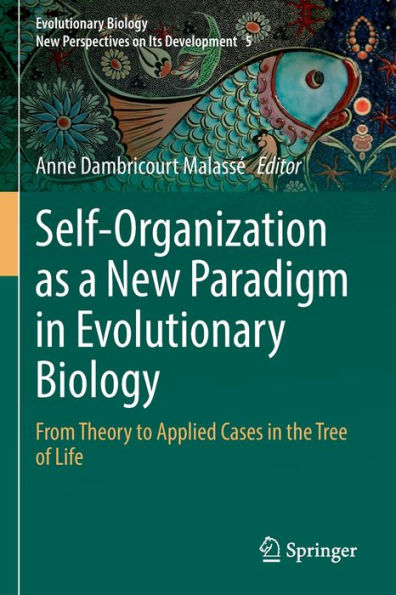
Self-Organization as a New Paradigm Evolutionary Biology: From Theory to Applied Cases the Tree of Life in Bloomington, MN
Current price: $199.99

Self-Organization as a New Paradigm Evolutionary Biology: From Theory to Applied Cases the Tree of Life in Bloomington, MN
Current price: $199.99
Loading Inventory...
Size: Hardcover
The epistemological synthesis of the various theories of evolution, since the first formulation in 1802 with the transmission of the inherited characters by J.B. Lamarck, shows the need for an alternative synthesis to that of Princeton (1947). This new synthesis integrates the scientific models of self-organization developed during the second half of the 20th century based on the laws of physics, thermodynamics, and mathematics with the emergent evolutionary problematics such as self-organized memory.
This book shows, how self-organization is integrated in modern evolutionary biology. It is divided in two parts: The first part pays attention to the modern observations in paleontology and biology, which include major theoreticians of the self-organization (d’Arcy Thompson, Henri Bergson, René Thom, Ilya Prigogine). The second part presents different emergent evolutionary models including the sciences of complexity, the non-linear dynamical systems, fractals, attractors, epigenesis, systemics, and mesology with different examples of the sciences of complexity and self-organization as observed in the human lineage, from both internal (embryogenesis-morphogenesis) and external (mesology) viewpoints.
This book shows, how self-organization is integrated in modern evolutionary biology. It is divided in two parts: The first part pays attention to the modern observations in paleontology and biology, which include major theoreticians of the self-organization (d’Arcy Thompson, Henri Bergson, René Thom, Ilya Prigogine). The second part presents different emergent evolutionary models including the sciences of complexity, the non-linear dynamical systems, fractals, attractors, epigenesis, systemics, and mesology with different examples of the sciences of complexity and self-organization as observed in the human lineage, from both internal (embryogenesis-morphogenesis) and external (mesology) viewpoints.
The epistemological synthesis of the various theories of evolution, since the first formulation in 1802 with the transmission of the inherited characters by J.B. Lamarck, shows the need for an alternative synthesis to that of Princeton (1947). This new synthesis integrates the scientific models of self-organization developed during the second half of the 20th century based on the laws of physics, thermodynamics, and mathematics with the emergent evolutionary problematics such as self-organized memory.
This book shows, how self-organization is integrated in modern evolutionary biology. It is divided in two parts: The first part pays attention to the modern observations in paleontology and biology, which include major theoreticians of the self-organization (d’Arcy Thompson, Henri Bergson, René Thom, Ilya Prigogine). The second part presents different emergent evolutionary models including the sciences of complexity, the non-linear dynamical systems, fractals, attractors, epigenesis, systemics, and mesology with different examples of the sciences of complexity and self-organization as observed in the human lineage, from both internal (embryogenesis-morphogenesis) and external (mesology) viewpoints.
This book shows, how self-organization is integrated in modern evolutionary biology. It is divided in two parts: The first part pays attention to the modern observations in paleontology and biology, which include major theoreticians of the self-organization (d’Arcy Thompson, Henri Bergson, René Thom, Ilya Prigogine). The second part presents different emergent evolutionary models including the sciences of complexity, the non-linear dynamical systems, fractals, attractors, epigenesis, systemics, and mesology with different examples of the sciences of complexity and self-organization as observed in the human lineage, from both internal (embryogenesis-morphogenesis) and external (mesology) viewpoints.
Shop Similar Products










Find at Mall of America® in Bloomington, MN
Visit at Mall of America® in Bloomington, MN