


Home
Modelling the Efficiency of Family and Hired Labour: Illustrations from Nepalese Agriculture
Barnes and Noble
Loading Inventory...
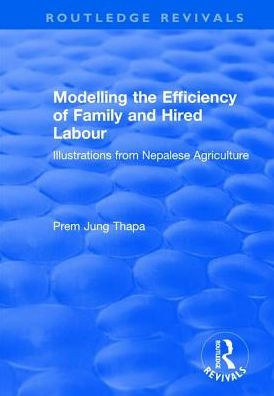
Modelling the Efficiency of Family and Hired Labour: Illustrations from Nepalese Agriculture in Bloomington, MN
Current price: $170.00

Modelling the Efficiency of Family and Hired Labour: Illustrations from Nepalese Agriculture in Bloomington, MN
Current price: $170.00
Loading Inventory...
Size: Hardcover
This title was first published in 2003.The principal economic units in most developing countries are family based farm households. Empirical models that recognize the dual role of the farm household as producer and consumer in a theoretically consistent manner are essential tools for policy analyses. This book provides an important extension of the conventional farm household model by developing an analytical framework that allows for efficiency differences between family and hired labour as inputs in farm production. The model is estimated with survey data from the southern lowland region of Nepal. The estimation strategy is a two-step process. The first step estimates a farm-level production function in which is embedded a test for heterogeneity between family and hired labour. The labour heterogeneity detected in the production function estimation is incorporated, at the second step, in the labour supply estimation in a theoretically consistent manner.
This title was first published in 2003.The principal economic units in most developing countries are family based farm households. Empirical models that recognize the dual role of the farm household as producer and consumer in a theoretically consistent manner are essential tools for policy analyses. This book provides an important extension of the conventional farm household model by developing an analytical framework that allows for efficiency differences between family and hired labour as inputs in farm production. The model is estimated with survey data from the southern lowland region of Nepal. The estimation strategy is a two-step process. The first step estimates a farm-level production function in which is embedded a test for heterogeneity between family and hired labour. The labour heterogeneity detected in the production function estimation is incorporated, at the second step, in the labour supply estimation in a theoretically consistent manner.
Shop Similar Products














Find at Mall of America® in Bloomington, MN
Visit at Mall of America® in Bloomington, MN